
 https://www.omahamediagroup.com/images/uploads/monster_gallery/Omaha-Media-Group-Black.jpg
admin
https://www.omahamediagroup.com/images/uploads/monster_gallery/Omaha-Media-Group-Black.jpg
admin
What Is Brand Visibility and Why It Drives Revenue

TL;DR:
- Brand visibility measures how often your brand appears at decision moments with quality distribution across channels. It is a system built through technical SEO, earned media, and consistent content, not just short-term campaigns. Tracking metrics like branded search volume and share of voice helps ensure your presence influences buyer evaluation effectively.
Most business owners treat brand visibility as a synonym for brand awareness. They are not the same thing, and confusing the two is costing companies real revenue. What is brand visibility, exactly? It is the measurable frequency and quality of your brand’s presence at the moments when buyers are actively looking. Not general recognition built over time, but real-time market presence across search results, AI-generated answers, media mentions, and distribution channels. This article breaks down the distinction, shows you how to measure visibility with precision, identifies the factors that shrink it, and gives you a system for growing it deliberately.
Table of Contents
- Key takeaways
- What brand visibility actually means
- Measuring brand visibility without blind spots
- What affects brand visibility and where companies go wrong
- Brand visibility strategies that produce revenue outcomes
- My take on brand visibility as operational infrastructure
- How Monstrousmediagroup builds measurable visibility systems
- FAQ
Key takeaways
| Point | Details |
|---|---|
| Visibility is not awareness | Brand visibility measures real-time market presence at decision moments, not long-term mental recall. |
| Multi-metric measurement matters | Relying on one KPI creates blind spots; track branded search volume, share of voice, direct traffic, and social mentions together. |
| Consistency drives compounding returns | Inconsistent messaging and positioning directly reduce visibility effectiveness and cost you revenue. |
| Earned media compounds over time | PR and authoritative media mentions build credibility that paid campaigns cannot replicate and AI search engines reward. |
| Visibility is an operational system | Treating visibility as a soft metric rather than a revenue infrastructure problem leads to missed growth and higher acquisition costs. |
What brand visibility actually means
Brand visibility is distinct from brand awareness. Awareness is the degree to which your audience recognizes or recalls your brand over time. It builds slowly through repeated exposure and lives inside the buyer’s memory. Visibility, by contrast, is a distribution and timing problem. It measures whether your brand appears in front of the right people at the exact moment they are evaluating a purchase decision.
Think of it this way. A buyer searches “best CRM for small business,” scans AI-generated overviews, reads two comparison articles, and clicks a result. Every brand that surfaces during that sequence is visible. The brands the buyer has heard of but cannot find in that moment are merely known. High brand awareness without visibility at decision moments is commercially useless.
Visibility is fundamentally a distribution problem. More surfaces, the right message, in front of the right audience at the right time equals a higher visibility score. In 2026, those surfaces now include AI overviews in Google Search, AI chat responses, earned media, organic search rankings, and paid placements simultaneously.
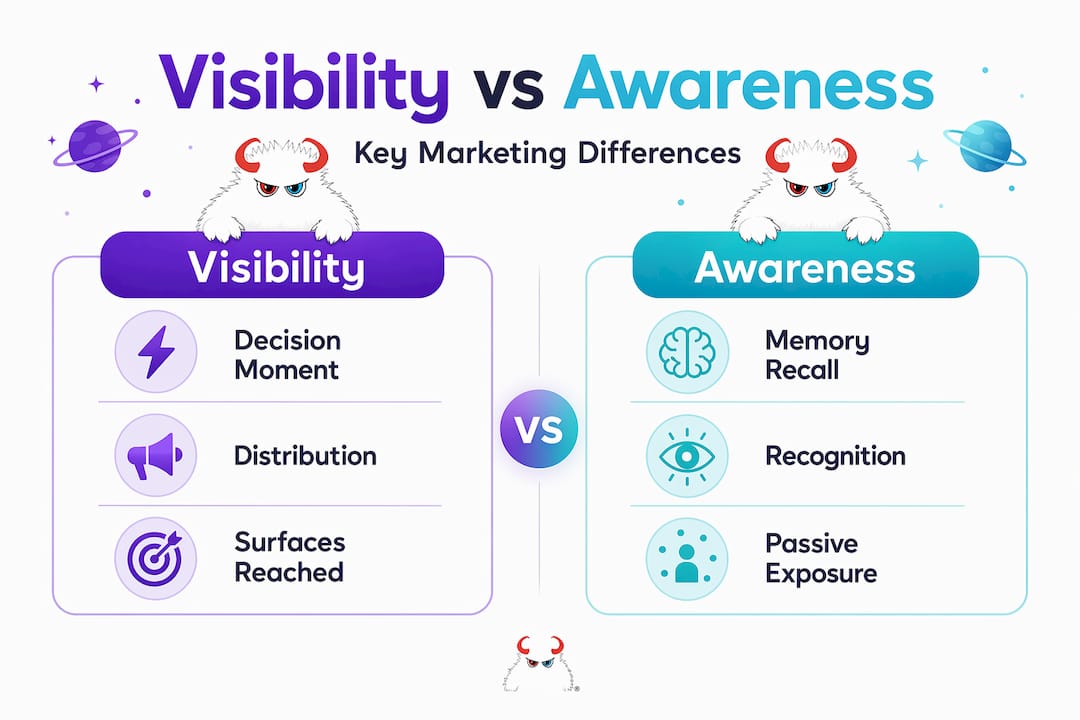
| Dimension | Brand visibility | Brand awareness |
|---|---|---|
| What it measures | Presence at decision moments | Mental recall over time |
| Speed of change | Can shift quickly with technical and distribution work | Builds slowly through sustained exposure |
| Primary driver | Algorithms, distribution, SEO, and earned media | Repetition, advertising, and emotional association |
| How you measure it | Search volume, SOV, direct traffic, mentions | Surveys, aided and unaided recall tests |
| Business impact | Immediate revenue opportunity capture | Long-term brand equity and pricing power |
Pro Tip: If you want a fast read on your current visibility, search your brand name plus your three most competitive product or service categories. Count how many of the top ten results you own or appear in. Anything below six is a gap that a competitor is filling at your expense.
Measuring brand visibility without blind spots
The most common mistake in visibility measurement is reducing everything to a single number. Branded search volume is the cleanest single proxy because it reflects active intent rather than passive exposure. When someone searches your brand name, they already know you exist and want to find you specifically. That is intent-driven visibility in its purest form.
But branded search alone misses the full picture. Brand visibility measurement requires tracking a composite of metrics including organic share of voice, direct traffic trends, and social mention share. Each one illuminates a different part of the problem.
Here is what each metric tells you:
- Branded search volume reveals demand generated by your brand. Track it monthly against a rolling 12-month baseline and compare it against competitors using tools like Google Search Console and Semrush.
- Organic share of voice (SOV) measures how often your brand appears in search results relative to competitors across your target keyword set. SOV above market share correlates with brand growth, making it a leading indicator worth watching closely.
- Direct traffic trends show how many visitors type your URL directly or use bookmarks. Rising direct traffic signals growing unprompted brand recognition.
- Social mention share tracks what percentage of total industry conversation includes your brand name, measured through tools like Brandwatch or Mention.
The measurement discipline matters as much as the metrics. Multi-metric visibility dashboards should be built around business questions, not just the data that is easiest to pull. Start with the question: “Are we appearing where buyers evaluate our category?” Then build the dashboard backward from that question.
Pro Tip: Set up a weekly branded search volume alert in Google Search Console. A sudden drop of 15% or more week over week often indicates a reputation event, a technical indexing problem, or a competitor campaign specifically targeting your brand name. Catching it early cuts recovery time in half.
What affects brand visibility and where companies go wrong
Several controllable factors determine how visible your brand becomes. SEO infrastructure is the most direct lever. Your site’s technical health, content volume, topical authority, and backlink profile all determine how often you surface in organic search. Geographic targeting (GEO) adds another layer, since local intent signals, business listings, and regional content all affect how visible you are in location-specific searches.

Earned media carries compounding weight that most marketers underestimate. Mentions in respected publications boost brand visibility beyond what paid impressions can achieve and increasingly feed the training data that AI search engines draw from when generating answers. A single feature in an authoritative trade publication can improve your AI search visibility for months.
Common pitfalls that suppress brand visibility include:
- Treating visibility as a vanity metric. Visibility directly affects how many buyers encounter you during evaluation. Lower visibility means fewer opportunities to convert, which means higher acquisition costs across every paid channel you run.
- Inconsistent messaging across channels. Inconsistent brand messaging and positioning reduce visibility effectiveness, causing brand confusion that undermines trust and dilutes organic authority signals.
- Over-indexing on paid media. Paid campaigns create visibility that evaporates the moment you stop spending. Organic and earned visibility compounds. Brands that build only paid presence are renting market presence at increasing cost.
- Ignoring technical SEO. Crawlability issues, duplicate content, and slow page load times can hide pages that would otherwise rank, collapsing organic visibility almost invisibly.
- Measuring awareness when you need to measure visibility. Survey-based recall data tells you about memory. It does not tell you whether buyers found you when they were ready to buy.
The importance of brand visibility becomes obvious when you calculate what a 20% drop in organic visibility costs in lead volume at your current conversion rate. Run that number once and it will reframe how you budget for visibility infrastructure.
Brand visibility strategies that produce revenue outcomes
Effective brand visibility strategies share one characteristic. They treat visibility as infrastructure to be built, not a campaign to be run. Here is a system-level approach:
-
Audit your distribution surfaces. Map every channel where your brand could appear during a buyer’s evaluation: organic search, AI overviews, review platforms, trade publications, industry directories, and social channels. Identify the gaps. That gap map is your visibility backlog.
-
Build topical authority through structured content. Google and AI systems reward brands that demonstrate deep, consistent expertise in a defined subject area. Publishing one broad article per month does not build topical authority. Publishing 15 tightly related articles that cover every dimension of your category does. The Monstrousmediagroup approach to strategic visual content reflects exactly this kind of structured content architecture.
-
Pursue earned media with the same discipline as paid. Develop a press outreach system, contribute expert commentary to industry publications, and submit to award programs in your category. Each mention expands your distribution surface and transfers credibility that algorithms reward.
-
Connect visibility measurement to revenue tracking. Build a dashboard that maps organic share of voice and branded search volume changes to lead volume and revenue. Buyers who know and trust a brand cost less to convert, spend more, and are harder for competitors to displace. Visibility investment should reduce your blended customer acquisition cost over time. If it is not, the measurement system is broken.
-
Operationalize your brand standards across every channel. Typography, tone, positioning statements, and value propositions must be consistent from your website to your Google Business Profile to your email sequences. Inconsistency fragments authority and confuses algorithms and buyers alike.
Pro Tip: Branded search volume is the cleanest proxy for intent-driven visibility. Before investing in any new visibility channel, establish your baseline branded search volume in Google Search Console. Review it monthly. Growth in branded search is one of the earliest signals that your wider visibility efforts are producing real market awareness.
My take on brand visibility as operational infrastructure
I have reviewed hundreds of marketing strategies over the years, and the pattern is consistent. Companies treat brand visibility as something that happens as a byproduct of advertising. They spend heavily on paid campaigns, see a traffic spike, and call it visibility. Then the campaign ends and so does the traffic.
What I have learned is that genuine visibility is an operational system, not a campaign outcome. Nielsen’s 2025 Annual Marketing Report, which surveyed 1,400 global marketing professionals, shows that brand awareness and revenue growth are almost equally weighted priorities for top marketers in North America. Yet most of those same marketers lack a structured measurement framework that connects visibility to revenue outcomes.
The businesses that protect revenue through market downturns are not spending more on ads. They are the ones whose brands appear organically everywhere buyers look during evaluation. That is a systems achievement, built through consistent investment in SEO, earned media, and content infrastructure. The compounding value of sustained visibility is not visible in a single quarter’s data. It shows up when you look at customer acquisition cost trends over 18 months. I have watched that number drop by 30% or more for companies that made visibility a standing operational priority rather than a campaign budget line.
If you are measuring your visibility by impressions or ad spend, you are measuring the inputs, not the outcome. Shift to branded search volume, organic share of voice, and direct traffic. Build the dashboard around the question “Are we present when buyers decide?” Then fund the system that keeps the answer yes.
— Vector
How Monstrousmediagroup builds measurable visibility systems

Most agencies will sell you a campaign to boost your visibility for 90 days. Monstrousmediagroup builds the infrastructure that keeps your brand present at every buyer evaluation point, month after month, without requiring constant ad spend to maintain it. The work starts with your SEO services architecture, building the technical foundation, topical content structure, and earned media system that compound into durable organic share of voice. That connects directly to Monstrousmediagroup’s digital marketing systems, which integrate visibility measurement with lead capture and revenue protection. And Monstrousmediagroup’s marketing automation capabilities convert that visibility into closed revenue by nurturing the leads your visibility attracts. The outcome is not busywork. It is a measurable, growing brand presence that lowers your acquisition cost and protects revenue over time.
FAQ
What is brand visibility in marketing?
Brand visibility is the measurable frequency with which your brand appears in front of potential buyers during active evaluation moments, across search results, AI answers, media, and distribution channels. It is distinct from brand awareness, which measures long-term mental recall.
How is brand visibility different from brand awareness?
Brand visibility measures real-time market presence at decision moments through distribution and algorithms, while brand awareness measures how well customers recognize or recall your brand over time through sustained exposure and advertising.
What metrics should you track to measure brand visibility?
The core metrics are branded search volume, organic share of voice, direct traffic trends, and social mention share. Tracking all four together prevents the blind spots that come from relying on a single KPI.
Why does brand visibility matter for revenue?
Visibility reduces the cost of acquisition over time because buyers who encounter your brand during evaluation need less persuasion to convert, spend more per transaction, and are harder for competitors to displace.
What is the fastest way to improve brand visibility?
Fix technical SEO issues that prevent your existing content from indexing, increase your branded search volume tracking baseline, and pursue earned media placements in authoritative industry publications. These three moves can shift your organic share of voice within 60 to 90 days without additional ad spend.
Recommended
Hire the team to help you with your website, app, or other marketing needs.
We have a team of digital marketers who can help plan and bring to life all your digital marketing strategies. They can help with social media marketing, email marketing, and digital advertising!
CONTACT US
Comments