
 https://www.omahamediagroup.com/images/uploads/monster_gallery/Omaha-Media-Group-Black.jpg
admin
https://www.omahamediagroup.com/images/uploads/monster_gallery/Omaha-Media-Group-Black.jpg
admin
Website Developer Near Me | MMG
Website Developer Near Me: How to Choose a Partner That Builds Revenue, Not Just Pages

| Point | Details |
|---|---|
| Search intent | People searching for “website developer near me” usually need a credible, reachable partner who can build, fix, or improve a business website quickly. |
| Best-fit provider | The right choice depends on scope: freelancer for small tasks, local website developer for hands-on collaboration, or nearby web development company for strategy, integrations, and scale. |
| What matters most | Performance, conversion tracking, SEO structure, CRM integration, accessibility, security, and clear attribution matter more than visual polish alone. |
| Cost reality | Cheap websites often become expensive when they fail to generate leads, track behavior, or support ongoing growth. |
| MMG position | Monstrous Media Group builds AI-driven marketing infrastructure that turns visibility into revenue through web systems, SEO/AEO/GEO, automation, and conversion optimization. |
Table of Contents
What “Website Developer Near Me” Really Means
If you searched for website developer near me, you are probably not just looking for someone who can write code. You are looking for a reliable partner who understands your business, can move quickly, and can turn a website into a measurable growth asset.
That search usually comes from a business problem. Your site may be outdated, slow, hard to update, invisible in search, disconnected from your CRM, or generating traffic without enough qualified leads. A capable local website developer should be able to diagnose those issues before proposing design concepts.
The mistake many companies make is treating a website as a one-time project. That is how businesses end up with attractive websites that do not convert, do not track revenue, and do not support sales. MMG treats the website as infrastructure: a system that captures demand, routes leads, measures after-click behavior, and improves over time.
Transform visibility into revenue today with MMG: Contact
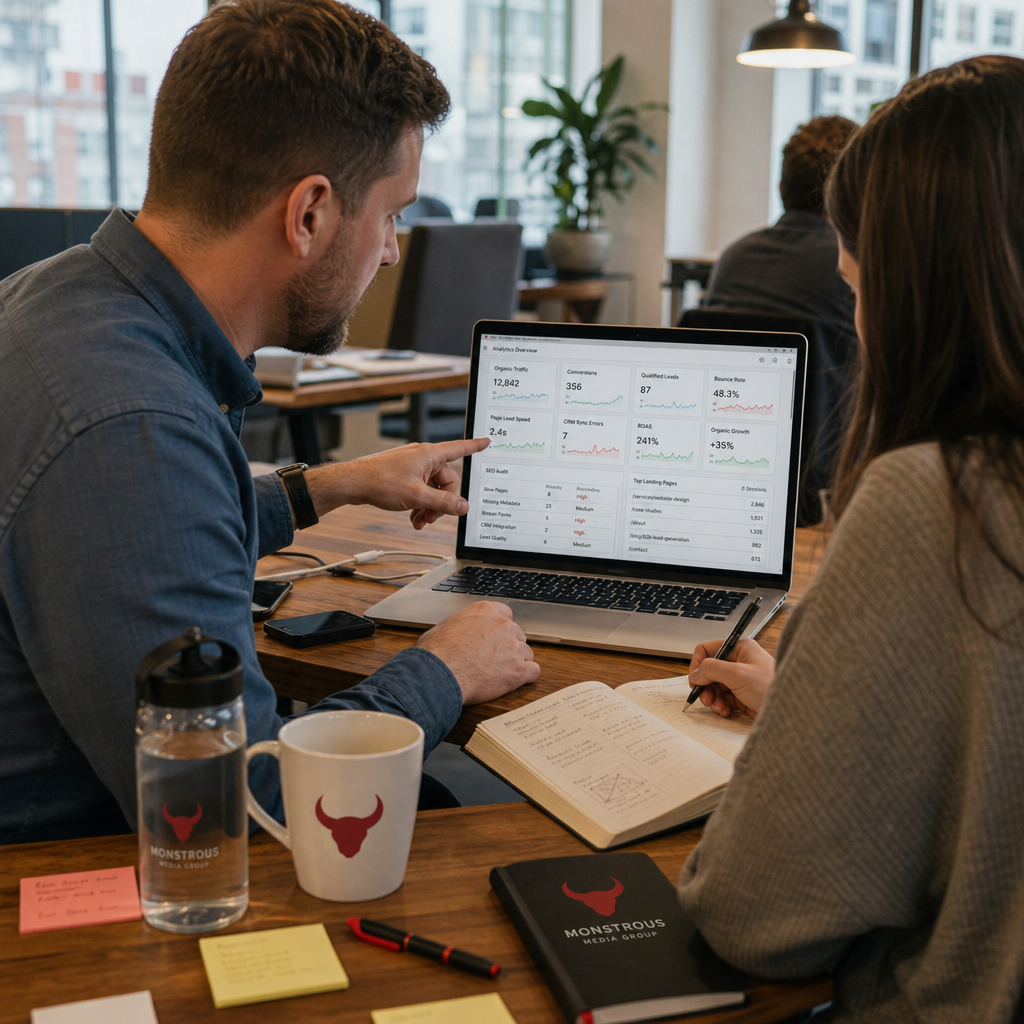
A search for a nearby provider also suggests trust matters. You may want someone who can explain decisions clearly, meet with your team, and understand the realities of your market. That can be valuable, but proximity alone is not enough. The better question is: can this partner connect your website to pipeline, attribution, automation, and revenue?
Expert view: A business website is not successful because it launches. It is successful when it consistently captures qualified demand, converts that demand into opportunities, and gives leadership clean visibility into what is working.
For technical standards, Google’s documentation on SEO fundamentals, web performance, and accessibility all point to the same reality: good websites are built with structure, speed, usability, and discoverability in mind. Those are not extras. They are baseline requirements.
Local Website Developer vs. Freelancer vs. Web Development Company
When comparing options, you will likely see three categories: a freelance web developer near me, a local website developer, and a nearby web development company. Each can be the right choice depending on the size of the problem you are trying to solve.
A freelancer may be a good fit for a landing page, bug fix, plugin update, or small redesign. A local developer may be better when you need more collaboration, brand understanding, and ongoing support. A web development company is usually the stronger choice when the website must integrate with SEO, paid media, analytics, automation, CRM systems, and conversion strategy.
| Provider Type | Best For | Limitations | Revenue Impact |
|---|---|---|---|
| Freelance web developer | Small builds, fixes, templates, maintenance tasks | May lack strategy, analytics, SEO, automation, or conversion depth | Useful for execution, limited for full revenue systems |
| Local website developer | Local collaboration, small to mid-sized business websites, practical support | Capabilities vary widely by individual or small team | Can improve presence if strategy and measurement are included |
| Nearby web development company | Custom website development, integrations, performance, SEO, lead capture, attribution | Higher investment and more discovery required | Best fit when the website must generate and convert demand |
| Systems-driven digital partner | Growth infrastructure, AI-assisted workflows, CRM connection, SEO/AEO/GEO, paid media, automation | Not ideal for companies looking for the cheapest possible website | Designed to connect visibility, conversion, and revenue |
The category matters less than the operating model. If the provider starts with colors, fonts, and homepage mockups before asking about lead quality, conversion data, sales process, attribution, and traffic sources, they are probably selling activity. That is not enough.
Pro Tip: Ask every provider how they will measure success 90 days after launch. If the answer is limited to “the site will be live” or “you will like the design,” keep looking.
For businesses already spending on SEO, paid media, email, or sales development, the website is where performance is won or lost. If traffic arrives but does not convert, the problem is rarely “more traffic.” It is usually a broken capture system, weak offer architecture, poor page intent alignment, slow performance, or missing follow-up automation.
How to Evaluate Web Design Services Near Me
Most companies searching for web design services near me want someone close enough to trust and skilled enough to execute. The issue is that many providers show portfolios, not performance systems. A nice-looking portfolio does not prove the site generated pipeline.
Start with business questions. What does the site need to produce? More booked calls, ecommerce revenue, qualified form fills, demo requests, local service leads, partner inquiries, or recruiting applications? Once the outcome is defined, the build can be structured around conversion paths, content hierarchy, analytics, and speed.
- Strategy: Do they map pages to search intent, customer journey stage, and offer type?
- Technical SEO: Do they structure metadata, headings, schema, indexation, internal links, and crawl paths?
- Conversion: Do they design calls to action, forms, trust signals, case studies, and lead capture flows around buyer behavior?
- Analytics: Do they configure events, goals, source tracking, call tracking, and CRM visibility?
- Performance: Do they build for Core Web Vitals, fast load times, lean code, and mobile usability?
- Security: Do they maintain updates, backups, access control, and safe deployment processes?
- Optimization: Do they improve the site after launch based on data?
Google’s Google Analytics 4 documentation makes it clear that modern measurement depends on events, conversions, and user behavior data. If your developer is not planning how to track meaningful actions, you will struggle to prove ROI after launch.
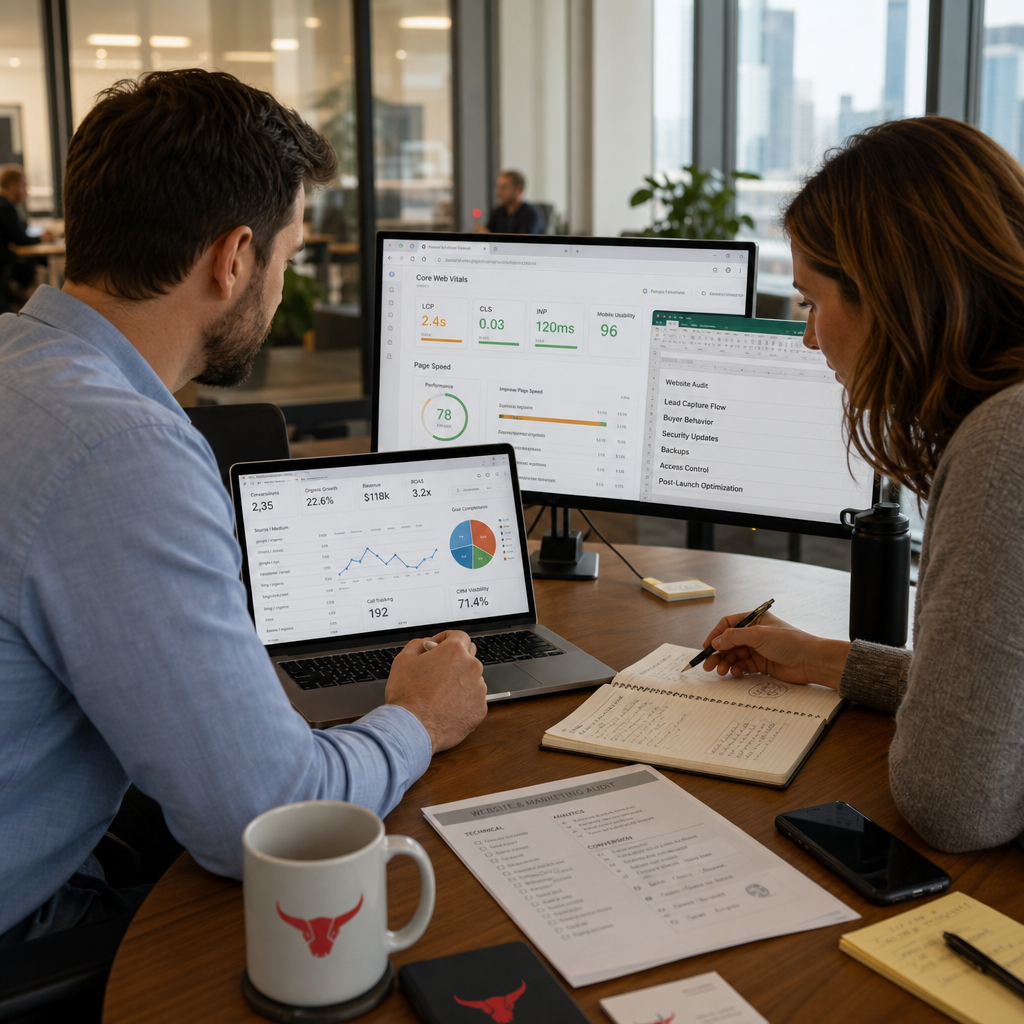
Accessibility should also be part of the conversation. The ADA guidance on web accessibility explains why digital accessibility matters for public-facing websites. Beyond compliance, accessible websites are often easier to use, easier to navigate, and better structured for search engines and AI systems.
Do not accept vague promises like “SEO-friendly” or “conversion-focused” without specifics. Ask what will be implemented. Ask how success will be tracked. Ask what happens after launch. The right partner will have clear answers because they operate from a system, not a mood board.
Why Your Website Should Be a Revenue System
A website is not just a digital brochure. For companies with real growth goals, it should be a revenue system that connects demand generation, traffic capture, conversion, follow-up, reporting, and continuous improvement.
This is where many website projects fail. The agency launches a site, hands over the login, and calls the project complete. Then leadership still cannot answer basic questions: Which channels produce qualified leads? Which pages leak conversions? Which forms are underperforming? Which visitors should receive follow-up? Which content influences pipeline?
MMG builds the website around those questions from the start. That means pairing custom website development with SEO/AEO/GEO structure, conversion paths, CRM integration, automation, analytics, paid media alignment, and AI-assisted interaction layers. The goal is not activity. The goal is a system that produces measurable business outcomes.
| Website Component | Weak Build | Revenue-Focused Build |
|---|---|---|
| Homepage | Generic brand statement and broad service claims | Clear positioning, buyer pain points, proof, segmentation, and conversion paths |
| Service pages | Thin descriptions and stock visuals | Intent-matched content, FAQs, proof, outcomes, process, and CTAs |
| Lead capture | One basic contact form | Multiple conversion points, qualification logic, routing, and CRM sync |
| SEO | Page titles and plugin settings only | Technical SEO, content architecture, internal linking, schema, and answer engine optimization |
| Analytics | Basic traffic reporting | Event tracking, conversion tracking, source attribution, and funnel visibility |
| Post-launch | No structured improvement process | Continuous optimization based on user behavior, search data, and revenue signals |
This is also where AI changes the build standard. AI search engines and answer engines reward clear information architecture, direct answers, credible entities, structured content, and topical depth. A website that is hard for humans to understand is usually hard for AI systems to interpret as well.
That is why pages need to answer real questions, support entity clarity, and connect related topics through internal architecture. MMG’s approach to SEO AEO GEO strategy is built for modern discovery, where Google, ChatGPT, Gemini, Claude, and Perplexity are all part of the buyer’s research process.
For companies with traffic but weak lead flow, the problem is often not visibility. It is conversion infrastructure. See conversion rate optimization and lead capture systems for how better routing, tracking, and page structure can recover revenue already sitting inside existing traffic.
Cost, Timeline, and Scope Expectations
The cost of hiring a website developer near me depends on scope, complexity, content, integrations, and ongoing support. A small brochure site costs less than a 30- to 50-page revenue platform with conversion tracking, CRM integration, blog architecture, case studies, automation, AI tools, and technical SEO.
The cheaper option is not always the lower-cost option. A website that underperforms for two years can quietly burn far more money than the difference between a low-cost vendor and a serious systems partner. Lost conversions, unclear attribution, slow pages, and weak search structure all have a cost.
| Project Type | Typical Scope | Common Timeline | Best Fit |
|---|---|---|---|
| Basic website refresh | 5-10 pages, light content updates, template-based design | 3-6 weeks | Small businesses needing a cleaner presence |
| Custom business website | 10-25 pages, custom design, SEO setup, forms, analytics | 6-12 weeks | Companies needing better credibility and lead capture |
| Revenue-focused website system | 30-50 pages, SEO/AEO/GEO architecture, CRM integration, case studies, blog engine, conversion tracking, automation | 10-20 weeks | Growth-focused companies that need measurable pipeline impact |
| Continuous improvement program | Ongoing testing, content expansion, technical optimization, funnel improvement, reporting | Monthly operating cadence | Businesses that want compounding growth after launch |
Timeline also depends on decision speed. The strongest projects have clear owners, fast feedback loops, access to subject matter experts, and clean approval paths. Delays usually come from unclear scope, missing content, slow approvals, or trying to satisfy every internal opinion instead of the buyer’s intent.
For businesses that want the website to support SEO and AI search visibility, content cannot be an afterthought. Service pages, comparison pages, FAQs, case studies, and educational resources all contribute to topical authority. MMG connects that content engine to content strategy for search and answer engines so traffic growth has a direct path to conversion.
Performance should be budgeted, not patched later. The Chrome team’s Core Web Vitals guidance shows how loading speed, responsiveness, and visual stability affect user experience. If the site is bloated from day one, every marketing dollar sent to it works harder than it should.
Choosing MMG for Custom Website Development
Monstrous Media Group is not positioned as a cheap website vendor. That is intentional. Cheap websites usually ignore the expensive parts: attribution, conversion logic, search architecture, CRM alignment, automation, performance, and post-launch optimization.
MMG builds for businesses that are serious about revenue. If you already spend on marketing and still cannot see what is working, your website may be the bottleneck. We find the leak, rebuild the system around measurable outcomes, and keep improving it after launch.
- Web infrastructure: Fast, stable, scalable websites built without unnecessary bloat.
- SEO/AEO/GEO: Search and answer engine architecture designed for modern discovery.
- Conversion systems: Offers, forms, landing pages, calls to action, and trust signals tied to buyer intent.
- Automation: Lead routing, notifications, CRM workflows, and follow-up logic.
- AI systems: AI-assisted interaction layers, internal workflows, and smarter user experiences.
- Paid media alignment: Landing pages and tracking built to support campaign ROI.
- Continuous improvement: A rolling optimization model, not a “launch and disappear” handoff.
The right website partner should make your marketing easier to measure. They should help leadership understand which channels generate qualified opportunities, which pages influence conversion, and where revenue is being lost. That is the difference between a website project and a business system.

MMG’s model fits companies that want a serious platform: core pages, case studies, blog and SEO engine, tracking, system diagrams, AI-assisted interaction, and conversion paths that connect to CRM. It is not for businesses looking for the lowest bid. It is for operators who know poor infrastructure gets expensive.
If you are comparing a local website developer, a freelance web developer near me, and a nearby web development company, use one filter: who can prove they understand the whole revenue system? The right answer is the partner who can connect visibility, infrastructure, conversion, attribution, and optimization.
Transform visibility into revenue today with MMG: Contact
Frequently Asked Questions
What should I look for in a website developer near me?
Look for a developer who understands business outcomes, not just design execution. They should be able to explain performance, SEO, conversion tracking, CRM integration, accessibility, and post-launch optimization.
Is hiring a local website developer better than hiring remotely?
A local website developer can be useful when you want easier collaboration and market familiarity. However, capability matters more than location, so prioritize a partner who can build a measurable revenue system.
How much does custom website development cost?
Custom website development cost depends on page count, design complexity, integrations, content, SEO structure, and automation needs. A revenue-focused business website usually costs more than a simple brochure site because it includes strategy, tracking, conversion systems, and ongoing improvement.
Should I hire a freelance web developer near me?
A freelance web developer near me can be a good fit for small tasks, fixes, or simple sites. If your website needs SEO strategy, CRM integration, analytics, automation, paid media alignment, and conversion optimization, a systems-driven company is usually the better fit.
What is the difference between web design and web development?
Web design focuses on layout, visual hierarchy, user experience, and presentation. Web development turns that strategy into a functional, fast, secure, trackable, and integrated website.
How long does it take to build a business website?
A small website may take 3 to 6 weeks, while a custom business website can take 6 to 12 weeks. A larger revenue-focused website with SEO architecture, CRM integration, automation, and content systems may take 10 to 20 weeks or more.
Why is my website getting traffic but not leads?
Traffic without leads usually means there is a conversion problem. Common causes include weak offers, unclear messaging, poor page intent alignment, slow performance, confusing forms, missing trust signals, or no structured follow-up.
Can a website developer help with SEO and AI search visibility?
Yes, if they understand technical SEO, structured content, internal linking, schema, and answer-focused page architecture. For AI search visibility, your website needs clear entities, direct answers, strong topical coverage, and credible supporting content.
Recommended Reading
Transform visibility into revenue today with MMG
Hire the team to help you with your website, app, or other marketing needs.
We have a team of digital marketers who can help plan and bring to life all your digital marketing strategies. They can help with social media marketing, email marketing, and digital advertising!
CONTACT US
Comments