
 https://www.omahamediagroup.com/images/uploads/monster_gallery/Omaha-Media-Group-Black.jpg
admin
https://www.omahamediagroup.com/images/uploads/monster_gallery/Omaha-Media-Group-Black.jpg
admin
Web creatives: 1.5x ROAS boost for your marketing strategy

Refreshing your web creatives five to seven times per week can boost ROAS by 1.5x compared to campaigns running static visuals. That single data point should reframe how you think about creative assets entirely. Web creatives are not decorative additions to your marketing plan. They are precision instruments that drive clicks, conversions, and revenue. In this article, we break down what web creatives are, how production velocity affects your bottom line, and how to integrate them into a campaign strategy that actually performs.
Table of Contents
- What are web creatives and why do they matter?
- How creative production influences marketing outcomes
- Integrating web creatives into a winning campaign strategy
- Real-world examples: Creative-driven results
- Enhance your campaigns with creative expertise
- Frequently asked questions
Key Takeaways
| Point | Details |
|---|---|
| Creative refresh boosts revenue | Updating web creatives frequently can increase return on ad spend by up to 1.5 times. |
| Video and images drive conversions | Combining both creative formats leads to nearly 20 percent more conversions in online campaigns. |
| Strategic integration maximizes results | Web creatives achieve their best impact when coordinated across multiple marketing channels. |
| Avoid ad fatigue for sustained performance | Rotating new creatives prevents audience burnout and keeps campaign results strong. |
What are web creatives and why do they matter?
Web creatives are the visual and multimedia assets that power your digital marketing presence. They include display banners, social media graphics, video ads, animated GIFs, email imagery, and landing page visuals. Every touchpoint a potential customer encounters online is shaped by a creative asset of some kind.
Think of web creatives as the face of your campaign messaging. Without them, even the most precisely targeted ad spend falls flat. With them, your brand communicates value, builds trust, and moves buyers through the funnel faster.
Here are the primary types of web creatives used in modern campaigns:
- Display banners: Static or animated graphics placed across websites and apps
- Video ads: Short-form or long-form video content for paid and organic channels
- Social graphics: Platform-specific visuals for Instagram, LinkedIn, Facebook, and more
- Email creatives: Header images, product visuals, and CTA buttons within email campaigns
- Landing page assets: Hero images, infographics, and embedded video that support conversion
The format mix matters enormously. Combining video and images yields 19% more conversions than relying on a single format. That is not a marginal gain. It is a measurable revenue shift driven purely by creative decisions.
“Web creatives are not just visuals. They are the primary vehicle through which your brand promise reaches your audience and compels action.”
Strategic visual content marketing treats every creative asset as a revenue-generating tool, not an afterthought. When you align your digital marketing strategy with a disciplined creative production process, the results compound quickly. Understanding the full range of video and visual creatives available to your campaigns is the first step toward making smarter production decisions.
How creative production influences marketing outcomes
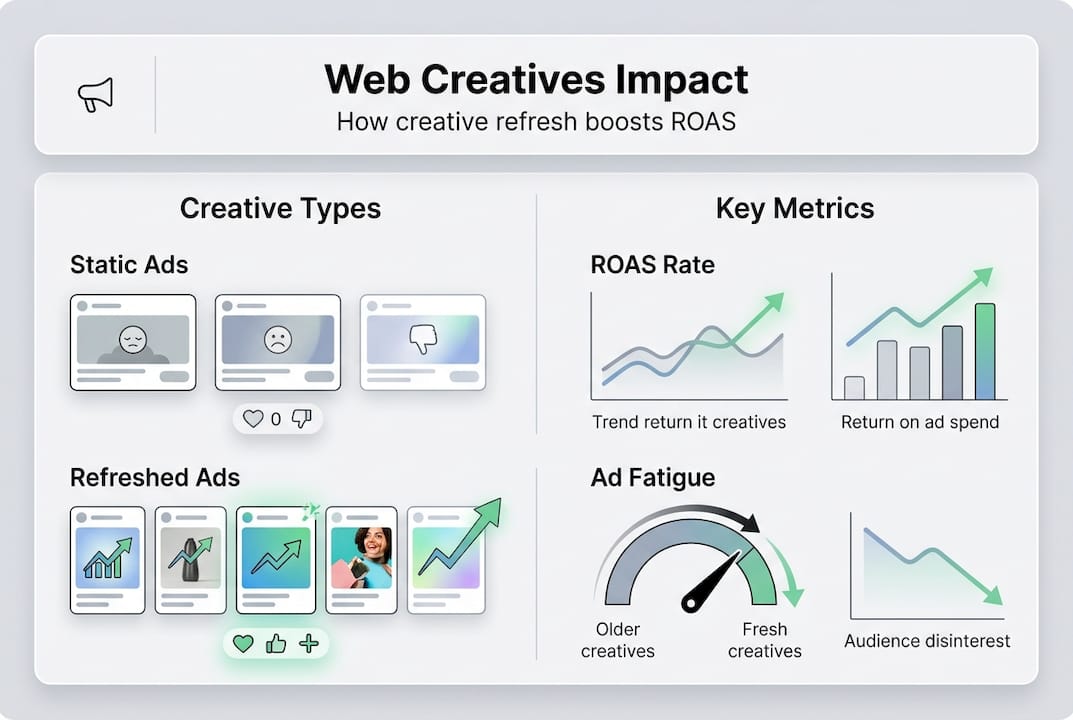
Speed and consistency in creative production are not operational details. They are competitive advantages. The data is clear: high-velocity creative production boosts ROAS by 1.5x when teams refresh five to seven creatives per week.

Why does refresh rate matter so much? Audiences exposed to the same ad repeatedly stop responding. This is called ad fatigue, and it silently drains your ad budget while your performance metrics decline. Regular creative rotation keeps your messaging fresh and your audience engaged.
Here is how a high-velocity creative production cycle works in practice:
- Audit current creatives to identify which assets are underperforming or showing signs of fatigue
- Develop five to seven new creative variants each week, testing different headlines, visuals, and formats
- Run A/B tests across your paid channels to identify which variants drive the highest click-through and conversion rates
- Retire low performers quickly and scale the budget behind winning creatives
- Document learnings to inform the next production cycle and build a library of proven creative patterns
| Creative refresh frequency | Estimated ROAS impact | Ad fatigue risk |
|---|---|---|
| Static (no refresh) | Baseline | High |
| Monthly refresh | Moderate improvement | Medium |
| Weekly refresh (5-7 creatives) | Up to 1.5x boost | Low |
Staying current with marketing trends helps you anticipate which creative formats are gaining traction before your competitors catch on. Structured creative production schedules give your team the rhythm needed to sustain output without sacrificing quality.
Pro Tip: Set a fixed creative review day each week. Evaluate performance data every Monday, retire the bottom 20% of creatives, and brief your team on new variants to launch by Wednesday. This simple cadence prevents ad fatigue and keeps your campaigns performing at peak efficiency.
Integrating web creatives into a winning campaign strategy
Web creatives do not operate in isolation. They are the connective tissue between your campaign goals and your audience’s response. Whether you are running paid search ads, email nurture sequences, or social media campaigns, the creative layer determines whether your message lands or gets ignored.
Consider how creatives function across different campaign types:
- Paid ads: Display and video creatives carry the visual weight of your targeting strategy. A perfectly segmented audience still needs a compelling creative to convert.
- Email campaigns: Header visuals and product imagery directly influence open-to-click rates. Personalized creative elements increase relevance and response.
- Social media: Platform-native creatives, sized and formatted for each channel, outperform generic repurposed assets every time.
The web creative mix including video and image assets increases conversion rates across all these channels. The brands that win are the ones that treat creative strategy as inseparable from campaign strategy.
| Campaign element | Without strong creatives | With strong creatives |
|---|---|---|
| Paid ad CTR | Below industry average | Above industry average |
| Email click-through rate | 1-2% | 3-5%+ |
| Social engagement rate | Minimal organic reach | Amplified reach and shares |
| Landing page conversion | High bounce rate | Lower bounce, higher conversion |
Building a strong creative content marketing foundation ensures your assets reinforce each other across every channel. A cohesive web creative strategy also protects your brand identity as you scale. Explore how transforming your marketing strategy with fresh creative thinking can shift your entire campaign trajectory.
Pro Tip: Create a brand creative style guide that defines your color palette, typography, image tone, and video style. Apply it consistently across every creative type. Audiences recognize and trust brands that look the same everywhere they appear.
Real-world examples: Creative-driven results
Strategy is only as credible as the results it produces. Here is what happens when businesses commit to high-velocity creative production and disciplined testing.
Scenario one: Weekly creative refresh drives conversion growth. A direct-to-consumer brand running static display ads for 60 days saw declining click-through rates and rising cost-per-acquisition. After switching to a weekly creative refresh cycle, producing five new variants each week and retiring underperformers, their conversion rate increased significantly within 30 days. The creative change, not the targeting, drove the improvement.
Scenario two: Video plus image combination lifts sales. An e-commerce retailer running image-only ads added short-form video creatives to the same campaign. The blended approach produced a measurable uptick in both add-to-cart rates and completed purchases. High-velocity creative testing multiplies ROAS and boosts conversions when formats are combined strategically.
Here are the quick wins that consistently emerge from creative-driven campaigns:
- Retiring one underperforming creative per week frees budget for higher-converting variants
- Testing two headline variations per creative batch reveals messaging preferences quickly
- Adding a single video asset to an image-only campaign often produces an immediate lift
- Aligning creative themes to seasonal moments increases relevance and engagement
- Documenting winning creative patterns shortens future production cycles
“The brands that treat creative testing as a core business function, not a creative department task, are the ones that consistently outperform their competitors.”
Look at how ThredUp’s digital triumph was built on consistent, data-informed creative decisions. Similarly, the Chase marketing success story demonstrates how brand-consistent creatives at scale build both recognition and revenue. Even decisions around asset quality, such as understanding watermark removal for clean creative production, reflect the attention to detail that separates high-performing campaigns from average ones.
Enhance your campaigns with creative expertise
The evidence is clear: web creatives are not a supporting element of your marketing strategy. They are a primary revenue driver. When produced at the right velocity, tested systematically, and aligned to campaign goals, they multiply the return on every dollar you spend.
At Monstrous Media Group, we build systems that turn creative production into a measurable growth engine. Our digital marketing services are designed to eliminate revenue leaks and accelerate performance through data-driven creative strategy. Our web design and development team ensures your creative assets are built for conversion from the ground up. And our social media management solutions keep your brand visible, consistent, and compelling across every platform. Let us build the creative system your campaigns deserve.
Frequently asked questions
How often should web creatives be refreshed in digital marketing campaigns?
Refreshing creatives 5-7 times per week can multiply ROAS by 1.5x compared to static campaigns. Consistent rotation prevents ad fatigue and keeps audience engagement high.
Do videos or images perform better in online campaigns?
Using both formats together is the stronger approach. Combining video and images yields 19% higher conversions than relying on a single creative type.
What is ad fatigue and how does creative rotation help?
Ad fatigue occurs when audiences see the same creative too frequently, causing engagement to drop. Rotating creatives regularly resets audience attention and boosts campaign effectiveness without increasing ad spend.
How do web creatives contribute to brand identity?
Consistent visual themes, color use, and messaging across all creative types build a recognizable brand that audiences trust. Creative assets are the primary vehicle through which brand identity is expressed and reinforced at every online touchpoint.
Recommended
Hire the team to help you with your website, app, or other marketing needs.
We have a team of digital marketers who can help plan and bring to life all your digital marketing strategies. They can help with social media marketing, email marketing, and digital advertising!
CONTACT US
Comments