
 https://www.omahamediagroup.com/images/uploads/monster_gallery/Omaha-Media-Group-Black.jpg
admin
https://www.omahamediagroup.com/images/uploads/monster_gallery/Omaha-Media-Group-Black.jpg
admin
Unified Marketing: The Revenue Growth Strategy You Need

TL;DR:
- Unified marketing differs from omnichannel by integrating strategy, data, teams, and measurement into a single operating system. It improves pipeline velocity, attribution accuracy, scalability, and team productivity, enhancing revenue growth. Success depends on organizational culture shift, shared processes, unified data, and continuous measurement refinement.
Most marketing executives use “omnichannel” and “unified marketing” as if they mean the same thing. They don’t, and that confusion is quietly costing businesses real revenue. While omnichannel focuses on delivering consistent customer experiences across channels, unified marketing goes deeper, aligning your data, your teams, your processes, and your measurement into a single operating system for growth. The distinction isn’t semantic. It’s the difference between a company that looks coordinated and one that actually performs. This article breaks down what unified marketing truly means, why it matters in 2026, and how to build it without adding chaos to your operations.
Table of Contents
- What is unified marketing and how is it different?
- Core benefits of a unified marketing strategy
- Key pillars of an effective unified marketing ecosystem
- Overcoming obstacles: Why most unified marketing initiatives stumble
- Our take: Why unified marketing is still misunderstood in 2026
- Ready to unlock unified marketing? Here’s how to take the next step
- Frequently asked questions
Key Takeaways
| Point | Details |
|---|---|
| Unified vs. omnichannel | Unified marketing requires deep internal alignment of data and teams beyond channels. |
| Measurable business benefits | True unification increases efficiency, revenue, and organizational scalability. |
| Common pitfalls | Most unified marketing failures stem from siloed teams and poor technology adoption. |
| Critical success factors | Cross-team collaboration, unified data management, and modern measurement models drive real results. |
What is unified marketing and how is it different?
Let’s settle this once and for all. Unified marketing is not just omnichannel with better branding. It is not integrated marketing with a new name. Each of these terms describes a meaningfully different level of organizational maturity, and conflating them leads to misaligned investments and stalled initiatives.
Here is a clear breakdown of the three approaches:
| Approach | Focus | Core strength | Common gap |
|---|---|---|---|
| Integrated marketing | Blending tactics and creative | Consistent messaging | Lacks structural alignment |
| Omnichannel marketing | Channel coordination | Seamless customer experience | Silos often remain internally |
| Unified marketing | Strategy, data, teams, and measurement | Scalable, measurable, ROI-driven | Requires significant cultural shift |
The table above tells a precise story. Integrated marketing ensures your email campaign looks and sounds like your paid ads. Omnichannel ensures the customer moves smoothly from a social ad to a landing page to a follow-up email. Unified marketing asks a harder question: are your teams, data systems, and measurement frameworks actually working from the same playbook?
Key distinctions to keep top of mind:
- Unified marketing connects internal operations, not just customer-facing channels.
- It requires shared data infrastructure, cross-functional accountability, and real-time visibility across the entire revenue funnel.
- It demands measurement sophistication, specifically the ability to triangulate MMM and MTA for true ROI in a privacy-first world.
- It supports both short-term performance goals and long-term brand equity, simultaneously.
“The companies that win in 2026 are not just coordinating channels. They are unifying people, data, and decisions into one operating system for growth.”
Why does this matter now? Privacy regulations, the deprecation of third-party cookies, and the rise of AI-driven media buying have fundamentally changed what attribution looks like. Last-click models no longer tell the truth. Single-channel dashboards no longer tell the whole story. If your approach to transforming your marketing strategy does not account for these shifts, you are making budget decisions based on incomplete data. Unified marketing, by design, is built to function in this more complex environment.
Core benefits of a unified marketing strategy
Now that we have established what unified marketing actually is, the natural question becomes: what does it deliver? The business case is compelling, but only when leaders understand exactly what to expect.
Here is a performance comparison of siloed versus unified approaches:
| Business outcome | Siloed marketing | Unified marketing |
|---|---|---|
| Pipeline velocity | Slow, with hand-off delays | Faster, with shared funnel visibility |
| Attribution accuracy | Channel-level only | Cross-channel, multi-touch clarity |
| Campaign scalability | Requires rebuilding per channel | Scales across channels from one framework |
| Team productivity | Duplicated effort, misaligned KPIs | Shared goals, reduced redundancy |
| Technology utilization | Fragmented tools, low adoption | Integrated stack with higher ROI |
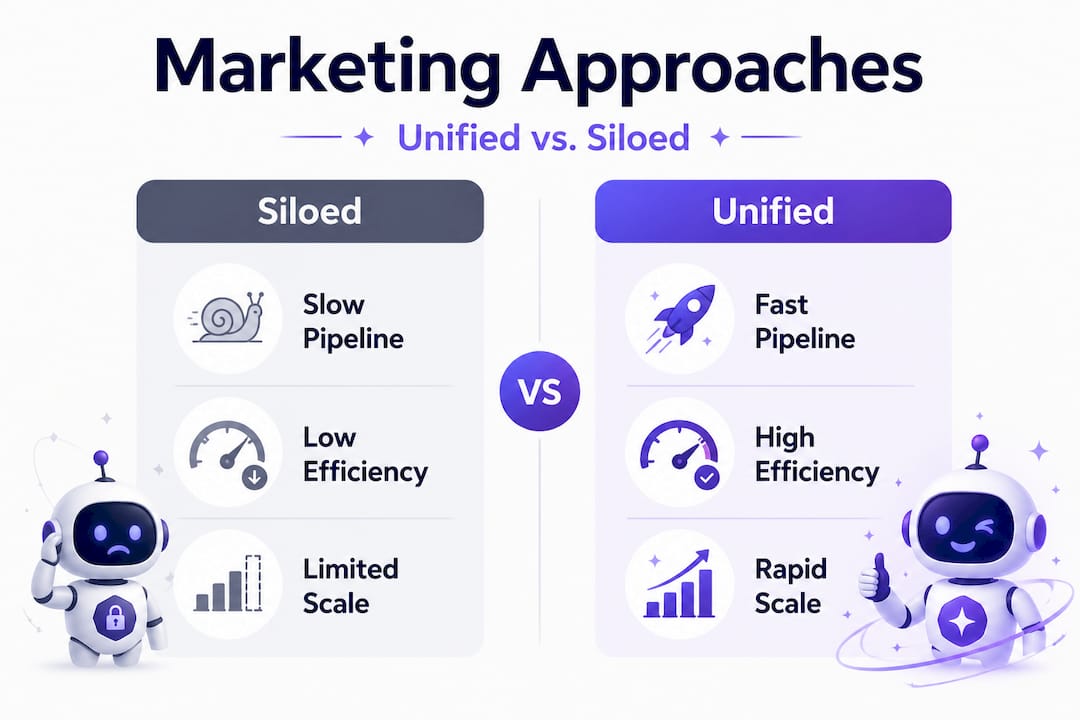
The revenue impact alone justifies the investment. When your demand generation team and your sales team are operating from the same data, pipeline velocity increases because hand-offs are faster and more informed. Account targeting improves because both teams know which prospects have engaged, at what depth, and through which touchpoints.

Operational efficiency is the second major win. Most mid-size marketing teams spend 20 to 30 percent of their time reconciling data across disconnected tools or duplicating efforts because of poor cross-team communication. Unified marketing eliminates that waste. Marketing automation benefits compound when they are built on a unified data layer rather than bolted onto a fragmented stack.
The scalability benefit is just as significant. Once your framework is unified, scaling into new markets, adding new channels, or onboarding new team members becomes dramatically faster. You are not rebuilding the architecture every time you grow. You are simply extending it.
Here is the sobering reality: despite these advantages, martech utilization sits at 49% across most organizations, and only 15% of high performers have achieved true marketing unification, according to Gartner. That gap represents both a warning and an opportunity. The companies that close it will hold a structural competitive advantage.
Pro Tip: Before investing in new martech, audit your current tool utilization. If your team is using less than 60% of the features in your existing platforms, adding new software will not solve your unification problem. People and process must lead technology adoption, not follow it.
The advertising and marketing industry is shifting toward agentic AI models, where software makes real-time decisions on budget allocation, audience targeting, and content personalization. Unified marketing is what makes those AI systems actually useful, because AI is only as good as the data you feed it.
Key pillars of an effective unified marketing ecosystem
Making unified marketing a reality requires more than good intentions. It requires building and maintaining four distinct pillars that work together. Treat them as sequential priorities for implementation.
-
Unified data. Every team needs access to the same data, in real time, without dependency on another team to pull reports. This means investing in a central data layer, whether that is a customer data platform (CDP), a data warehouse, or a robust CRM integration. Privacy compliance is non-negotiable here. Your data architecture must be built for a privacy-first environment from the ground up, not patched to comply after the fact.
-
Unified processes. Shared dashboards, cross-functional planning sessions, and automated reporting are the operational backbone of a unified system. Teams should not be operating from separate weekly reports that tell different stories about the same campaign. One source of truth, visible to everyone, eliminates the political friction that derails most marketing initiatives.
-
Unified teams. This is where most organizations struggle hardest. Breaking down silos between brand, demand generation, content, paid media, and sales is a cultural challenge before it is a structural one. Start with shared KPIs. If brand is measured on awareness and demand gen is measured on pipeline, you will never achieve true unification regardless of how many tools you deploy.
-
Unified measurement. Standard last-click attribution is a known distortion of marketing reality. High-performing organizations use triangulated measurement models that combine MMM (Marketing Mix Modeling, which analyzes aggregate spend and results over time) with MTA (Multi-Touch Attribution, which tracks individual customer journeys). Together, triangulated MMM and MTA give you a full picture of what is working, at what scale, and at what cost.
Additional capabilities that support unified execution include:
- AI-assisted planning: Modern AI tools can identify audience overlap, predict campaign performance, and recommend budget shifts in real time. Explore how AI in unified marketing accelerates every stage of this process.
- Marketing automation infrastructure: Automation should serve a unified strategy, not substitute for one. The right marketing automation solutions reduce manual effort and increase the speed of execution across all pillars.
- Governance protocols: Establish clear data ownership, campaign approval processes, and performance review cadences that keep all teams accountable.
Pro Tip: Map every martech tool in your current stack to one of the four pillars above. Any tool that does not clearly serve data, process, team, or measurement unity should be on your audit list for elimination or replacement.
Overcoming obstacles: Why most unified marketing initiatives stumble
Even with strong intentions and a clear framework, the majority of unified marketing projects underdeliver. Understanding why they fail is just as important as knowing what success looks like.
Organizational inertia is the most common killer. Teams that have operated in silos for years will not naturally collaborate just because leadership announces a new strategy. Inertia is powerful. Without active change management, people revert to familiar workflows within weeks of any initiative launch.
Martech underutilization compounds the problem. Companies invest heavily in platforms and then fail to train teams, define governance, or integrate the tools into actual workflows. The 49% utilization rate across organizations means most companies are getting less than half the value from their marketing technology investments. That is not a technology problem. That is an adoption and process problem.
Measurement dependency on flawed models is another frequent stumbling block. When organizations continue to rely on last-click attribution or platform-reported ROAS (Return on Ad Spend) as their primary source of truth, they make budget decisions that favor visible, bottom-of-funnel activity while starving the top-of-funnel activities that create future demand.
Here is what separates high performers from the rest:
- They establish a clear, staged roadmap before launching any initiative.
- They celebrate incremental wins publicly to build momentum and buy-in.
- They secure executive sponsorship at the C-suite level from day one.
- They treat change management as a primary workstream, not an afterthought.
- They review and adjust their measurement models quarterly, not annually.
Studying successful marketing transformations reveals a consistent pattern: the technical work is almost never the hardest part. The culture shift is. Organizations that invest as much in communication, training, and leadership alignment as they do in software implementation are the ones that actually cross the finish line.
Pro Tip: Assign a dedicated “unification champion” inside your organization, someone with cross-functional authority and leadership backing whose explicit job is to break down silos and drive adoption. Without that role, even the best strategy loses momentum. The marketing automation advantages you expect will only materialize if your teams are aligned and committed to the new model.
Our take: Why unified marketing is still misunderstood in 2026
Here is the uncomfortable truth most consultants and platform vendors will not tell you. The conversation about unified marketing has been captured by the technology industry. Every major martech vendor will tell you that their platform is the key to unification. Buy the right CDP, deploy the right automation suite, integrate the right attribution tool, and suddenly your marketing becomes unified. That framing is convenient for them. It is also fundamentally misleading.
Real unification has almost nothing to do with which tools you use and almost everything to do with whether your people share a common language, a common goal structure, and a common view of performance. We have seen organizations with world-class martech stacks that are structurally fragmented. We have also seen companies with relatively modest technology investments that operate with genuine unity because their leadership made culture and clarity the priority.
The shift toward agentic AI as a leadership model actually reinforces this point. AI systems will increasingly make autonomous decisions about media buying, content delivery, and audience segmentation. But those systems operate on the data and goal structures humans define. If your teams are not aligned on what success means and how it is measured, your AI will optimize for the wrong outcomes at machine speed. That is a far more dangerous problem than having a siloed spreadsheet.
The companies that genuinely win in 2026 share three characteristics: they link leadership accountability to marketing outcomes, they maintain radical transparency in measurement by using triangulated attribution approaches rather than convenient single-source metrics, and they treat unification as an ongoing operating discipline rather than a one-time project. Unified marketing is not something you build and ship. It is something you practice, refine, and defend every quarter.
Ready to unlock unified marketing? Here’s how to take the next step
If this article has made one thing clear, it is that unified marketing is not a technology purchase. It is a strategic commitment, and it requires the right partner to implement correctly and at pace.

At Monstrous Media Group, we build systems that stop revenue leaks and drive growth. Not activities, not reports, not vanity dashboards. If you are ready to move from fragmented marketing to a unified revenue engine, our team can help you design, deploy, and measure a system built for real outcomes. Explore our digital marketing solutions to see how we approach unified strategy from the ground up. If automation is your next priority, our marketing automation services are built to integrate directly into your existing operations without disruption. Let’s build something that actually works.
Frequently asked questions
How can unified marketing drive revenue growth in my company?
Unified marketing aligns your teams and data so that sales cycles shorten, targeting improves, and every dollar is tied to measurable outcomes. When strategy, data, and teams operate from a single framework, revenue impact becomes traceable rather than assumed.
What’s the biggest challenge in implementing unified marketing?
Organizational silos and leadership buy-in are consistently the top barriers, compounded by the fact that martech utilization averages just 49% across most companies. Technology alone will not solve a people and process problem.
How do you measure the success of unified marketing initiatives?
The most reliable method is triangulated measurement, combining MMM (Marketing Mix Modeling) with MTA (Multi-Touch Attribution) to capture both aggregate trends and individual customer journeys. Relying on triangulated MMM and MTA removes the blind spots that single-source attribution creates.
Is adopting AI technology essential for unified marketing?
Yes, particularly as privacy regulations eliminate traditional tracking signals. AI as a leadership model accelerates real-time data integration and enables smarter decisions, but only when it operates on top of a unified data and team structure.
Recommended
Hire the team to help you with your website, app, or other marketing needs.
We have a team of digital marketers who can help plan and bring to life all your digital marketing strategies. They can help with social media marketing, email marketing, and digital advertising!
CONTACT US
Comments