
 https://www.omahamediagroup.com/images/uploads/monster_gallery/Omaha-Media-Group-Black.jpg
admin
https://www.omahamediagroup.com/images/uploads/monster_gallery/Omaha-Media-Group-Black.jpg
admin
Understand the role of marketing campaigns for growth in 2026

Most marketing professionals believe their campaigns are data-driven, yet 73% struggle to prove actual ROI beyond vanity metrics. The confusion stems from treating marketing as art rather than science. Marketing campaigns should drive measurable revenue growth and reduce leaks, not just generate impressions or clicks. Evidence-based marketing transforms this landscape by separating correlation from causation. You will learn proven frameworks for planning campaigns that deliver real business outcomes, from balancing brand investments to leveraging high-ROI channels and personalization strategies that work in 2026.
Table of Contents
- Understanding The Foundational Role Of Marketing Campaigns
- Balancing Long-Term Brand Building And Short-Term Activation For Effective Campaigns
- Leveraging High-Roi Channels And Personalization In 2026 Marketing Campaigns
- Case Study: Nike’s 2026 Influencer Campaign In India And Lessons For Marketers
- Explore Expert Marketing Services To Amplify Your Campaigns
- Frequently Asked Questions About Marketing Campaigns
Key takeaways
| Point | Details |
|---|---|
| Balance brand and activation | Allocate 60% to long-term brand building and 40% to short-term sales activation for maximum effectiveness. |
| Direct mail delivers high ROI | Direct mail ranks as the third-highest ROI channel, outperforming many digital tactics when executed well. |
| Micro influencers win engagement | Mid-tier and micro creators generate better save rates and conversions than macro influencers in 2026. |
| Evidence-based marketing works | Shifting from opinion to evidence transforms campaigns into predictable revenue systems with measurable outcomes. |
| Personalization drives results | Tailored messaging using behavioral data and segmentation increases email engagement and campaign conversion rates. |
Understanding the foundational role of marketing campaigns
Marketing campaigns encompass coordinated efforts across channels designed to achieve specific business objectives, from building brand awareness to driving immediate sales. They include everything from social media pushes and email sequences to influencer partnerships and direct mail. The strategic importance lies in their ability to generate, capture, and close revenue systematically rather than relying on random acts of marketing.
Many professionals struggle because they confuse activity with outcomes. Running ads or posting content feels productive, but these actions do not guarantee revenue growth. The real challenge is measuring true impact beyond surface-level metrics like impressions or clicks. Without understanding causation, you cannot know if your campaign drove sales or simply correlated with existing demand.
Evidence-based marketing revolutionizes this approach by treating campaigns as applied science rather than creative guesswork. The profound difference between opinion and evidence is critical for marketing success. Instead of assuming tactics work, you test hypotheses, measure outcomes, and iterate based on data. This shift eliminates the common trap of passive metrics that look impressive but reveal nothing about business impact.
Most marketers struggle with ineffective experimentation. They run tests without proper control groups, confuse statistical significance with business relevance, or cherry-pick data that confirms existing beliefs. These mistakes lead to campaigns that waste budget on tactics that feel right but deliver minimal returns. Separating correlation from causation requires rigorous methodology, not just analytics dashboards.
“Marketing without evidence is just expensive hope. Evidence-based approaches transform campaigns from cost centers into predictable revenue engines.”
The stakes are high. Businesses cannot afford revenue leaks caused by poorly designed campaigns. When you invest in transforming your marketing strategy using evidence-based principles, you build systems that produce outcomes rather than busywork. This foundation allows you to allocate budgets confidently, knowing which tactics drive growth and which drain resources.
Key challenges include:
- Distinguishing between metrics that indicate success versus those that simply measure activity
- Building proper testing frameworks that isolate variables and measure incremental impact
- Overcoming organizational bias toward familiar tactics that may no longer deliver results
- Integrating data from multiple channels to understand true customer journeys and attribution
Balancing long-term brand building and short-term activation for effective campaigns
Binet and Field’s research suggests a 60:40 ratio of long-term to short-term investments for maximum marketing effectiveness. This finding challenges the common practice of overinvesting in performance marketing at the expense of brand building. Long-term brand building creates mental availability and emotional connections that make future sales easier and cheaper. Short-term activation captures demand and drives immediate conversions.

Long-term brand building includes campaigns focused on awareness, consideration, and preference. These efforts use broad reach channels, emotional storytelling, and consistent messaging over months or years. Think television ads, sponsorships, content marketing, and brand partnerships. The impact accumulates slowly but compounds over time, reducing customer acquisition costs and increasing pricing power.
Short-term activation targets customers ready to buy now. These campaigns use direct response tactics, promotional offers, retargeting, and conversion-optimized landing pages. Results appear quickly in sales data, making them attractive to executives demanding immediate ROI. However, overreliance on activation depletes the brand equity that makes these tactics effective.
Implementing the 60:40 balance requires strategic discipline:
- Audit current spending across all campaigns and categorize each as brand building or activation based on primary objective and timeframe.
- Reallocate budget gradually toward the 60:40 ratio, understanding that brand investments take 6 to 12 months to show measurable impact.
- Establish separate KPIs for each category, tracking brand health metrics like awareness and consideration alongside immediate sales and conversion rates.
- Resist pressure to shift all budget to activation during slow periods, as this creates a vicious cycle of declining brand strength.
- Test and refine the ratio based on your market, competitive intensity, and business maturity, as the optimal balance varies by context.
The Ehrenberg Bass Institute offers a nuanced perspective through their sophisticated mass marketing framework. They argue that consistent, broad-reach campaigns targeting light buyers and non-customers often outperform narrow targeting and personalization. This challenges conventional wisdom about segmentation but aligns with evidence showing that growing market share requires reaching beyond your core audience.
Pro Tip: Align campaign KPIs with both brand health and immediate sales metrics to optimize effectiveness. Track awareness, consideration, and preference quarterly while monitoring weekly sales, conversion rates, and customer acquisition costs. This dual focus prevents the trap of optimizing for short-term wins that undermine long-term growth.
The Binet and Field marketing research provides a framework, not a rigid rule. Your optimal ratio depends on market maturity, competitive dynamics, and business goals. Startups may need more activation to generate initial traction. Established brands in saturated markets benefit from sustained brand investment to maintain differentiation.
Leveraging high-ROI channels and personalization in 2026 marketing campaigns
Direct mail marketing campaigns have the third-highest ROI among direct marketing channels, surprising many marketers who assume digital always wins. The tangible nature of physical mail creates higher engagement rates when executed with precision targeting and compelling creative. Recipients spend more time with direct mail than email, and response rates often exceed digital channels for certain audiences.
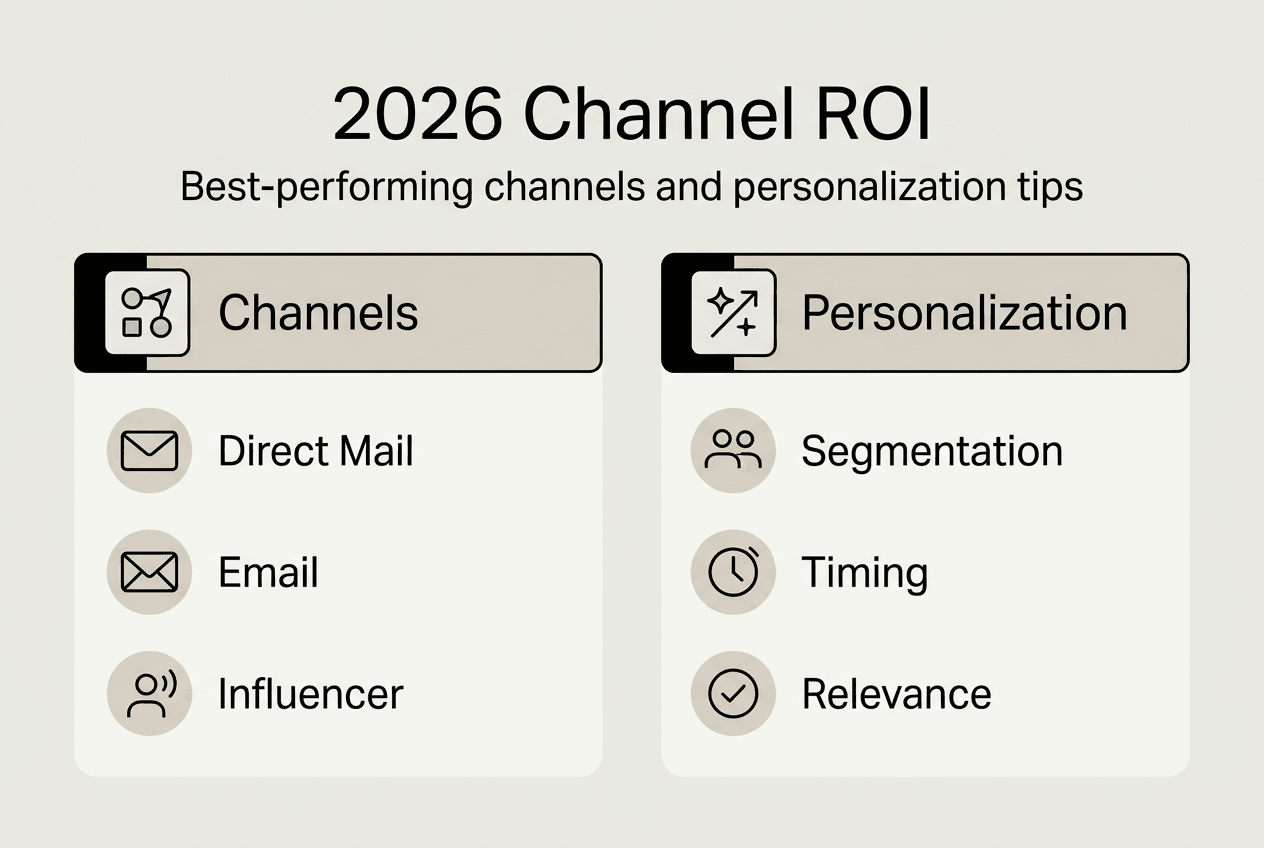
| Channel | Median ROI | Best Use Case | Key Success Factor |
|---|---|---|---|
| Direct Mail | 29% | High-value B2B prospects, older demographics | Precise targeting and personalized creative |
| Email Marketing | 122% | Nurturing existing customers, promotional campaigns | Segmentation and behavioral triggers |
| Influencer Marketing | 300%+ | Product launches, cultural relevance campaigns | Creator authenticity and audience alignment |
Personalization is key to successful email marketing campaigns, transforming generic blasts into relevant conversations. Personalization extends beyond inserting a first name in the subject line. It means tailoring content, offers, and timing based on behavioral data, purchase history, and engagement patterns. Personalized emails generate six times higher transaction rates than non-personalized messages.
Best practices for campaign personalization:
- Segment audiences based on behavior and lifecycle stage, not just demographics, to deliver contextually relevant messages
- Use dynamic content blocks that change based on recipient attributes, showing different products or messaging to different segments
- Trigger campaigns based on specific actions like cart abandonment, browsing behavior, or milestone dates rather than arbitrary calendar schedules
- Test personalization elements systematically to identify which variables drive the biggest lift in engagement and conversion
- Balance personalization with privacy, being transparent about data use and providing clear opt-out mechanisms
Pro Tip: Use segmentation and behavioral data to tailor campaign content for higher engagement. Start with simple segments based on purchase recency and frequency, then layer in product preferences and channel engagement patterns. Even basic segmentation outperforms one-size-fits-all campaigns significantly.
The key to email marketing ROI strategies lies in combining the right channel mix with sophisticated personalization. Direct mail works for high-value prospects where cost per contact is justified by deal size. Email excels at nurturing and activation for existing customers. Effective influencer marketing bridges the gap between brand building and activation when you select creators whose audiences align with your target customers.
Channel selection should follow audience behavior and campaign objectives. B2B campaigns targeting executives may benefit from direct mail combined with LinkedIn ads. E-commerce brands driving repeat purchases rely heavily on email and retargeting. Product launches seeking cultural relevance lean on influencer partnerships and social media. The highest ROI comes from integrated campaigns that use each channel for its strengths rather than spreading budget equally across all options.
Case study: Nike’s 2026 influencer campaign in India and lessons for marketers
Nike’s influencer campaign in India achieved a 300% ROI in 2026 by focusing on trust, timing, and creator relevance. The campaign prioritized use-case proof content over polished brand storytelling, showing real athletes and fitness enthusiasts using Nike products in authentic situations. This approach resonated with Indian consumers who value practical demonstrations over aspirational imagery.
The strategic insight centered on cultural and linguistic relevance. Indian consumers respond better to content in regional languages like Hindi, Tamil, and Telugu than English, even among educated urban audiences. Nike partnered with micro and mid-tier creators who spoke these languages naturally and understood local fitness culture. These creators had smaller followings but higher engagement rates and deeper audience trust than macro influencers.
| Metric | Result | Insight |
|---|---|---|
| Campaign ROI | 300% | Evidence-based creator selection and performance focus delivered exceptional returns |
| Save Rate (Micro Influencers) | 18% | Smaller creators generated higher intent signals than celebrity partnerships |
| Save Rate (Mid-Tier Influencers) | 22% | Mid-tier creators balanced reach and authenticity for optimal engagement |
| Conversion Rate | 8.5% | Use-case proof content drove purchase decisions more effectively than brand storytelling |
Key tactics that drove success:
- Selected creators based on audience demographics and engagement quality rather than follower counts or celebrity status
- Focused on performance metrics like save rates and conversion tracking instead of vanity metrics like impressions
- Avoided over-polished content that felt like advertising, encouraging creators to maintain their authentic voice and style
- Timed content releases around local festivals and sporting events when fitness motivation and purchase intent peak naturally
- Tested different content formats and doubled down on what worked, iterating quickly based on real-time performance data
The lessons extend beyond influencer marketing. Successful campaigns require deep audience understanding that goes beyond demographic data. Nike recognized that Indian consumers wanted proof, not promises. They valued authenticity over production quality. Regional language content outperformed English despite the perception that urban consumers prefer English.
This influencer marketing success demonstrates the power of aligning content, creators, and audience culture. Generic campaigns translated from other markets rarely work. You must adapt messaging, creative approach, and channel selection to local preferences and behaviors. The 300% ROI came from evidence-based decisions about creator selection and content strategy, not from throwing money at big-name influencers.
Marketers can apply these principles regardless of industry or market. Start by understanding what type of content your audience trusts and how they prefer to consume it. Test different creator tiers and content styles systematically. Measure what matters, focusing on metrics that correlate with business outcomes rather than those that simply look impressive. Cultural relevance and authenticity beat production budgets every time.
Explore expert marketing services to amplify your campaigns
Implementing evidence-based marketing campaigns requires expertise in strategy, execution, and optimization. Professional digital marketing services incorporate data-driven approaches that transform campaigns from expensive experiments into predictable revenue systems. You need partners who understand the difference between activity and outcomes, who build systems that stop revenue leaks rather than generating busywork.

Email marketing services become crucial when personalization and segmentation drive your campaign strategy. The right expertise helps you leverage behavioral data, automate triggered campaigns, and optimize every element from subject lines to send times. These details compound into significant ROI improvements over time.
Consider how tailored campaign planning addresses your specific market dynamics, competitive landscape, and customer journey. Generic templates and best practices only take you so far. You need strategic partners who analyze your situation, test hypotheses rigorously, and iterate based on evidence. Search engine optimization services complement campaign efforts by building sustained visibility that makes every dollar work harder.
Reach out to explore how professional guidance can amplify your marketing campaigns, reduce wasted spend, and drive measurable growth without adding chaos or headcount to your organization.
Frequently asked questions about marketing campaigns
What is the main purpose of a marketing campaign?
The main purpose is to generate, capture, and close revenue by coordinating messaging and tactics across channels to achieve specific business objectives. Campaigns should drive measurable outcomes like sales, qualified leads, or market share growth, not just impressions or engagement. Every campaign must connect directly to revenue impact.
How do you measure the ROI of a marketing campaign effectively?
Measure ROI by tracking incremental revenue directly attributable to campaign activities, divided by total campaign costs including creative, media, and labor. Use control groups or holdout testing to isolate campaign impact from baseline sales. Focus on metrics that correlate with business outcomes rather than vanity metrics like clicks or impressions that do not predict revenue.
Why is balancing brand building and short-term activation important?
Balancing these investments prevents the trap of depleting brand equity through constant promotional activity while ensuring you capture immediate demand. Brand building creates mental availability and emotional connections that make future sales easier and cheaper. Activation converts ready buyers but becomes less effective without strong brand foundations. The 60:40 ratio optimizes long-term growth and short-term results.
What channels currently deliver the best ROI in marketing?
Direct mail, email marketing, and influencer partnerships with micro and mid-tier creators deliver strong ROI in 2026 when executed with precision targeting and personalization. Email generates the highest median ROI at 122% for customer nurturing. Direct mail ranks third overall and excels for high-value B2B prospects. Channel effectiveness depends on your audience, product, and campaign objectives, so test systematically.
How can personalization improve marketing campaign results?
Personalization increases relevance by tailoring content, offers, and timing to individual behaviors and preferences rather than treating all recipients identically. Personalized campaigns generate six times higher transaction rates because they address specific needs and contexts. Use segmentation based on purchase history, browsing behavior, and lifecycle stage to deliver messages that feel like helpful recommendations rather than generic advertising.
Recommended
Hire the team to help you with your website, app, or other marketing needs.
We have a team of digital marketers who can help plan and bring to life all your digital marketing strategies. They can help with social media marketing, email marketing, and digital advertising!
CONTACT US
Comments