
 https://www.omahamediagroup.com/images/uploads/monster_gallery/Omaha-Media-Group-Black.jpg
admin
https://www.omahamediagroup.com/images/uploads/monster_gallery/Omaha-Media-Group-Black.jpg
admin
The Role of Sustainable Marketing in Building Brand Trust

TL;DR:
- Sustainable marketing integrates environmental and social responsibility into core business practices, not just messaging. Overcoming the systemic execution gap and building cross-functional alignment are essential for trust, compliance, and long-term growth. Transparent, data-backed communication and verified KPIs help transform sustainability claims into credible, impactful consumer relationships.
Sustainable marketing is defined as the strategic integration of environmental and social responsibility into core marketing practices to build consumer trust, influence purchase behavior, and drive long-term business growth. This is not a communications exercise. It is a business capability that touches product design, pricing, distribution, and cross-functional governance. The UN Global Compact–Kantar CMO Benchmark reports that 69% of marketers claim progress on sustainability, yet the average execution score sits at only 52%. That gap is where brand equity is lost, regulatory risk accumulates, and consumer trust erodes. For business leaders and marketers, closing that gap is the defining challenge of sustainable marketing in 2026.

What is the role of sustainable marketing in consumer behavior?
Sustainable marketing shapes consumer responses through three distinct pathways: cognitive processing, emotional trust, and behavioral action. A systematic review of 78 studies confirms that green marketing influences all three, but effectiveness depends heavily on moderating factors including environmental concern, price sensitivity, label clarity, and baseline skepticism. This means the same campaign can produce radically different outcomes across audience segments, which is why generic sustainability messaging consistently underperforms.
The attitude-behavior gap is the most stubborn obstacle in sustainable marketing. Consumers express strong environmental intentions but fail to convert those intentions into purchases when they encounter price-quality trade-offs or ambiguous certification labels. The research on this gap is clear: bridging it requires building affective trust, not simply increasing message volume. Emotional credibility is the mechanism that moves a consumer from “I care about sustainability” to “I will buy this product.”
Personalized communication accelerates that trust-building process. A May 2026 study of 102 consumers found that transparent AI-enabled messaging significantly enhances credibility and reduces skepticism compared to generic sustainability claims. The implication is direct: personalization is not a nice-to-have feature in sustainable marketing. It is a trust infrastructure decision.
Key moderators that determine whether sustainable marketing converts intention into purchase:
- Environmental concern: Consumers with high baseline concern respond more strongly to sustainability claims and require less persuasion.
- Price sensitivity: When sustainable options carry a premium, purchase rates drop unless the value proposition is made explicit and credible.
- Label clarity: Vague certifications or undefined terms like “eco-friendly” increase skepticism rather than reduce it.
- Skepticism levels: Audiences with prior exposure to greenwashing require stronger third-party validation before trusting new claims.
Pro Tip: Segment your audience by environmental concern before allocating sustainable marketing spend. High-concern segments respond to emotional appeals; price-sensitive segments need a concrete cost-to-own or durability argument to close the gap.
Key principles behind a sustainable marketing strategy
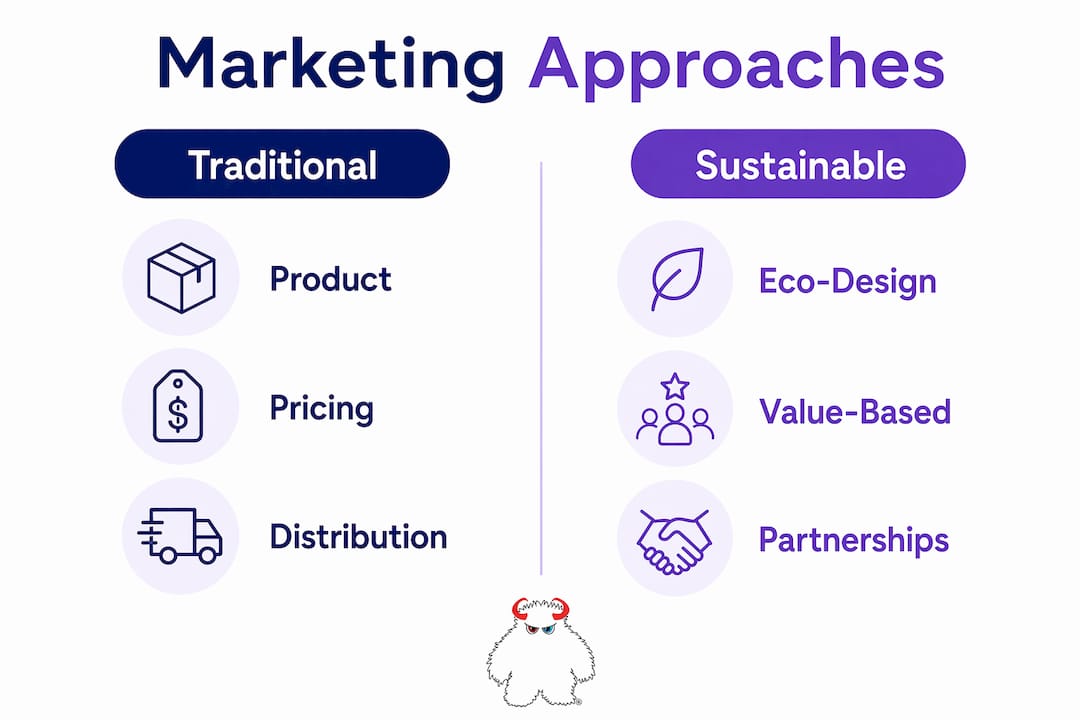
Sustainable marketing strategy rests on five foundational principles: customer orientation, innovation, social responsibility, value focus, and long-term sustainability. These principles reframe the traditional marketing mix in ways that create measurable brand differentiation. The 4 Ps adapted for sustainability extend product, price, place, and promotion to align with environmental and social goals rather than treating sustainability as a bolt-on campaign.
The table below compares traditional and sustainable marketing mix elements to illustrate where the strategic differences are sharpest.
| Marketing mix element | Traditional approach | Sustainable approach |
|---|---|---|
| Product | Optimized for performance and cost | Designed for durability, repairability, and reduced environmental impact |
| Price | Set by competitive benchmarking | Reflects environmental attributes; consumers pay an average premium of 9.7% for sustainably produced goods |
| Place | Distribution optimized for speed and margin | Green retail channels, reduced packaging, lower-emission logistics |
| Promotion | Claim-based messaging focused on product features | Substantiated, transparent communication backed by certifications and life-cycle data |
The pricing row deserves particular attention. A PwC 2024 Voice of the Consumer survey across 31 countries found that roughly 80% of consumers indicate willingness to pay more for sustainable products. That willingness does not translate automatically into revenue. It requires a pricing strategy that makes the environmental value proposition explicit, not assumed. Patagonia’s repair-and-reuse model and Unilever’s Sustainable Living brands both demonstrate that premium pricing holds when the product story is operationally credible.
Distribution is the most underrated element of the sustainable marketing mix. Choosing retail partners, logistics providers, and packaging formats that align with sustainability commitments sends a signal that is harder to fake than advertising copy. It also creates a verifiable evidence trail that supports marketing claims under regulatory scrutiny.
What are the biggest challenges in sustainable marketing execution?
The execution gap identified by the UN Global Compact–Kantar benchmark is not a messaging problem. It is a systems problem. Cross-functional alignment between marketing, procurement, product design, and finance is the prerequisite for sustainable marketing that holds up under scrutiny. Marketing-only campaigns without operational backing create exactly the conditions that produce greenwashing accusations and regulatory exposure.
Greenwashing risk is the most immediate threat to brand equity in this space. The FTC Green Guides under 16 CFR Part 260 require marketers to substantiate eco-friendly claims with life-cycle assessments, baseline comparisons, and third-party certifications. Unqualified terms like “green,” “natural,” or “eco-friendly” used without specific attribute qualifiers are explicitly flagged as deceptive. The EU Greenwashing Directive, which took effect in 2026, imposes similar requirements across European markets, with enforcement mechanisms that include product bans and financial penalties.
Common execution failures that expose brands to greenwashing risk:
- Vague umbrella claims: Stating a product is “environmentally friendly” without specifying which attributes and by what measure.
- Selective disclosure: Highlighting one positive attribute while omitting significant negative impacts elsewhere in the product life cycle.
- Unverified certifications: Using certification logos that lack independent third-party verification or are no longer current.
- Disconnected campaigns: Running sustainability advertising while internal procurement, manufacturing, or logistics practices contradict the claims.
The two sides of tackling greenwash research shows a 70% success rate when brands proactively address both the communication and the operational dimensions of sustainability claims simultaneously. That figure underscores a point most marketing teams miss: credibility is built in operations, not in copy.
Pro Tip: Before publishing any sustainability claim, run it through an internal evidence audit. Map every claim to a specific data source, certification, or operational change. If the evidence trail breaks down at any point, the claim is a liability.
How to implement sustainable marketing strategies that build trust
Building a sustainable marketing system that produces measurable outcomes requires four integrated components: AI-driven personalization, cross-functional governance, verified sustainability KPIs, and transparent communication architecture.
-
Deploy AI personalization with full transparency. Trust rises with transparent AI communication and falls when consumers sense opaque or manipulative targeting. Explain how personalization works, what data it uses, and what sustainability outcome it connects to. Vague AI claims accelerate skepticism rather than reduce it.
-
Build cross-functional governance before launching campaigns. Connect marketing with procurement, product design, finance, and operations through a shared sustainability governance structure. This is the mechanism that creates the evidence trail required by FTC Green Guides and EU regulations. Monstrousmediagroup frames this as marketing infrastructure, not campaign planning.
-
Define and track sustainability KPIs that link to marketing claims. Metrics like carbon intensity per unit sold, percentage of recycled materials, or supply chain audit scores give marketing teams verifiable data to communicate. Sustainability perceptions contribute approximately 10% of brand value for leading global brands, which means these KPIs have direct financial implications.
-
Frame sustainability alongside concrete product value. Durability, lower total cost of ownership, and health benefits are purchase drivers that align with sustainability attributes. Communicating both simultaneously addresses the price-quality trade-off that suppresses conversion. The most effective sustainable marketing balances credible environmental communication with removing practical purchase barriers.
The following table maps sustainable marketing strategies to their primary business outcomes.
| Strategy | Primary outcome |
|---|---|
| AI-personalized sustainability messaging | Increased consumer trust and reduced skepticism |
| Cross-functional governance integration | Regulatory compliance and operational credibility |
| Verified sustainability KPIs | Substantiated claims and brand equity protection |
| Value-plus-sustainability framing | Higher conversion rates among price-sensitive segments |
| Third-party certification and transparent labeling | Reduced attitude-behavior gap and stronger purchase intent |
Brands like Interface, the commercial flooring company, demonstrate what this looks like in practice. Interface built its Mission Zero and Climate Take Back programs by connecting product design changes to specific measurable targets, then communicating those targets through marketing that cited verifiable progress data. The result was a brand equity position that competitors could not replicate through messaging alone because the operational reality was the message.
For teams building sustainable brand identity, the starting point is always the evidence base, not the creative brief. You can also explore how AI capabilities are reshaping personalized marketing communication at scale.
Key takeaways
Sustainable marketing produces brand equity, consumer trust, and regulatory resilience only when it operates as an integrated business system rather than a standalone campaign function.
| Point | Details |
|---|---|
| Execution gap is the core problem | 69% of marketers claim progress, but average execution scores only 52%, per UN Global Compact–Kantar. |
| Trust drives purchase more than volume | Building affective trust closes the attitude-behavior gap more effectively than increasing message frequency. |
| Regulatory compliance is non-negotiable | FTC Green Guides and the EU Greenwashing Directive require substantiated, specific claims backed by verifiable evidence. |
| AI personalization requires transparency | Transparent AI-enabled messaging increases credibility; opaque targeting accelerates consumer skepticism. |
| Cross-functional integration is the foundation | Marketing claims without procurement, product, and operations alignment create reputational and legal exposure. |
Why sustainable marketing is a systems problem, not a messaging problem
Every week, I see marketing teams treat sustainability as a content calendar decision. They brief an agency, approve a campaign, and measure impressions. Then they wonder why consumer trust scores don’t move and why a journalist or regulator eventually calls with uncomfortable questions.
The brands that get this right treat sustainable marketing the way an engineer treats infrastructure. They ask: what is the operational reality we are communicating, and can we prove it at every point in the supply chain? Interface did this. So did Seventh Generation before it was acquired by Unilever. The common thread is that their marketing departments had direct lines into procurement and product development, not just creative and media.
The disconnect I see most often is between the ambition of the sustainability narrative and the maturity of the internal systems supporting it. A brand can have a genuinely good environmental story to tell, but if the evidence trail is fragmented across three departments and two legacy systems, the marketing team cannot tell it credibly. That is a systems problem. It requires transforming your marketing strategy at the infrastructure level, not just refreshing the messaging.
The regulatory environment in 2026 has removed the option of ambiguity. FTC and EU enforcement means that vague claims are now a financial liability, not just a reputational one. The brands that invest now in cross-functional governance and verified KPIs will have a structural advantage as compliance requirements tighten further. The ones that don’t will spend the next three years in reactive mode.
— Vector
How Monstrousmediagroup helps you build sustainable marketing systems
Monstrousmediagroup builds marketing infrastructure that connects sustainability claims to verifiable operational data, then makes that story visible to the right audiences at scale. The team’s AI-powered marketing services deliver personalized sustainability messaging that meets the transparency standards required to build genuine consumer trust. SEO and content systems are designed to surface substantiated brand claims in search, so your sustainability positioning reaches audiences actively looking for credible options. If you are ready to move from sustainability campaigns to a sustainability system, Monstrousmediagroup’s digital marketing solutions are built for exactly that outcome.
FAQ
What is sustainable marketing?
Sustainable marketing is the integration of environmental and social responsibility into core marketing strategy, product development, pricing, and communication. It functions as a business capability, not a campaign type.
Why does the attitude-behavior gap matter for marketers?
The attitude-behavior gap describes the disconnect between consumers’ stated environmental intentions and their actual purchase decisions. Closing it requires building affective trust and removing practical barriers like price sensitivity and label ambiguity.
What do FTC Green Guides require from marketers?
The FTC Green Guides under 16 CFR Part 260 require that eco-friendly claims be substantiated with life-cycle assessments, baseline comparisons, and third-party certifications. Unqualified terms like “green” or “natural” are treated as potentially deceptive.
How does AI improve sustainable marketing outcomes?
Transparent, personalized AI-enabled sustainability communication increases consumer credibility and reduces skepticism, with trust identified as the strongest predictor of purchase intention in a 2026 study of 102 consumers.
What is the biggest execution risk in sustainable marketing?
The biggest risk is running marketing campaigns that outpace the operational reality they claim to represent. Cross-functional integration between marketing, procurement, and product design is the only reliable defense against greenwashing exposure.
Recommended
Hire the team to help you with your website, app, or other marketing needs.
We have a team of digital marketers who can help plan and bring to life all your digital marketing strategies. They can help with social media marketing, email marketing, and digital advertising!
CONTACT US
Comments