
 https://www.omahamediagroup.com/images/uploads/monster_gallery/Omaha-Media-Group-Black.jpg
admin
https://www.omahamediagroup.com/images/uploads/monster_gallery/Omaha-Media-Group-Black.jpg
admin
The Role of Keyword Research in Driving SEO Growth

TL;DR:
- Keyword research transforms SEO into a demand-driven system by identifying audience intent and opportunity gaps.
- It guides content structure, site architecture, and ongoing strategy to improve relevance, rankings, and revenue.
Keyword research is defined as the systematic process of identifying the exact terms, phrases, and intents your audience uses when searching, giving you the data to build content and SEO strategies that produce measurable rankings and revenue. This process forms the operational backbone of every effective SEO system. Tools like Semrush, Ahrefs, and Google Keyword Planner make this data accessible, but the real value lies in how you interpret and act on it. Data-driven content strategies can triple organic traffic within six months by replacing assumptions with targeted, intent-matched content. For business owners and marketers, understanding the role of keyword research means understanding where your revenue pipeline begins.
How keyword research drives SEO effectiveness and organic traffic growth
Keyword research transforms SEO from guesswork into a measurable system. Without it, you are writing content based on what you think your audience wants. With it, you are building pages around verified demand signals that align directly with what people are actively searching.
The most direct keyword research benefit is traffic quality, not just volume. Shifting to commercial intent keywords can triple revenue even when total traffic drops by a factor of four. That outcome is not a coincidence. It reflects the difference between attracting readers and attracting buyers.
Here is what effective keyword analysis reveals that raw traffic data cannot:
- Search intent by stage: Informational queries signal early-stage awareness. Navigational and transactional queries signal purchase readiness. Mapping your content to each stage prevents misaligned messaging.
- Demand volume and competition balance: High-volume keywords often carry high competition. Keyword research surfaces low-competition opportunities with 500 or more monthly searches that competitors have missed entirely.
- Conversion-linked KPIs: Visits are a vanity metric. Keyword research connects content decisions to conversions, lead quality, and revenue, which are the KPIs that actually matter to your business.
- Content gaps in your current strategy: Comparing your existing rankings against demand data shows exactly where you are losing organic visibility to competitors.
High-quality keyword research replaces guesswork with focused, measurable SEO efforts that directly impact business KPIs like conversions and revenue. This is not a tactical upgrade. It is a structural one. Businesses that treat keyword research as a one-time checklist item consistently underperform against those that run it as an ongoing intelligence system.
Pro Tip: When evaluating keywords in Semrush or Ahrefs, filter first by intent, then by difficulty. A keyword with 800 monthly searches and clear transactional intent will almost always outperform a 10,000-search informational keyword in revenue impact.
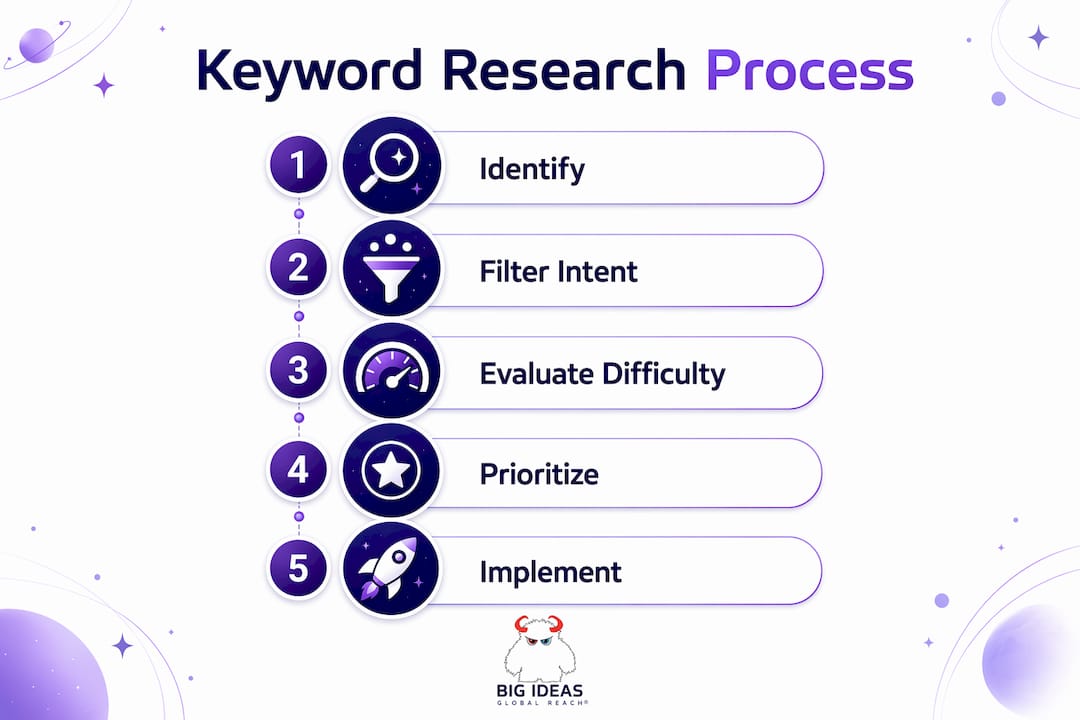
How has keyword research changed in the AI era?
The traditional model of keyword research produced a ranked list of terms sorted by volume. That model is functionally obsolete. Google now matches search intent, not exact keywords, which means the keyword as a standalone ranking unit no longer drives strategy the way it once did.
AI tools have commoditized list generation. Any marketer can generate 200 keyword variations in seconds using ChatGPT or Google’s AI Overviews. The competitive advantage now belongs to teams that can interpret demand signals, identify opportunity gaps, and build content systems around intent clusters rather than individual terms.
Search behavior itself has fragmented. Volume data is less reliable because users now search across AI chat interfaces, voice assistants, YouTube, Reddit, and social platforms in addition to Google. A keyword tool captures only a portion of total demand. This means keyword research in 2026 must account for how your audience asks questions across multiple surfaces, not just what they type into a search bar.
The shift redefines what keyword research produces:
- Old output: A spreadsheet of keywords ranked by monthly search volume.
- New output: Strategic intelligence about customer demand, intent patterns, content opportunity gaps, and competitive positioning.
AI has commoditized keyword lists, but the strategic interpretation of that data remains the differentiator. The businesses winning in organic search are not the ones with the longest keyword lists. They are the ones using keyword data to make smarter decisions about what to build, what to update, and where to compete.
Pro Tip: Run your keyword research through Google Search Console alongside Semrush. Search Console shows you what you already rank for and where you are losing clicks. That gap between impressions and clicks is often your highest-priority optimization target.
How keyword research shapes content strategy and site architecture
Keyword research does not just inform what you write. It determines how your entire site is organized. The pillar-and-cluster content model depends entirely on keyword intent analysis to assign the right scope and depth to each page.
Here is how to apply keyword data to site architecture systematically:
- Identify broad pillar topics using high-volume, high-authority keywords that represent your core service or product categories. These become your pillar pages.
- Map supporting cluster topics using long-tail and question-based keywords that address specific aspects of the pillar topic. Each cluster page links back to the pillar.
- Assign content roles clearly so that no two pages compete for the same keyword. Keyword mapping prevents cannibalization, where two pages on your site split ranking signals for the same term.
- Prioritize content creation and updates based on keyword opportunity scores, not editorial preference. Pages with high-demand keywords and weak current rankings are your fastest wins.
- Use keyword data to guide internal linking by connecting pages that share topical relevance, which strengthens authority signals across the cluster.
One well-structured pillar page built on a keyword cluster can rank for 15 to 30 related terms from a single article rather than requiring 30 separate pages. That efficiency compounds over time as your topical authority grows.
| Approach | Outcome |
|---|---|
| Single keyword per page | High production cost, limited ranking surface area |
| Keyword cluster per pillar page | Ranks for 15 to 30 terms, builds topical authority faster |
| No keyword mapping | Internal cannibalization, diluted ranking signals |
| Intent-matched architecture | Aligned user experience, higher engagement and conversion rates |
Keyword research also informs messaging, product positioning, and content prioritization by surfacing the exact language your audience uses. When your content mirrors how buyers describe their problems, it converts at a higher rate because it feels written for them specifically.

Integrating keyword research into your ongoing digital marketing system
Keyword research is not a project. It is a process that runs continuously alongside your content and SEO operations. Demand shifts, competitors enter and exit, and search behavior evolves. A keyword strategy built in 2024 and left untouched will lose ground steadily.
Here is how to operationalize keyword research as a repeatable system:
- Run quarterly keyword audits using Google Search Console and Semrush to identify new ranking opportunities and pages losing traffic. Declining impressions on high-value pages often signal a content update is overdue.
- Prioritize by conversion potential, not volume. Businesses must shift from volume-first tactics to keywords with direct business value. A keyword driving three qualified leads per month outperforms one driving 500 unqualified visits.
- Monitor competitor keyword gaps using Ahrefs’ Content Gap tool or Semrush’s Keyword Gap feature. These tools show you which terms your competitors rank for that you do not, revealing where you are losing organic market share.
- Expand your data sources. Google Search Console captures actual search queries driving clicks to your site. Pair it with Semrush for competitive data and AI tools for question-based query patterns that traditional tools undercount.
- Align keyword priorities with revenue goals. If your business goal is lead generation, prioritize keywords with transactional and commercial intent. If it is brand awareness, informational keywords serve that objective. The keyword strategy must follow the business objective, not the other way around.
Integrating keyword research into content clusters and site architecture strengthens topical authority and internal linking efficiency over time. For data-driven marketing decisions, keyword research provides the demand signal layer that makes every other marketing investment more precise. Businesses that connect keyword data to their SEO and content systems consistently outperform those running content production on instinct.
Key takeaways
Keyword research is the foundational intelligence system that connects audience demand to content decisions, site architecture, and revenue outcomes across every stage of SEO.
| Point | Details |
|---|---|
| Intent over volume | Prioritize keywords by conversion potential and buyer intent, not raw search volume. |
| AI-era strategic shift | Keyword research now produces demand intelligence, not just keyword lists. |
| Cluster-based architecture | One pillar page built on keyword clusters can rank for 15 to 30 related terms. |
| Continuous process | Run quarterly audits using Google Search Console and Semrush to track evolving demand. |
| Revenue alignment | Align keyword priorities directly to business goals like lead generation or revenue growth. |
Why most businesses are still doing keyword research wrong
Most businesses treat keyword research as a launch task. They do it once before a website redesign or content push, then file the spreadsheet and move on. That approach explains why so many sites plateau after an initial traffic bump and never recover.
The businesses I see consistently winning in organic search treat keyword research the way a finance team treats cash flow modeling. It is not a deliverable. It is an ongoing read on market conditions. When a competitor enters your space, keyword data tells you where they are gaining ground before your traffic numbers show the damage. When buyer language shifts, keyword data captures it before your conversion rates drop.
The other mistake is confusing keyword research with keyword stuffing. Google’s intent-matching systems are sophisticated enough that recent changes to SEO have made exact-match density largely irrelevant. What matters is whether your content genuinely satisfies the intent behind the query. Keyword research tells you what that intent is. Your content execution determines whether you meet it.
One more observation worth stating plainly: keyword research is where content strategy and revenue strategy intersect. If your keyword priorities are not mapped to your sales funnel stages, you are producing content that may rank but will not convert. That is a resource leak, not a growth system.
— Vector
How Monstrousmediagroup builds keyword research into revenue systems

Monstrousmediagroup does not run keyword research as a one-time audit. It runs as a core component of the SEO systems MMG builds for clients, connected directly to content architecture, lead recovery workflows, and organic visibility goals. Every keyword priority is mapped to a revenue outcome, not a traffic target.
If your current SEO strategy is producing visits but not leads, the problem is almost always keyword intent misalignment. MMG’s SEO services in Omaha are built to fix that at the system level, not the page level. From keyword intelligence to pillar-and-cluster architecture to ongoing demand monitoring, MMG builds the infrastructure that turns organic search into a predictable revenue channel. Explore MMG’s full digital marketing services to see how keyword research fits into a complete growth system.
FAQ
What is the role of keyword research in SEO?
Keyword research identifies the exact terms and intents your audience uses when searching, enabling you to create content that ranks for relevant queries and attracts qualified traffic. It is the data foundation that every other SEO decision builds on.
How does keyword research help increase conversions?
Targeting commercial and transactional intent keywords connects your content to buyers who are ready to act, not just readers looking for information. Focusing on conversion-oriented keywords can triple revenue even with lower overall traffic volume.
Is keyword research still relevant with AI search?
Keyword research is more strategic in the AI era, not less. Because Google matches intent rather than exact keywords, research now focuses on understanding demand patterns and opportunity gaps rather than optimizing for specific phrases.
How often should you update your keyword research?
Quarterly audits using Google Search Console and Semrush are the standard for businesses in competitive markets. Demand shifts, competitor activity, and algorithm updates all affect which keywords represent the best opportunities at any given time.
What tools are best for keyword research in 2026?
Semrush and Ahrefs provide the most complete competitive and volume data. Google Search Console shows actual query performance for your existing pages. Combining all three gives you both market-level demand data and site-specific performance signals.
Recommended
Hire the team to help you with your website, app, or other marketing needs.
We have a team of digital marketers who can help plan and bring to life all your digital marketing strategies. They can help with social media marketing, email marketing, and digital advertising!
CONTACT US
Comments