
 https://www.omahamediagroup.com/images/uploads/monster_gallery/Omaha-Media-Group-Black.jpg
admin
https://www.omahamediagroup.com/images/uploads/monster_gallery/Omaha-Media-Group-Black.jpg
admin
The Real Role of SEM in Marketing Strategy

TL;DR:
- Search engine marketing is a comprehensive system that combines paid advertising and SEO to enhance search visibility and support conversions at all funnel stages. It requires continuous optimization, strategic integration with SEO, and a focus on Quality Score and landing page relevance for maximum efficiency. Properly structured SEM can generate immediate results while building long-term brand authority through coordinated efforts.
Most businesses treat search engine marketing as a lever you pull when you need leads fast. Pay some money, get some clicks, call it done. That framing misses almost everything that makes SEM genuinely powerful. The role of SEM in marketing goes far beyond running pay-per-click ads. SEM combines paid advertising and SEO techniques to increase search engine results page visibility, attract active searchers, and support conversions at every stage of the funnel. For marketing professionals and business owners serious about revenue outcomes, understanding how SEM actually works as a system is the difference between burning budget and building a customer acquisition engine.
Table of Contents
- Key Takeaways
- The role of SEM in marketing, defined
- How SEM drives brand visibility and customer acquisition
- Optimizing SEM campaigns: strategies and best practices
- Integrating SEM with your digital marketing infrastructure
- My take on SEM as revenue infrastructure
- Build an SEM system that produces real outcomes
- FAQ
Key Takeaways
| Point | Details |
|---|---|
| SEM is a system, not a tactic | Paid search works best when built as an integrated revenue system with defined goals, keyword targeting, and continuous optimization. |
| Quality Score is a cost multiplier | Improving ad relevance, expected click-through rate, and landing page experience lowers your cost per click and improves placement. |
| SEM delivers speed; SEO delivers durability | Use SEM for immediate visibility and SEO for long-term organic presence. Combined, they maximize both short and long-term results. |
| Early-funnel SEM is underused | Discovery campaigns capture buyers before they know your brand, influencing acquisition before any transaction intent exists. |
| Stopping spend stops results | Unlike SEO, SEM visibility ends when your budget does. Budget planning and campaign continuity are non-negotiable. |
The role of SEM in marketing, defined
Search engine marketing is the practice of gaining website visibility through both paid advertising and optimization techniques on search engines. The industry standard term most practitioners use is SEM, though it is sometimes narrowed in conversation to refer only to paid search or pay-per-click (PPC) advertising. That narrower definition leaves out the strategic architecture that makes SEM valuable.
At its core, SEM works through three interconnected mechanisms: keyword research, ad auctions, and performance measurement. Keyword research and auction mechanics form the foundation of how ads get matched to user queries. When someone types a search query, Google runs an auction in milliseconds. The winner is not always the highest bidder. Ad rank is determined by a combination of bid amount and Quality Score, a metric scored 1 to 10 that evaluates expected click-through rate, ad relevance, and landing page experience.
Here is how SEM and SEO compare at a strategic level:
| Factor | SEM (Paid Search) | SEO (Organic Search) |
|---|---|---|
| Speed to results | Days to weeks | Months to years |
| Cost structure | Pay per click | Time and content investment |
| Visibility control | Immediate, budget-dependent | Earned, algorithm-dependent |
| Targeting precision | High (keywords, device, location) | Moderate |
| Longevity | Stops when budget stops | Compounds over time |
| Best use case | Launches, promotions, high-intent queries | Brand authority, sustained traffic |
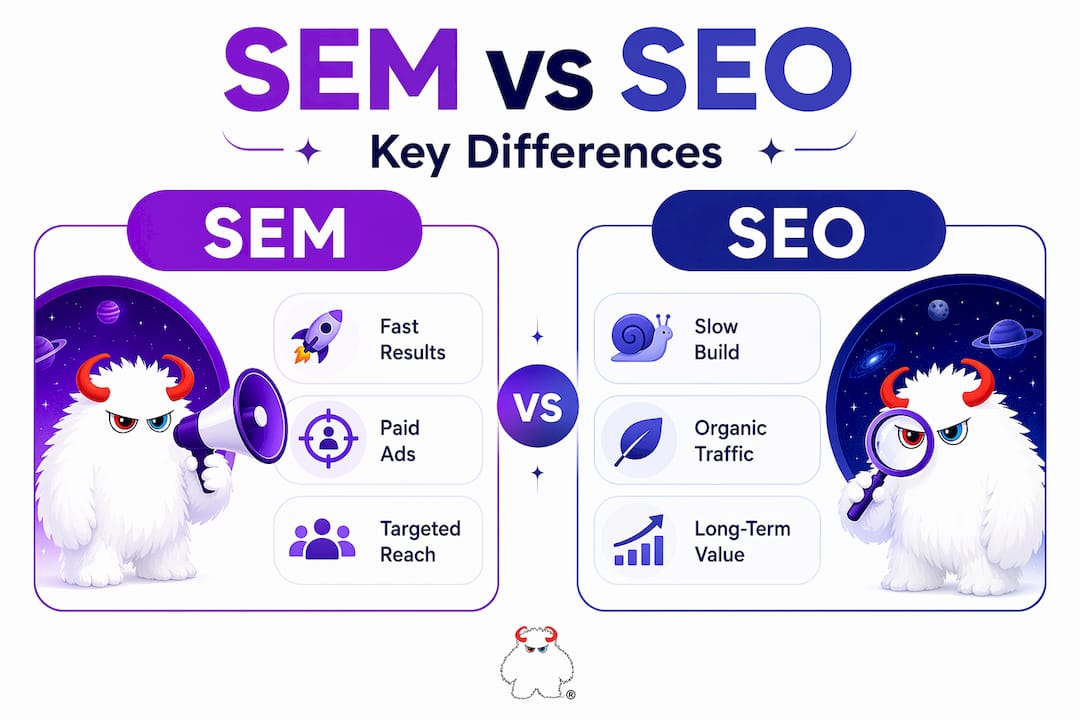
Understanding this comparison is not just academic. It tells you exactly when to deploy each channel and how to allocate budget intelligently across both.
SEM campaigns are measurable and targeted by design. You can track impressions, clicks, cost per acquisition, and conversion rates in real time. That measurability is what separates SEM from most other marketing channels and what makes it central to any performance-driven strategy.
How SEM drives brand visibility and customer acquisition
The most underappreciated search engine marketing benefit is intent. When someone searches “accounting software for small business,” they are not browsing. They are actively solving a problem and often ready to buy. SEM positions your brand precisely at that moment. No other channel matches that degree of timing precision.
Xero, the cloud accounting platform, offers one of the clearest illustrations of the impact of SEM on sales at scale. Xero reports 42% growth in paying subscribers linked directly to its SEM campaigns, with early-stage discovery campaigns accounting for half of all SEM-driven acquisitions. That last point deserves attention. Half of their paid search conversions came from users who were not yet searching with transaction intent. They were in discovery mode, exploring the problem space, and Xero’s SEM system captured them early.

This challenges the assumption that paid search only works for bottom-of-funnel, high-intent keywords. Discovery campaigns allow brands to influence buyers before purchase intent fully crystallizes, which means SEM brand visibility extends well beyond “buy now” queries. It shapes awareness and primes audiences for conversion later, often through both paid and organic touchpoints.
Pro Tip: Map your SEM campaigns to funnel stages explicitly. Run discovery-focused campaigns for awareness queries and conversion-focused campaigns for high-intent keywords. Measure each stage separately so you can optimize budget allocation based on actual acquisition contribution, not just last-click data.
Quality Score directly impacts ad ranking and cost per click. A higher Quality Score means lower CPC and better placement, even against competitors with larger budgets. Businesses that ignore Quality Score and focus only on bids consistently overpay for lower positions. That is a revenue leak most companies never identify because it hides inside their ad platform dashboard.
Optimizing SEM campaigns: strategies and best practices
Effective SEM is not set up once and forgotten. SEM requires continuous budget management and optimization to sustain visibility and results. Here is the execution sequence that produces outcomes:
- Define measurable goals. Revenue targets, cost per acquisition thresholds, and conversion volume targets must be set before a single dollar is spent. Campaigns without defined success metrics produce data, not decisions.
- Build audience and keyword frameworks. Segment keywords by intent stage: informational, navigational, and transactional. Use match types strategically. Broad match captures volume; exact match controls spend efficiency.
- Write ads that match the keyword’s promise. Ad copy must reflect the specific query it targets. Generic headlines create friction. Specific headlines build relevance, which improves Quality Score and click-through rate.
- Align landing pages with ad messaging. This is where most SEM spend is wasted. Landing page relevance and user experience are key Quality Score factors that directly determine whether your ad performs or drains budget. A landing page about your full product suite will not convert a user who clicked an ad about a specific feature.
- Set bids and budget by campaign priority. Allocate more to high-converting campaigns. Use automated bidding strategies once you have sufficient conversion data, typically 30 to 50 conversions per month per campaign.
- Monitor, test, and optimize weekly. Pause underperforming keywords. Test ad copy variations. Adjust bids by device, location, and time of day based on actual conversion data.
Pro Tip: Never measure SEM success by clicks alone. Map campaigns to qualified conversion events like form fills, demo requests, or purchases. Clicks that don’t convert are just a cost. Conversion-mapped campaigns generate the data you need to actually grow.
One often-overlooked pitfall: stopping SEM spend halts visibility immediately. Unlike organic content, there is no residual benefit. Budget continuity is a structural requirement for any business using paid search as a primary acquisition channel. Plan campaigns with that constraint in mind, especially around seasonal demand cycles or product launches.
Integrating SEM with your digital marketing infrastructure
SEM does not operate in isolation. Its full value emerges when it functions as part of a coordinated digital marketing system rather than a standalone channel. The importance of SEM in digital marketing comes precisely from this integration capacity.
Here is how the two primary channels align in practice:
| Integration Factor | SEM Contribution | SEO Contribution |
|---|---|---|
| Immediate traffic | Delivers volume from day one | Builds gradually over time |
| Keyword intelligence | Reveals converting terms quickly | Confirms organic ranking potential |
| Content signals | Tests messaging before investing in content | Provides long-term authority for those same topics |
| Budget reallocation | Scales up or down based on demand | Cannot be switched off or accelerated easily |
| Conversion data | Feeds CRM and retargeting systems | Supports brand trust and lower-funnel organic capture |
SEM and SEO complement each other in ways that reduce overall acquisition cost when managed together. SEM provides fast visibility for high-value queries while your SEO investment builds authority over time. When you rank organically for a keyword where you also run paid ads, click-through rates across both placements increase because your brand dominates more of the search results page.
Beyond the SEM versus SEO discussion, connecting your campaigns to conversion tracking infrastructure is non-negotiable. SEM campaigns that feed data into your CRM and lead recovery systems create closed-loop attribution, meaning you can trace a subscriber or customer back to the specific keyword, ad, and landing page that started the relationship. For more on how PPC supports long-term growth, that closed-loop view is what separates businesses that scale from those that guess. Monstrousmediagroup builds exactly this kind of infrastructure for its clients.
My take on SEM as revenue infrastructure
I have watched businesses approach SEM the same way they approach renting a billboard: pay for it, assume it works, stop when it feels expensive. That mental model produces mediocre results almost every time.
In my experience, the businesses that get the most out of paid search treat it as operational infrastructure, not an advertising expense. They obsess over Quality Score because they understand it is a multiplier on every dollar they spend. They align their landing pages tightly with their ad messaging because they know a mismatch costs them both money and conversions. And they never evaluate SEM in isolation. They look at the full path from query to closed revenue.
What most articles won’t tell you is that the biggest SEM leverage point is rarely the bid. It’s the landing page. I’ve seen campaigns cut their cost per acquisition by 40% not by adjusting bids at all, but by rewriting the landing page to directly answer the query that triggered the ad. That’s the kind of result that makes SEM a real business system rather than a budget line item.
The other thing I’d push back on: the idea that SEM and SEO compete for budget. They don’t. SEM tells you what converts today. SEO protects that position for free over time. Running both in parallel with shared data is how you build a search presence that’s both fast and durable.
— Vector
Build an SEM system that produces real outcomes

Most businesses running paid search are leaving significant revenue on the table. Not because the channel doesn’t work, but because the campaigns lack structure, the landing pages don’t match the ads, and there’s no closed-loop attribution connecting clicks to customers.
Monstrousmediagroup is a multi-award-winning SEM and digital marketing firm that builds systems designed to generate, capture, and close more revenue. From PPC campaign management to landing page optimization and full-stack digital marketing services, every engagement is built around measurable outcomes. No vanity metrics. No activity reports. If your current paid search program can’t tell you the exact cost per acquired customer or why Quality Scores are dragging down ad position, it’s time for a different approach. Explore how Monstrousmediagroup’s SEO and SEM services work together as a unified visibility system, and start turning search intent into revenue.
FAQ
What is the role of SEM in marketing?
SEM increases a brand’s search engine visibility through paid advertising and optimization techniques, targeting users at the moment of active search intent. Its core function is to drive qualified traffic that converts into customers.
How does SEM improve visibility faster than SEO?
SEM ads appear on search results pages within days of campaign launch because they operate through paid auctions rather than algorithm-based ranking. Organic SEO builds authority over months, making SEM the faster option for immediate visibility.
What is Quality Score and why does it matter?
Quality Score is a 1 to 10 rating Google assigns based on expected click-through rate, ad relevance, and landing page experience. A higher score lowers your cost per click and improves ad position, making it one of the most important levers in any paid search campaign.
Does SEM stop working when you stop spending?
Yes. Unlike SEO, which builds compounding organic presence over time, SEM visibility ends the moment your campaign budget is exhausted or paused. Budget continuity is a structural requirement for businesses relying on paid search for acquisition.
How do SEM and SEO work together?
SEM delivers immediate traffic while SEO builds sustained organic authority. Used together, they create overlapping search presence that increases overall click-through rates and lowers blended acquisition costs across both paid and organic channels.
Recommended
Hire the team to help you with your website, app, or other marketing needs.
We have a team of digital marketers who can help plan and bring to life all your digital marketing strategies. They can help with social media marketing, email marketing, and digital advertising!
CONTACT US
Comments