
 https://www.omahamediagroup.com/images/uploads/monster_gallery/Omaha-Media-Group-Black.jpg
admin
https://www.omahamediagroup.com/images/uploads/monster_gallery/Omaha-Media-Group-Black.jpg
admin
The Content Creation Process That Drives Real Revenue

TL;DR:
- Implementing a structured content creation system driven by documented strategies and automation significantly increases ROI and lead generation.
- Effective workflows incorporate seven quality checkpoints, clear roles, and regular audits, enabling consistent, high-quality content at scale.
Most businesses treat content creation as a creative exercise. They assign a writer, wait for a draft, approve it in a group email chain, and publish it whenever it’s ready. The result is inconsistent output, wasted budget, and content that generates traffic without generating revenue. A structured content creation process changes that equation entirely. Documented content strategies are 60% more effective and yield 3x more leads per dollar spent. That gap between top performers and everyone else isn’t talent. It’s infrastructure.
Table of Contents
- Key Takeaways
- What you need before starting the process
- The step-by-step content creation workflow
- Quality assurance and content governance
- Common pitfalls and how to avoid them
- Why systems beat creativity every time
- How Monstrousmediagroup builds your content engine
- FAQ
Key Takeaways
| Point | Details |
|---|---|
| Document your strategy first | A written content development strategy aligned to revenue goals is the foundation every other step depends on. |
| Standardize your briefs | Content briefs prevent scope creep, protect quality, and give writers clarity before a single word is drafted. |
| Use AI as a system layer | AI reduces content production costs significantly and handles QA tasks that slow human reviewers down. |
| Govern with defined roles | Clear ownership models like RACI prevent approval bottlenecks and the creative fatigue that kills campaigns. |
| Audit content every 90 days | Regular performance reviews and content refreshes maintain topical authority and protect long-term content ROI. |
What you need before starting the process
Skipping the foundation is where most content operations fail. Businesses jump into production without alignment on audience, goals, or governance. That produces volume without direction.
Document your strategy before you create anything
Content creation should be standardized through governance and automation to produce predictable quality. That standardization starts with a documented content development strategy tied directly to business objectives. This isn’t a mission statement. It’s a working document that defines your content goals, maps them to revenue outcomes, and specifies the audience segments each content type is built to serve.
Your content planning essentials include four key inputs:
- Audience personas with mapped user intent: Go beyond demographics. Define what questions your buyer is asking at each stage of the funnel and what content format best answers those questions.
- Measurable goals tied to lead generation: Every content type should have an assigned KPI. Blog posts might target organic sessions and form completions. Case studies target mid-funnel pipeline influence.
- Content inventory and gap analysis: Catalog what you have, assess what’s performing, and identify the topics and formats missing from your current library.
- Role definitions and governance structures: Decide who creates, who reviews, who approves, and who publishes. Ambiguity here is where timelines collapse.
Pro Tip: Before assigning any content, run a gap analysis against your top ten revenue-generating keywords. The topics you haven’t covered yet are your fastest path to additional organic lead flow.
Tools and systems you actually need
| Tool Category | Primary Function | What to Look For |
|---|---|---|
| Editorial calendar | Publishing cadence management | Real-time visibility across the team |
| Content brief template | Scope and direction alignment | SEO targets, audience, format, word count |
| AI drafting tool | Efficiency in first-draft production | Brand voice training capability |
| CMS integration | Publishing and metadata control | SEO plugin compatibility |
| QA and style checker | Consistency enforcement | Brand voice and factual accuracy flags |
AI adoption in content creation reduces production costs by up to 68% and increases output efficiency. That’s not a tool recommendation. That’s a competitive reality. By 2026, 80% of B2B marketers use AI specifically for content creation. If you’re building your workflow without it, you’re building at a structural disadvantage.
The step-by-step content creation workflow
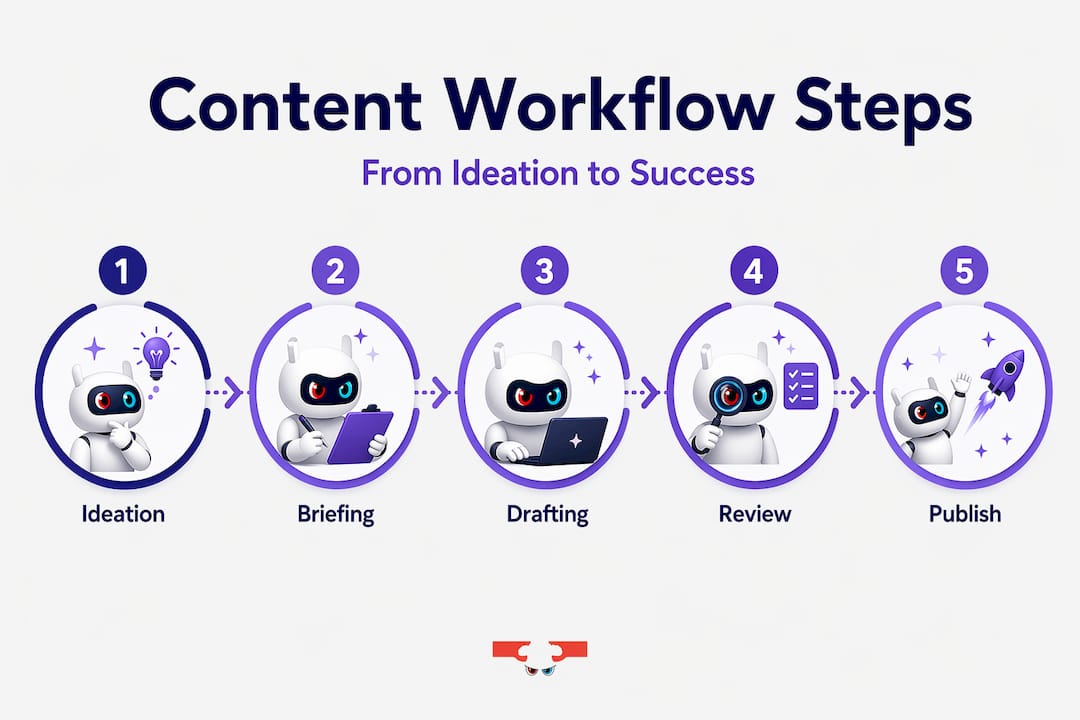
A scalable effective content workflow has seven stages. Each one is a checkpoint, not just a task.
-
Intent-driven ideation. Start with data, not opinions. Use keyword research, sales call transcripts, and support ticket themes to identify what your audience is actually asking. Pair this with search intent mapping so each topic is assigned a clear funnel position before it enters the queue.
-
Content briefing. Every piece gets a brief before a writer touches it. The brief includes the primary keyword, secondary keywords, intended audience segment, format, target word count, required sources, and the specific outcome the piece needs to achieve. This step eliminates the back-and-forth that kills timelines.
-
AI-assisted drafting. Writers use AI tools to produce structured first drafts based on the approved brief. The AI draft is not the final draft. It’s a scaffolded starting point that accelerates production without replacing the human judgment required for voice, narrative, and nuance.
-
Editorial review and quality gate one. A human editor reviews the draft for accuracy, clarity, tone, and adherence to brand voice. This is not a light proofread. It’s a structural assessment. Content that doesn’t meet the defined quality standard goes back for revision, not forward to approval.
-
SEO optimization pass. Embed SEO and content optimization directly into creation rather than treating it as a final step. This includes title tag and meta description writing, internal linking, header structure, image alt text, and schema markup where applicable. Optimizing visual assets for SEO is part of this pass, not an afterthought.
-
CMS upload and scheduling. Content enters the CMS with all metadata, categories, and scheduling parameters set. Publishing follows the editorial calendar. Ad hoc publishing destroys cadence and makes performance data impossible to interpret.
-
Cross-channel distribution. After publication, content is distributed across relevant channels with format-specific adaptations. An article becomes a LinkedIn post summary, an email newsletter teaser, and a sales enablement resource. The message stays consistent. The format shifts to match the channel. Brand voice consistency is non-negotiable across every distribution point.
Pro Tip: Treat your content brief as a legal contract between the requester and the creator. Once both parties sign off on scope, changes require a formal revision request. This single practice cuts revision cycles in half.
| Workflow Stage | AI Role | Human Role |
|---|---|---|
| Ideation | Keyword clustering, trend surfacing | Strategic prioritization and intent mapping |
| Briefing | Template population, SEO data pull | Audience alignment and goal assignment |
| Drafting | First draft generation | Voice, narrative, and insight layering |
| QA | Brand voice and factual flagging | Editorial judgment and final approval |
| Distribution | Format repurposing | Channel strategy and timing decisions |
Quality assurance and content governance
Publishing consistently is easy. Maintaining quality at scale is where most content programs break. Creative fatigue and approval chaos kill content performance. Clear role definition is the fix.

A RACI model applied to content operations assigns Responsible, Accountable, Consulted, and Informed roles to every content type. The writer is Responsible. The content director is Accountable. Subject matter experts are Consulted. The sales team is Informed after publication. With that structure in place, no piece waits in a three-day email thread for approvals.
Quality gates need to be defined per content type and risk level. A product page carries higher brand risk than a social caption. It needs more review stages. A blog post optimized for informational keywords needs one editorial pass and one SEO pass. Match the governance intensity to the stakes.
AI-powered automated QA checks factual accuracy and brand voice consistency before human editing, which reduces review workload significantly. High-performing content teams use AI classifiers to flag style violations and unverified claims before a human editor ever opens the draft. That keeps your best editorial talent focused on judgment calls, not catching typos.
Set a 90-day content audit cycle as a fixed calendar event. Regular 90-day content reviews improve citation rates by 67% in AI-driven search environments. Content that ranked well six months ago may be losing ground to fresher sources. The audit identifies what needs refreshing, what needs redirecting, and what needs to be retired entirely.
Pro Tip: Build a “content retirement protocol” into your governance model. Pages that receive fewer than 50 monthly visits and no inbound links for six consecutive months should either be updated with fresh data or redirected to a stronger asset. Dead content drags domain authority down.
Key metrics to track across your content program:
- Organic sessions and ranking positions per content piece
- Lead form completions and attributed pipeline by content type
- Content production velocity and time-to-publish against target
- Revision request rate as a measure of brief quality
- Content freshness score across your top 50 pages
Common pitfalls and how to avoid them
Most content workflow failures are predictable. Here’s where teams consistently go wrong and what to do instead.
- Publishing without a calendar. Ad hoc scheduling makes it impossible to maintain cadence or draw reliable performance conclusions. Fix it with a 90-day editorial calendar reviewed and updated monthly.
- Over-relying on AI without human oversight. AI excels at drafting and QA, but AI-only content lacks the depth, experience, and brand specificity that earns authority. Every AI-generated draft needs human editorial judgment before it publishes.
- Measuring vanity metrics. Page views tell you what people looked at. Pipeline influence tells you what content actually drove revenue. Build your reporting around business impact, not impressions.
- Scaling output before systemizing process. Producing more content with a broken workflow produces more broken content. Fix the system first, then increase volume.
- Ignoring the hybrid team model. In-house teams achieve 85% better ROI than fully outsourced operations, but hybrid models offer the best combination of scale and consistency. A small in-house editorial core managing vetted external contributors beats a large, inconsistent freelance pool every time.
Pro Tip: If your revision request rate exceeds 30% of published drafts, the problem isn’t your writers. It’s your briefs. Audit your brief template and add more specificity to the audience, tone, and outcome sections.
Why systems beat creativity every time
I’ve worked with enough marketing teams to say this plainly: the organizations that treat content as a creative free-for-all never build anything durable. The ones that treat it like an operational system, with defined inputs, checkpoints, and feedback loops, consistently outperform.
What I’ve seen again and again is that good content is the product of a governed system with embedded standards and automated checkpoints. Creativity matters. But creativity without structure produces brilliant one-off pieces surrounded by months of mediocre output.
The minimum viable content operation isn’t complicated. You need an editorial calendar, a brief template, an AI drafting tool, one human editor, and a quality gate before anything publishes. That’s it. Start there. The average content marketing ROI is 300%, with top performers reaching 500% or more. But that ROI takes roughly 9.7 months of consistent execution to materialize. You don’t get there by publishing sporadically and hoping something lands.
My honest take is this: if your content program feels chaotic, the answer isn’t more content. It’s a better system. Build the infrastructure first. The output quality will follow automatically.
— Vector
How Monstrousmediagroup builds your content engine

Monstrousmediagroup builds revenue systems, not content calendars. If your content program is producing activity without producing leads, the problem is structural, and that’s exactly what Monstrousmediagroup fixes. Their SEO services position your content where buyers are already searching, connecting organic visibility directly to pipeline growth. Their email marketing solutions turn that traffic into captured leads with nurture sequences built around your content assets. And their marketing automation removes the manual handoffs that slow your team down, so content reaches the right audience at the right stage without requiring constant intervention. If you’re ready to turn your content creation process into a predictable revenue system, Monstrousmediagroup is the operator-level partner to build it with you.
FAQ
What is a content creation process?
A content creation process is a documented, repeatable workflow that takes content from ideation through publication and performance review. It includes strategy alignment, briefing, drafting, editorial review, SEO optimization, publishing, and distribution.
How many steps are in the content creation process?
Most effective content workflows include seven core steps: ideation, briefing, drafting, editorial review, SEO optimization, CMS publishing, and cross-channel distribution. Each step functions as a quality checkpoint.
Why does a documented content strategy matter?
Businesses with a documented content development strategy achieve 3x higher content marketing ROI than those operating without one. Documentation creates alignment, accountability, and measurable benchmarks across the team.
How does AI fit into the content creation workflow?
AI handles first-draft generation, keyword research, and automated quality checks. AI adoption reduces production costs by up to 68%, but human editorial judgment remains required for voice, accuracy, and strategic framing.
How often should you audit your content?
A 90-day content audit cycle is the recommended cadence. Structured 90-day review cycles improve citation rates by 67% and help organizations sustain topical authority as search environments evolve.
Recommended
Hire the team to help you with your website, app, or other marketing needs.
We have a team of digital marketers who can help plan and bring to life all your digital marketing strategies. They can help with social media marketing, email marketing, and digital advertising!
CONTACT US
Comments