
 https://www.omahamediagroup.com/images/uploads/monster_gallery/Omaha-Media-Group-Black.jpg
admin
https://www.omahamediagroup.com/images/uploads/monster_gallery/Omaha-Media-Group-Black.jpg
admin
Sustainable business growth: proven strategies guide

TL;DR:
- Sustainable growth requires clarity on core customer, offer, and channel strategies.
- Building a second growth engine and automating processes supports scalable expansion.
- Tracking key metrics like revenue, CAC, retention, and margins ensures effective growth management.
Scaling a mid-sized company is one of the most disorienting experiences a business leader can face. Revenue climbs, headcount grows, and suddenly the clarity that drove early success starts to blur. Growth muddles company strategy and pulls organizations into what strategists call ‘Porter’s trap,’ where chasing expansion erodes the competitive focus that made you successful in the first place. This guide cuts through that confusion. You’ll find a structured, step-by-step path to driving sustainable growth without layering on operational chaos, unnecessary headcount, or strategies that look good on paper but stall in execution.
Table of Contents
- Assessing your current growth strategy
- Preparing for scalable growth: Building the foundation
- Executing your growth plan: Step-by-step framework
- Measuring and troubleshooting growth: Avoiding common pitfalls
- The uncomfortable truth about business growth: Experience speaks
- Accelerate your business growth with expert solutions
- Frequently asked questions
Key Takeaways
| Point | Details |
|---|---|
| Strategy clarity is critical | Rapid growth without a clear strategy leads to confusion and stalled progress. |
| Build scalable systems | Establish a second growth engine and automate processes to enable sustainable expansion. |
| Act, measure, iterate | Execute stepwise growth plans, track key metrics, and adjust strategies for long-term success. |
| Avoid common pitfalls | Recognize signs of strategic confusion early and course-correct before complexity increases. |
Assessing your current growth strategy
Before you can fix a problem, you need to see it clearly. Most mid-sized companies don’t have a growth problem. They have a clarity problem disguised as a growth problem.
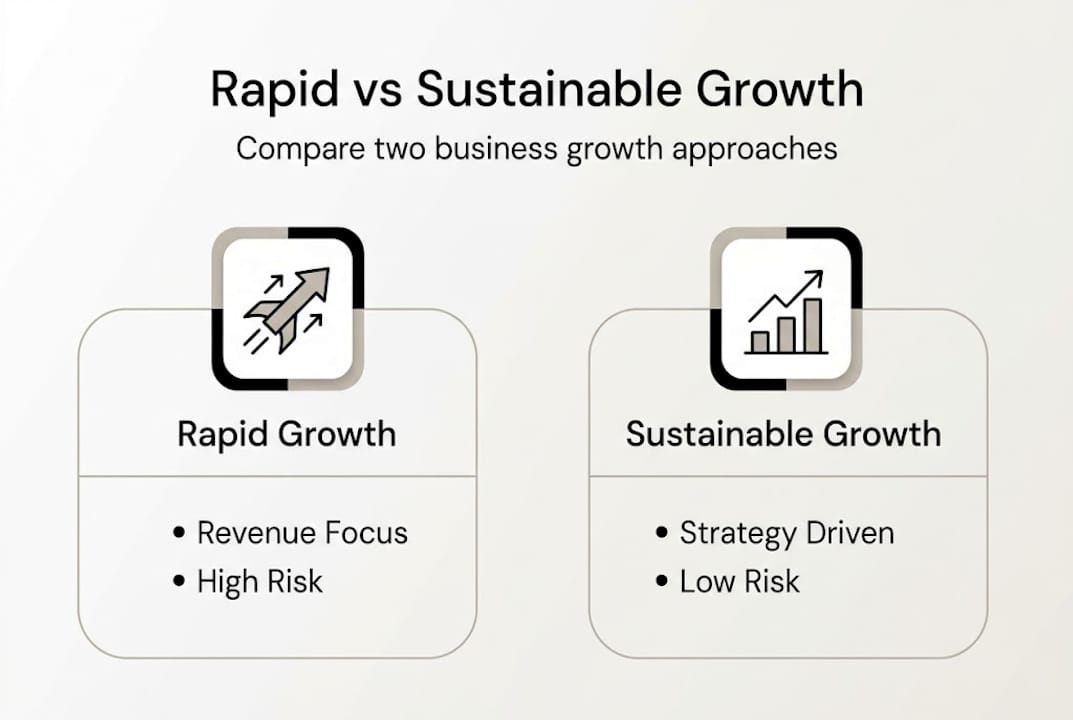
Rapid growth and sustainable growth are not the same thing. Rapid growth chases revenue at any cost. Sustainable growth builds systems that generate revenue repeatedly, without burning out your team or diluting your brand. Companies often confuse fast growth with smart growth, and that confusion is exactly how strategic muddling takes hold.
‘Porter’s trap’ is the point where a growing company tries to serve too many customer segments, enters too many markets, or adds too many products. The result is a business that’s busy but not focused. Recognizing it early is the difference between a temporary setback and a structural crisis.
Here’s a comparison of the three primary growth approaches mid-sized companies typically use:
| Growth approach | Speed | Risk level | Operational complexity |
|---|---|---|---|
| Organic | Slow to moderate | Low | Low |
| Inorganic (acquisitions) | Fast | High | Very high |
| Hybrid | Moderate | Medium | Medium |
For most mid-sized businesses, a hybrid approach offers the best balance. You grow your core through organic methods while using selective acquisitions or partnerships to accelerate specific capabilities. The HBR growth strategies special issue outlines how leading companies navigate this balance effectively.
Common mistakes mid-sized companies make during scaling:
- Expanding into new markets before mastering existing ones
- Hiring ahead of process, creating headcount without clear roles
- Ignoring margin erosion while celebrating top-line revenue gains
- Underinvesting in brand clarity as product lines multiply
- Skipping a transforming marketing strategy review during growth phases
If two or more of these resonate, your current strategy likely needs recalibration before you scale further. Companies operating in the advertising and marketing industry see this pattern constantly. Growth without strategic alignment is just expensive activity.
Preparing for scalable growth: Building the foundation
Once you’ve identified the gaps, the next phase is building the infrastructure that lets you grow without adding chaos. This is where most guides fall short. They tell you to scale. They rarely tell you what to build first.

The concept of a second growth engine is critical here. Your first growth engine is whatever got you to your current size, typically a core product, a key customer segment, or a dominant channel. A second growth engine is a parallel system that generates new revenue without cannibalizing or disrupting the first. Think of it as a backup power source that becomes your primary one over time.
Building that engine requires three foundational elements:
| Foundation element | What it means | Why it matters |
|---|---|---|
| Team capabilities | Right skills in the right roles | Prevents bottlenecks during expansion |
| Process automation | Systemizing repeatable tasks | Reduces manual load as volume grows |
| Resource allocation | Budgeting for growth, not just operations | Ensures capital flows to high-impact areas |
Team structure matters more than team size. A lean team with clear ownership and decision-making authority will outperform a large team with overlapping responsibilities every time. When you’re scaling, define who owns what before you hire anyone new.
Agile systems are not just for tech companies. Any mid-sized business can adopt sprint-based planning cycles, quarterly goal reviews, and rapid iteration processes. These systems allow you to move fast without losing control. Studying how established brands like Chase approach structured growth, as covered in this Chase marketing breakdown, reveals how disciplined systems enable massive scale.
Delegation is also non-negotiable. If every major decision runs through you, your growth ceiling is your own bandwidth. Build decision frameworks so your team can act without waiting.
Pro Tip: Automate the three most time-consuming repeatable tasks in your operations before you hire your next employee. Automation compounds. Headcount doesn’t.
For companies committed to sustainable business practices, building this foundation also means designing systems that are resource-efficient from the start, not retrofitting them later.
Executing your growth plan: Step-by-step framework
With your foundation in place, execution becomes a matter of sequencing. Here’s a proven framework for implementing your growth strategy without overwhelming your team.
-
Set goals with a clear outcome, not just a number. Revenue targets are useful, but they don’t tell your team what to do Monday morning. Define the specific outcome you want, such as 20% more qualified leads from organic search, and work backward to the tactics.
-
Optimize existing resources before adding new ones. Most companies have untapped capacity in their current channels and customer base. Maximizing what you already have is faster and cheaper than building something new.
-
Select channels based on where your buyers actually are. Not where you’re comfortable. Not where your competitors are. Study ThredUp’s digital strategy for a clear example of how channel selection drives outsized results when it’s aligned with buyer behavior.
-
Scale methods that have already proven themselves. Don’t scale experiments. Scale what works. If a specific campaign, product bundle, or customer segment is generating strong margins, put more resources behind it before testing something new.
-
Build a feedback loop into every initiative. Weekly check-ins, monthly performance reviews, and quarterly strategy audits are not bureaucracy. They’re the mechanism that keeps you from drifting. Channels like email marketing ROI are measurable precisely because feedback loops are built in.
Ranking your tactics by impact is straightforward. Score each initiative on three dimensions: revenue potential, speed to results, and resource requirement. High potential, fast results, low resource cost wins first. Low potential, slow results, high resource cost gets cut.
Optimal growth speed is not the fastest possible speed. It’s the speed at which your systems, team, and strategy stay aligned. Pushing past that threshold creates overload. Falling below it creates stagnation.
Pro Tip: Review your growth speed quarterly. If your team is consistently missing deadlines or quality is slipping, you’re moving too fast. Slow down, stabilize, then accelerate again.
Measuring and troubleshooting growth: Avoiding common pitfalls
Execution without measurement is guesswork. The companies that sustain growth over time are the ones that build measurement into the process from day one, not as an afterthought.
Key metrics for tracking growth performance:
- Revenue growth rate: Month-over-month and year-over-year
- Customer acquisition cost (CAC): How much you spend to win each new customer
- Customer retention rate: The percentage of customers who stay and buy again
- Gross profit margin: Revenue minus the direct cost of delivering your product or service
- Lead-to-close rate: How efficiently your pipeline converts
- Net Promoter Score (NPS): A direct signal of customer satisfaction and referral potential
Tracking these through a live dashboard, not a monthly spreadsheet, gives you the ability to catch problems early. Measuring marketing ROI is one of the clearest indicators of whether your growth spend is producing real outcomes or just activity.
Strategic confusion shows up in specific ways. Watch for these signals: your team can’t clearly explain who your best customer is, sales and marketing are targeting different segments, or your messaging has shifted three times in six months. These are not communication problems. They’re strategy problems.
Scaling without clear metrics is one of the most common reasons mid-sized companies stall. Without knowing what’s working, you can’t double down on it. Without knowing what’s failing, you can’t stop it. Scaling midsize businesses often fails precisely because leaders assume growth momentum will self-correct.
When you spot confusion, the fix is not a new strategy. It’s a return to clarity. Revisit your core customer, your core offer, and your core channel. Simplify before you expand again. The advertising and marketing metrics that matter most are the ones tied directly to revenue outcomes, not vanity numbers.
The uncomfortable truth about business growth: Experience speaks
Most growth guides focus on the mechanics. This one won’t end there.
After working with mid-sized companies across industries, the pattern is consistent: the businesses that grow sustainably are not the ones with the most aggressive strategies. They’re the ones with the most clarity. They know exactly who they serve, what problem they solve, and how they win. That clarity acts as a filter for every decision.
The uncomfortable truth is that optimal growth speed should be tailored to each business individually. There is no universal pace. What works for a SaaS company scaling from $5M to $50M will not work for a services firm doing the same. Copying someone else’s growth playbook without adapting it to your context is a fast path to Porter’s trap.
Ambition is not the problem. Ambition without a matching investment in client education and internal alignment is. The companies that stumble during scaling almost always skipped the foundation-building phase because growth felt urgent. Urgency is real. But building on a weak foundation doesn’t accelerate your timeline. It just makes the eventual correction more expensive.
Grow with intention. Measure what matters. Simplify before you scale.
Accelerate your business growth with expert solutions
Ready to put these strategies into action? Building a scalable growth system is faster and more effective when you have the right partner in your corner.
Monstrous Media Group works with mid-sized companies to build the systems that generate, capture, and close more revenue without adding operational complexity. From digital marketing services that drive qualified traffic to SEO expertise that compounds over time, and web development solutions that convert visitors into customers, every engagement is built around real outcomes. Not busywork. Not vanity metrics. If you’re serious about scaling sustainably, let’s build the system that makes it happen.
Frequently asked questions
What is ‘Porter’s trap’ and how does it impact business growth?
‘Porter’s trap’ is the risk of losing strategic clarity during rapid growth, where expanding into too many markets or segments erodes the competitive focus that drives long-term success. Growth muddling is the direct cause of this strategic confusion.
How can mid-sized companies scale without increasing operational complexity?
By building a second growth engine and automating key repeatable processes, companies can expand their revenue capacity without adding proportional headcount or management overhead. Sustainable scaling depends on systems, not just effort.
What’s the optimal growth speed for a mid-sized business?
The optimal growth speed is the pace at which your strategy, team, and systems stay aligned without overloading or stagnating. Optimal growth speed varies by business model, market conditions, and internal capacity.
Which growth metrics should I track for sustainable scaling?
Prioritize revenue growth rate, customer acquisition cost, retention rate, and gross profit margin as your core indicators. Scaling midsize businesses consistently fails when leaders track activity metrics instead of outcome metrics.
Recommended
Hire the team to help you with your website, app, or other marketing needs.
We have a team of digital marketers who can help plan and bring to life all your digital marketing strategies. They can help with social media marketing, email marketing, and digital advertising!
CONTACT US
Comments