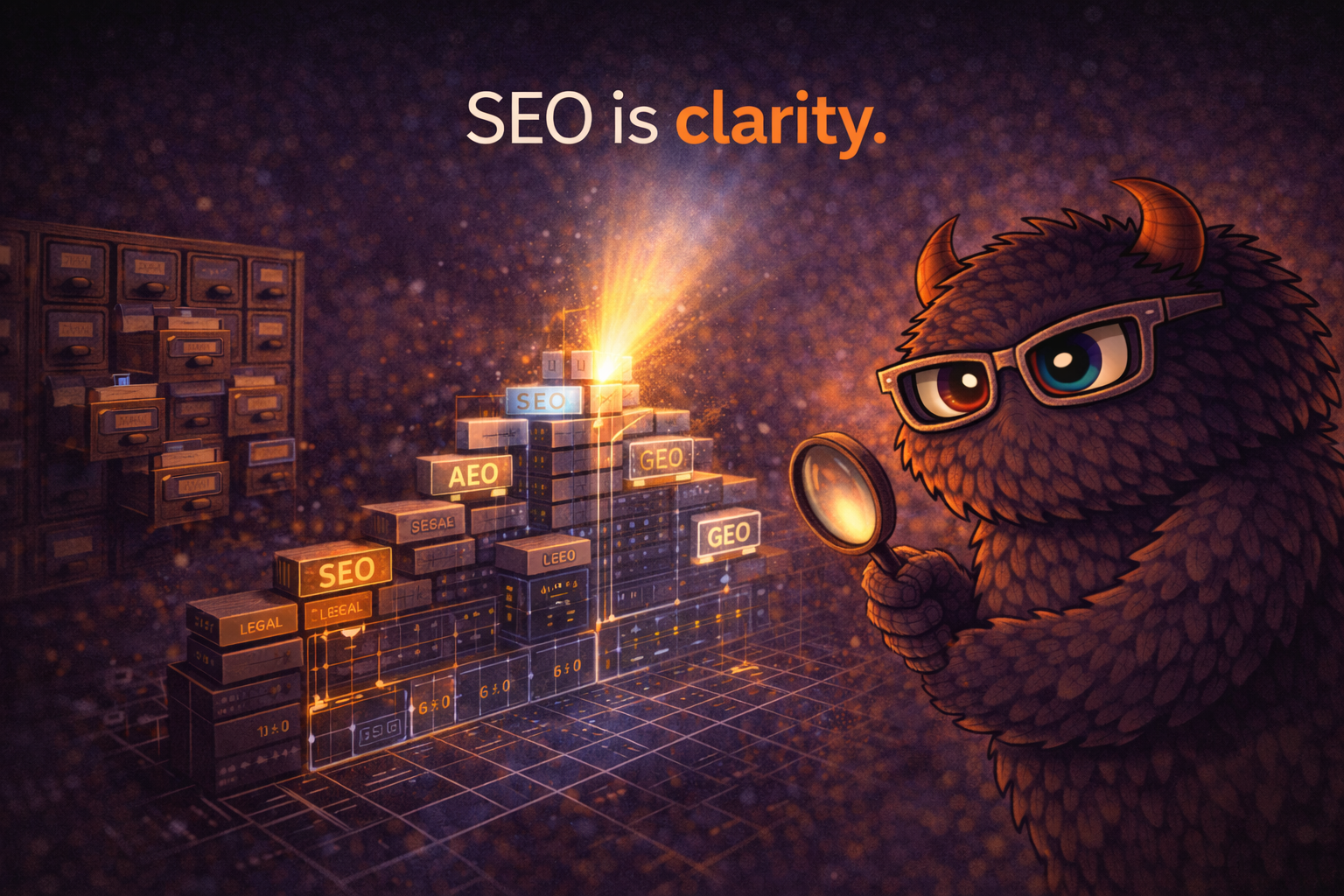
SEO Used to Be About Rankings. Now It’s About Clarity.

SEO Used to Be About Rankings. Now It’s About Clarity.

There was a time when SEO was simple. Pick keywords. Build backlinks. Climb the rankings. Position equaled power.

That era is over.

Search has not disappeared, but the way visibility is earned has fundamentally changed. AI systems now summarize, recommend, and synthesize information before users ever click a link. Rankings still matter, but they are no longer the entire game.

Clarity is.

The Shift From Position to Interpretation

Traditional SEO focused on being found. Modern discovery focuses on being understood.

Search engines and AI systems interpret structure, context, authority, and consistency. If your website lacks hierarchy, technical health, or topical depth, it becomes harder for machines to interpret confidently.

Interpretation now drives visibility.

This is where SEO, AEO, and GEO intersect.

SEO: The Structural Foundation

Search Engine Optimization remains the foundation layer.

Technical crawlability
Logical site architecture
Clear internal linking
Fast load times
Mobile responsiveness
Schema and structured data

Without these elements, your site becomes ambiguous. Ambiguity reduces trust and visibility.

SEO ensures your website can be crawled, indexed, and trusted. It is foundational infrastructure.

AEO: Optimization for Extractable Answers

Answer Engine Optimization focuses on structured clarity.

AI systems extract concise explanations, defined headings, and contextual authority. They prefer content that clearly answers specific questions.

Effective AEO requires:

Clear H1 and H2 hierarchy
Concise definitions
Logical formatting
Authoritative tone

AEO is not about keyword density. It is about making expertise machine-readable and easy to extract.

Disorganized content becomes difficult for AI systems to reference confidently.

GEO: Optimization for Generative Systems

Generative Engine Optimization extends beyond traditional search rankings.

Generative systems synthesize from multiple trusted sources. They evaluate consistency, depth, and authority across an entire domain.

GEO requires:

Coherent topic architecture
Interconnected blog clusters
Consistent terminology
Strong internal linking
Stable infrastructure

GEO rewards businesses that build systems of knowledge rather than isolated pages.

Why Most Websites Are Structurally Unprepared

Many websites were built around campaigns or visual design rather than structure.

Heavy page builders slow performance.
Blog categories lack cohesion.
Headings are misused.
Internal links are inconsistent.
Technical updates are neglected.

From a user perspective, the site may look fine. From a machine perspective, it lacks clarity.

When machines struggle to interpret structure, visibility becomes unstable.

The Integrated Visibility Loop

SEO provides crawlable structure.
AEO provides extractable clarity.
GEO provides durable authority within AI systems.

Together, they feed visibility into infrastructure. Infrastructure supports revenue capture. Revenue capture funds further authority building.

This loop must be engineered.

Infrastructure Determines Outcome

Even strong content fails without technical stability.

Slow sites reduce crawl efficiency.
Security gaps reduce trust.
Broken links reduce authority.
Inconsistent formatting reduces extractability.

Managed website infrastructure is inseparable from modern visibility strategy.

Technical health compounds over time. Instability compounds as well.

Clarity Compounds

As AI systems continue influencing discovery, structured websites gain advantage.

Those that chase tactics without improving architecture experience volatility.

Visibility is no longer about chasing rank. It is about building clarity into your digital foundation.

When structure aligns with how machines interpret information, visibility becomes durable.

Enhance Your Visibility

If your website was buiEnhance your Visibility. If your website was builtibility across search and AI systems.

We help businesses rebuild their digital infrastructure so SEO, AEO, and GEO operate as one cohesive system.

If that feels relevant, let’s talk.


Frequently Asked Questions

  1. What is the difference between SEO, AEO, and GEO?
  2. Is SEO still relevant in the age of AI search?
  3. How do AI systems decide which websites to reference?
  4. What is Answer Engine Optimization (AEO)?
  5. What is Generative Engine Optimization (GEO)?
  6. Why are most websites not optimized for AI search?
  7. How does website infrastructure affect SEO and AI visibility?
  8. How can a business improve visibility across search and AI platforms?

What is the difference between SEO, AEO, and GEO?

SEO (Search Engine Optimization) improves technical health, structure, and authority so your site can rank in traditional search engines. AEO (Answer Engine Optimization) structures content so AI systems can extract clear, direct answers. GEO (Generative Engine Optimization) builds topical authority and domain consistency so generative AI systems recognize your site as a trusted source. Together: SEO provides structure, AEO provides extractable clarity, and GEO provides durable authority across AI-driven discovery.

Back to questions

Is SEO still relevant in the age of AI search?

Yes. SEO is foundational. AI systems rely on structured, crawlable, technically sound websites. If your site cannot be indexed or interpreted clearly, it will not reliably appear in AI-generated answers. Modern SEO supports AI visibility rather than competing with it.

Back to questions

How do AI systems decide which websites to reference?

AI systems tend to favor sources with clear content hierarchy, strong definitions and headings, good technical health, topical authority across related pages, consistent terminology, and a logical internal linking structure. Sites that are coherent and well-structured are easier to interpret and more likely to be surfaced.

Back to questions

What is Answer Engine Optimization (AEO)?

AEO is the practice of structuring content so it directly answers specific user questions in a clear, extractable format. It typically includes well-defined headings, concise explanatory paragraphs, direct definitions, and clean formatting so AI systems can confidently summarize and cite the information.

Back to questions

What is Generative Engine Optimization (GEO)?

GEO focuses on building authority across topic clusters so AI models recognize your brand as credible within a subject area. GEO emphasizes consistent depth, strong internal linking, technical stability, and coherent site architecture. It rewards structured expertise rather than isolated keyword pages.

Back to questions

Why are most websites not optimized for AI search?

Many sites were built for design trends or short-term campaigns rather than structure. Common issues include inconsistent heading hierarchy, slow performance, weak internal linking, disconnected topics, and missing or inconsistent structured data. These reduce clarity for both search engines and AI systems.

Back to questions

How does website infrastructure affect SEO and AI visibility?

Infrastructure affects crawl efficiency, indexing accuracy, and trust signals. Speed, uptime, security, clean code, and reliable integrations all influence whether your content can be discovered and interpreted confidently. Unstable infrastructure can suppress visibility even when content quality is strong.

Back to questions

How can a business improve visibility across search and AI platforms?

Start with technical SEO health and site performance, then structure content with clear headings and direct answers. Build topic clusters, strengthen internal linking, implement structured data where appropriate, and keep infrastructure maintained. Visibility compounds when clarity and technical reliability work together.

Back to questions

Hire the team to help you with your website, app, or other marketing needs.

We have a team of digital marketers who can help plan and bring to life all your digital marketing strategies. They can help with social media marketing, email marketing, and digital advertising!

CONTACT US

Comments