Private AI Systems for Operations: The Next Operating Advantagehttps://pub-c065268fe1194494af1625a8b7104611.r2.dev/blog/Public_AI_tools_are_helpful.pngOmaha Media Grouphttps://www.omahamediagroup.com/images/uploads/monster_gallery/Omaha-Media-Group-Black.jpgadmin
Private AI Systems for Operations: The Next Operating Advantage
March 25, 2026
in 57 seconds
AI is no longer experimental.
It is operational.
Most businesses today use public AI tools for writing, research, or brainstorming. That is surface-level adoption. The real shift is happening beneath that layer.
Forward-thinking companies are deploying private AI systems inside their operations.
Not for novelty.
For leverage.
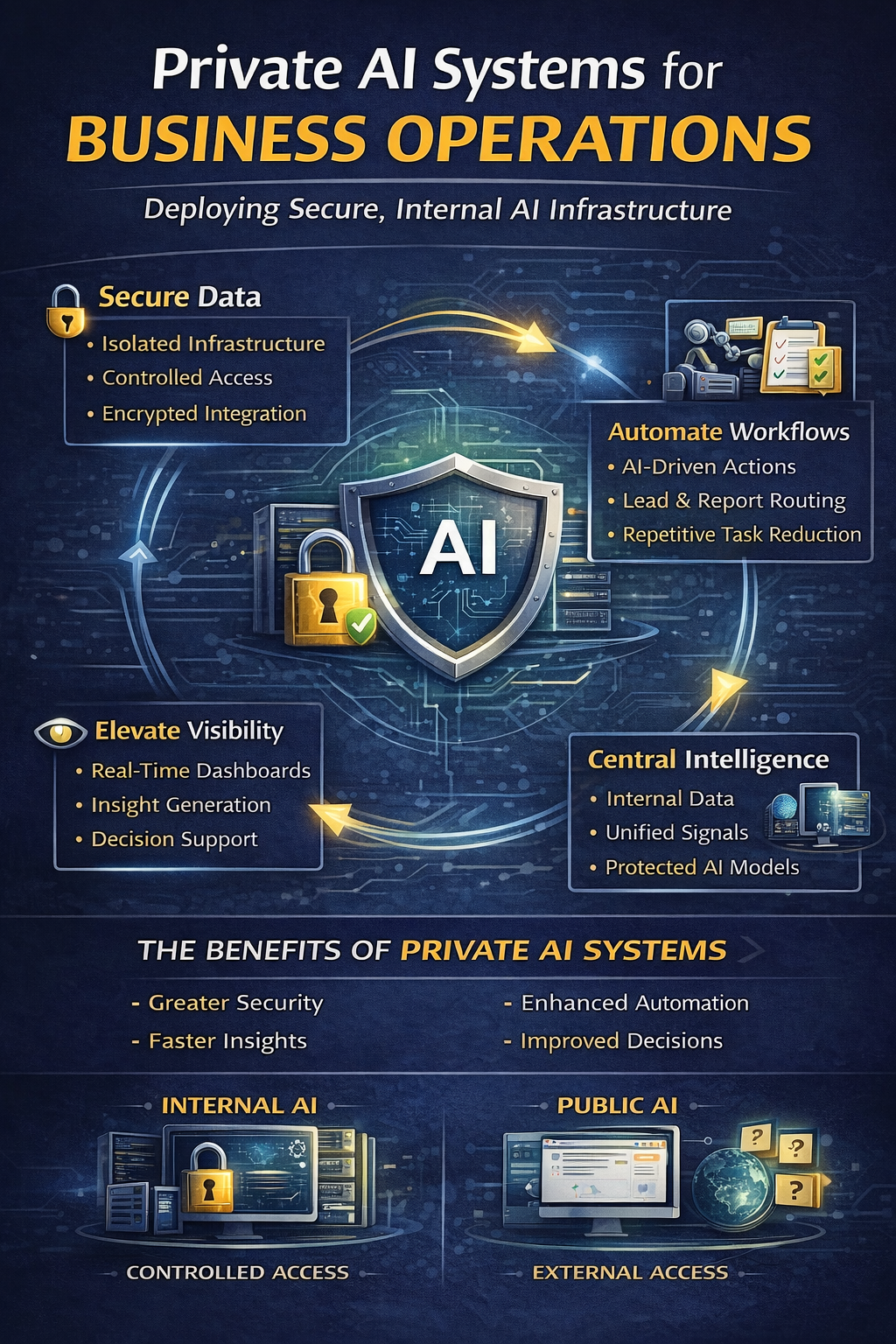
Public AI vs Private AI
Public AI tools are built for general use.
They are trained broadly.
They operate outside your infrastructure.
They process information through third-party systems.
Private AI systems operate differently.
They are deployed within your own environment.
They integrate with your internal data sources.
They operate under defined security and governance controls.
The difference is not intelligence.
The difference is control.
Why Operations Is the First AI Frontier
Operations is where friction hides.
Reporting delays.
Manual routing.
Data scattered across platforms.
Repeated administrative tasks.
Private AI systems reduce friction by:
Automating routine workflows.
Generating structured reports.
Surfacing key operational metrics.
Assisting decision-making with real-time data visibility.
AI becomes infrastructure, not experiment.
AI as an Operational Layer
Private AI systems can support:
Lead routing and qualification
Internal reporting dashboards
Customer service assistance
Project management oversight
Forecasting and performance tracking
Instead of adding more tools, private AI unifies signals.
Disconnected dashboards become centralized intelligence.
Security and Data Control
One of the most common executive concerns is data exposure.
Public AI platforms may store prompts or use submitted data to improve models, depending on configuration.
Private AI systems allow:
Controlled data access
Defined permissions
Isolated environments
Encrypted integrations
Security is not an afterthought. It is architectural.
Reducing Headcount Pressure Without Increasing Chaos
AI does not replace teams.
It removes repetitive strain.
Instead of hiring for coordination, aggregation, or reporting tasks, private AI systems can handle structured execution while teams focus on higher-leverage work.
This reduces operational drag without increasing management complexity.
AI + Business Intelligence
Business intelligence traditionally requires:
Manual data pulls
Spreadsheet consolidation
Dashboard configuration
Ongoing maintenance
Private AI systems can automate insight generation.
Instead of asking, “What happened last month?” executives can ask, “Why did close rates shift in Q1?” and receive structured summaries based on internal data.
Clarity improves speed of decision-making.
The Risk of Tool Fragmentation
Many organizations add AI tools without architectural planning.
The result is fragmentation.
Multiple subscriptions.
Disconnected outputs.
Inconsistent data.
Private AI infrastructure centralizes intelligence under one controlled framework.
That consolidation reduces noise.
From Experimentation to Infrastructure
The competitive advantage is not using AI.
It is structuring AI.
Private AI systems integrated into operations create durable leverage.
Less manual coordination.
Faster insight generation.
More consistent execution.
AI becomes part of the operating system of the business.
Executive Question
If your teams disappeared for a week, would your systems still move?
Private AI infrastructure exists to make operations less dependent on individual memory and more dependent on structured execution.
That is not futuristic.
It is operational discipline.
We'll Build You Your Own Internal AI System
If you are using public AI tools but not deploying private AI infrastructure inside your operations, you are at the beginning of the curve.
We design private AI systems that integrate with your workflows, protect your data, and reduce operational friction.
A private AI system is an AI platform deployed within a company’s controlled environment. It integrates with internal data sources and operates under defined security and governance controls rather than relying solely on public AI tools.
What is the difference between public AI tools and private AI systems?
Public AI tools are designed for general use and operate externally. Private AI systems are integrated into internal infrastructure, giving businesses greater control over data, security, and workflow integration.
AI can automate repetitive tasks, generate structured reports, route leads, monitor performance metrics, and surface operational insights. This reduces friction and improves decision-making speed.
Security depends on implementation. Private AI systems can be deployed with controlled access, encryption, and defined permissions to protect sensitive business data.
AI typically reduces repetitive coordination tasks rather than replacing strategic roles. It supports teams by automating low-leverage work and improving operational clarity.
AI systems can analyze internal data, identify patterns, generate summaries, and answer performance questions in real time. This accelerates executive insight and strategic decision-making.
Yes. AI can automate lead routing, reporting, scheduling, internal documentation, and other structured workflows when integrated properly into company systems.
Costs vary depending on scope, integrations, hosting environment, and complexity. Many companies find that private AI systems reduce operational overhead enough to justify the investment quickly.
How do private AI systems integrate with existing tools?
Private AI platforms connect through APIs to CRM systems, project management tools, analytics platforms, and internal databases to unify data and automate workflows.
Building a private AI system provides control, data protection, workflow integration, and long-term operational leverage that public tools alone cannot offer.
Hire the team to help you with your website, app, or other marketing needs.
We have a team of digital marketers who can help plan and bring to life all your digital marketing strategies. They can help with social media marketing, email marketing, and digital advertising!



Comments