
 https://www.omahamediagroup.com/images/uploads/monster_gallery/Omaha-Media-Group-Black.jpg
admin
https://www.omahamediagroup.com/images/uploads/monster_gallery/Omaha-Media-Group-Black.jpg
admin
What is a marketing funnel? Your guide to converting more leads

TL;DR:
- A marketing funnel is a dynamic system that reflects how real customers discover, evaluate, and decide to buy amid fragmented channels and AI influence.
- Optimizing each stage with targeted content, automation, and flexible strategies improves conversion rates, ROI, and predictable growth.
Most business owners think a marketing funnel is just a flowchart — push enough prospects in at the top, and revenue falls out at the bottom. That mental model is costing you money. The reality is that a marketing funnel is a living system, shaped by how real people discover, evaluate, and decide to buy in a world full of competing signals, AI-powered recommendations, and fragmented attention. Understanding what that system actually looks like, and how each stage works, is the difference between a pipeline that leaks revenue and one that consistently converts.
Table of Contents
- What is a marketing funnel?
- Key stages of the marketing funnel
- How marketing funnels drive growth and revenue
- Modern challenges: Why marketing funnels are evolving
- The uncomfortable truth: Why funnels alone aren’t enough in 2026
- Get expert help building your digital funnels
- Frequently asked questions
Key Takeaways
| Point | Details |
|---|---|
| Funnel is a journey | A marketing funnel visually maps each step from first interest to final sale for your customers. |
| Stages drive conversion | Understanding and optimizing each funnel stage can boost your conversions and revenue. |
| Modern funnels evolve | AI and shifting buyer behaviors mean today’s funnels must be flexible, not strictly linear. |
| Automation is key | Automation tools help you scale, personalize, and optimize every part of your marketing funnel. |
What is a marketing funnel?
A marketing funnel is a visual model of the customer journey, mapping the steps a prospect takes from first hearing about your business all the way to making a purchase. Think of it less like a straight road and more like a narrowing river: many people enter at the wide top, and a smaller, more qualified group exits at the bottom as paying customers. The funnel exists to help you understand where people are in their decision process and what they need at each point.
At its core, the traditional funnel moves through three primary stages:
- Awareness: The prospect learns your brand exists. Their pain is real, but the solution is still fuzzy. Your job is visibility, not the sales pitch.
- Consideration: They’re actively comparing options. Your digital marketing strategies must deliver credibility and differentiation here, not just reach.
- Conversion: The prospect is ready to decide. Friction removal, strong calls-to-action, and trust signals close the gap.
Here’s how the core stages stack up against the actions and key performance indicators (KPIs) that matter at each level:
| Funnel stage | Primary action focus | Core KPIs |
|---|---|---|
| Awareness | Brand exposure and reach | Impressions, traffic, new visitors |
| Consideration | Engagement and education | Time on page, email opens, return visits |
| Conversion | Decision and purchase | Lead-to-close rate, cost per acquisition |
| Retention | Loyalty and repeat buying | Customer lifetime value, churn rate |
Notice that retention is included. Many companies stop at conversion and ignore the bottom of the funnel entirely, which is one of the most common and expensive mistakes in growth marketing.
“The classic funnel framing is increasingly challenged because attribution and buyer behavior are multi-touch and nonlinear, and AI-mediated discovery is shifting optimization away from predictable stage progression.”
Understanding this reality is what separates forward-thinking marketers from those still chasing a strategy built for a pre-digital era. To see what marketing funnel success looks like in practice, it helps to study brands that have mastered the integration of awareness through retention.
Key stages of the marketing funnel
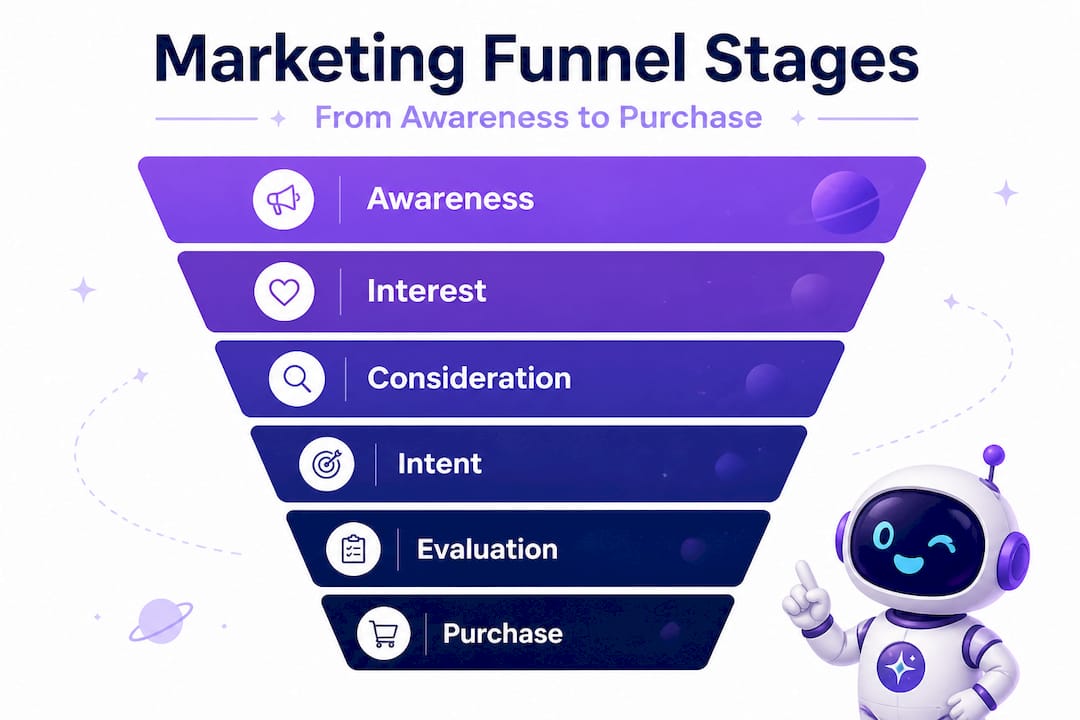
With the basics established, we can dive deeper into the individual stages and how each moves a prospect closer to becoming a customer. The traditional six-stage model gives marketers a practical lens for diagnosing where leads are dropping off and why.
1. Awareness is where your audience first encounters your brand, often through organic search, social media, paid ads, or word-of-mouth. At this stage, people are not shopping. They’re noticing a problem. Your content should reflect that context, prioritizing education over promotion.
2. Interest follows when a prospect starts paying attention. They might subscribe to your newsletter, follow your social accounts, or read several blog posts in one session. This is a signal that they want more.
3. Consideration is where things get competitive. The prospect is comparing you with alternatives. Case studies, comparison guides, webinars, and detailed product pages do heavy lifting here. Targeted content creation at this stage can be the deciding factor in whether they keep you in the running.
4. Intent signals that the prospect is leaning toward a purchase. They might request a demo, add something to a cart, or contact your sales team. This is a warm signal, and speed matters.
5. Evaluation is the final comparison. The prospect may revisit your pricing page, read reviews, or ask detailed questions. Reducing risk through testimonials, guarantees, and transparent pricing can tip the balance.
6. Purchase is the conversion event, but it’s not the finish line. Onboarding, follow-up, and the post-purchase experience determine whether this customer returns or churns.
| Funnel stage | Best tactics | Recommended tools |
|---|---|---|
| Awareness | SEO, paid social, PR | Google Ads, Meta Ads, blog content |
| Interest | Email capture, lead magnets | ConvertKit, HubSpot, OptinMonster |
| Consideration | Case studies, webinars, comparison pages | Zoom, Loom, landing page builders |
| Intent | Free trials, demos, retargeting | Retargeting ads, CRM follow-ups |
| Evaluation | Reviews, guarantees, live chat | Trustpilot, Intercom, Drift |
| Purchase | Checkout optimization, urgency offers | Shopify, Stripe, sales dialers |
Moving leads from one stage to the next isn’t automatic. Here’s how to do it systematically:
- Map every piece of content you have to a funnel stage. Gaps in your content map are gaps in your conversion rate.
- Score leads based on behavior, not just demographics. Someone who visits your pricing page three times is further along than someone who opened one email.
- Set up automated triggers that fire when a lead takes a specific action, like downloading a guide or revisiting a product page.
- Review stage-to-stage conversion rates weekly. A sharp drop between interest and consideration often points to weak nurturing content or misaligned messaging.
- Train your sales team to recognize funnel stage signals in their conversations. A lead in the evaluation stage needs different messaging than one in the awareness stage.
Note that classic funnel stages are being reimagined in light of digital and AI-powered interactions, meaning rigid stage definitions may need to flex based on how your specific audience actually behaves.
Pro Tip: Create a “stage-appropriate content library” by organizing your assets into three buckets: top-of-funnel (problem-aware content), middle-of-funnel (solution-aware content), and bottom-of-funnel (decision-ready content). Match every campaign to the right bucket and you will immediately see more relevant engagement.

How marketing funnels drive growth and revenue
After understanding the mechanics of each funnel stage, here’s why the funnel matters for real business growth. Managing a funnel is not an abstract marketing exercise. It directly impacts your bottom line in measurable, repeatable ways.
Five direct business benefits of an optimized funnel:
- Higher conversion rates: When messaging matches where a prospect is in their journey, it resonates. Mismatched messaging, like pushing a sale to someone in the awareness stage, burns opportunity.
- Better marketing ROI: You stop spending money on tactics that don’t align with where your audience is. Budget follows the data.
- Predictable revenue: A well-instrumented funnel lets you forecast. If you know your stage-to-stage conversion rates, you can calculate how many leads at the top eventually produce revenue at the bottom.
- Shorter sales cycles: Nurturing leads with the right content at the right time moves them faster through consideration and evaluation, reducing the time your sales team spends on education.
- Clearer team alignment: Marketing and sales stop arguing over lead quality when there’s a shared funnel model everyone uses to define readiness.
To get those benefits, you need to actively analyze and optimize funnel performance. Here’s what that looks like in practice:
- Track drop-off points at each stage using your CRM and analytics tools.
- A/B test landing pages, email subject lines, and calls-to-action in the consideration and intent stages.
- Use heatmaps and session recordings to identify friction on key conversion pages.
- Monitor your lead-to-opportunity and opportunity-to-close ratios monthly.
- Audit your nurture sequences quarterly to remove outdated content.
Statistic callout: Marketing automation tools support different phases of the funnel and increase both efficiency and effectiveness, giving teams the ability to deliver personalized communication at scale without adding headcount.
Automation isn’t a replacement for strategy, it’s a multiplier of good strategy. If your funnel is leaking at the consideration stage, automating bad nurturing emails faster won’t fix the problem. But when your strategy is sound, email marketing automation can dramatically increase the speed and consistency with which you move leads through the funnel. Automated drip sequences, behavior-triggered follow-ups, and personalized recommendations all reduce the manual effort required to maintain funnel momentum.
Pro Tip: Segment your leads by behavior, not just by list source. A lead who visited your pricing page twice in one week is in a fundamentally different mindset than a lead who read a top-of-funnel blog post. Treat them differently and your marketing automation solutions will perform significantly better.
Modern challenges: Why marketing funnels are evolving
The classic marketing funnel still has real value as a planning framework. But is it the best way to drive sales in 2026? That depends on whether your funnel reflects how your buyers actually behave or how you wish they behaved.
The modern buyer’s journey is anything but linear. A prospect might discover you through a YouTube ad, ignore it, see a LinkedIn post from your CEO three weeks later, search your brand name on Google, read two reviews on a third-party site, and then convert via a retargeted Facebook ad. That’s five distinct touchpoints across four different platforms, none of which follow the classic awareness-to-purchase sequence.
Modern challenges that every marketer needs to address:
- Multi-touch attribution complexity: When a customer interacts with six touchpoints before converting, which one gets credit? Most businesses still rely on last-click attribution, which systematically undervalues the early funnel stages that created the opportunity.
- AI-mediated discovery: Algorithms on search, social, and recommendation engines are now heavily influencing what content buyers encounter and when. Your funnel strategy has to account for content formats and channels that AI systems favor.
- Personalization demands: Today’s buyers expect messaging tailored to their situation. Generic funnel content that treats everyone the same produces shrinking results.
- Cross-channel journey fragmentation: Buyers move between devices and platforms constantly. A funnel strategy that doesn’t account for this creates disconnected experiences that erode trust.
- Shortened attention windows: The average time a prospect will give a piece of content before bouncing has decreased. Every stage of your funnel needs to deliver value faster.
As research into evolving funnels makes clear, the classic funnel framing is outdated because attribution and behavior are increasingly multi-touch and AI-mediated, shifting optimization away from linear stage progression.
Adapting your approach means embracing flexible funnel frameworks that allow for nonlinear progression. It means investing in AI-driven funnel optimization tools that personalize content delivery based on real-time behavior. It also means staying current with AI and marketing innovation so your systems can respond to buyer signals faster than your competitors can.
The businesses winning in 2026 are not those with the most sophisticated funnel diagrams. They are the ones whose systems detect where a buyer actually is and respond appropriately, regardless of which stage that buyer “should” be in on paper.
The uncomfortable truth: Why funnels alone aren’t enough in 2026
Most marketing guides treat the funnel as the destination. Build it, fill it, and revenue follows. That’s a comfortable narrative, but it’s incomplete. Having worked with businesses across industries, the pattern is clear: the funnel is a tool, not a strategy. And tools without skilled operators produce weak results.
The conventional wisdom pushes marketers to squeeze every prospect through the same predefined path. But today’s buyer journey is individual. Two people at the “consideration” stage may have arrived through completely different channels, consumed entirely different content, and have entirely different objections. Treating them identically because they share a funnel stage label is a form of strategic laziness that manifests as poor conversion rates and wasted ad spend.
Here’s what most marketers get wrong about funnels:
- They optimize for stage completion rather than buyer readiness.
- They treat the funnel as a one-way street instead of a feedback loop.
- They measure vanity metrics like impressions and clicks rather than stage-to-stage conversion efficiency.
- They build funnels once and assume they will work indefinitely, ignoring how buyer behavior shifts seasonally and competitively.
- They rely on the funnel to do the work that only great product positioning and messaging can do.
The businesses that outperform in the current environment are those that recognize nonlinear customer journeys as the norm, not the exception, and build systems flexible enough to meet buyers where they actually are.
The solution is not to abandon the funnel. It’s to stop treating it as gospel. Use it as a diagnostic framework, not a deterministic assembly line. Layer in adaptive technology, behavioral data, and emerging digital marketing trends to create customer experiences that respond to real signals. When your funnel is flexible enough to account for how buyers actually behave, it stops leaking revenue and starts compounding it.
The funnel is a lens. What you see through it depends entirely on how clearly you’ve focused it on your actual customer, not your ideal version of one.
Get expert help building your digital funnels
Understanding the funnel is one thing. Building a system that consistently generates, captures, and closes revenue is another. Most businesses know their funnel has gaps. Few have the internal capacity and specialized expertise to close them without adding cost or confusion to their operations.
Monstrous Media Group builds revenue systems grounded in funnel strategy, not busywork. From digital marketing services that fill your pipeline with qualified leads, to marketing automation experts who ensure no lead falls through the cracks, every solution we deploy is tied to outcomes you can measure. We specialize in helping business owners and marketing executives translate funnel theory into real conversions, higher ROI, and predictable growth. If your funnel isn’t performing the way it should, let’s fix that.
Frequently asked questions
What is the main purpose of a marketing funnel?
The main purpose of a marketing funnel is to guide prospects step-by-step from their first point of awareness all the way through to purchase, maximizing conversions at each stage by delivering the right message at the right time.
How do AI and automation change the marketing funnel?
AI and automation make funnels more dynamic, enabling personalized follow-ups, behavioral triggers, and real-time analysis at scale. As noted by Monstrous Media Group’s automation research, these tools support different phases of the funnel to increase efficiency and effectiveness.
Are linear funnels still relevant for modern buyers?
Linear funnels remain a useful planning framework, but most buyers today take nonlinear, multi-channel paths to purchase, making flexible funnel models far more effective in practice.
What are the best ways to optimize a marketing funnel?
Track stage-to-stage conversion rates, segment leads by actual behavior rather than demographics, and use automation to increase effectiveness at each funnel stage while adapting your messaging to match where each lead actually is in their journey.
Recommended
- Leading Marketing Automation Solutions in Omaha, NE
- The benefits of marketing automation: How it saves time and money for companies
- From stale to stellar: Transforming your marketing strategy for success
- Digital Marketing Company in Omaha | Monstrous Media Group
- How to transform your website to generate more leads?
Hire the team to help you with your website, app, or other marketing needs.
We have a team of digital marketers who can help plan and bring to life all your digital marketing strategies. They can help with social media marketing, email marketing, and digital advertising!
CONTACT US
Comments