
 https://www.omahamediagroup.com/images/uploads/monster_gallery/Omaha-Media-Group-Black.jpg
admin
https://www.omahamediagroup.com/images/uploads/monster_gallery/Omaha-Media-Group-Black.jpg
admin
Inbound Marketing: Strategies for Growth and Engagement

TL;DR:
- Inbound marketing attracts customers through valuable content and permission-based engagement.
- It builds a continuous growth cycle of attracting, engaging, and delighting customers.
- Success is measured by metrics like conversion rates, cost per lead, and customer retention.
Traditional marketing campaigns burn through budgets interrupting people who never asked to hear from them. Cold calls, banner ads, unsolicited emails — these tactics are losing ground fast. The most effective brands today don’t chase customers; they attract them by delivering genuine value at every stage of the buyer’s journey. This guide breaks down what inbound marketing is, how its core phases work, which tactics produce real results, and how to measure success in terms that matter to your bottom line. Whether you’re refining an existing strategy or starting from scratch, what follows gives you a clear, actionable framework for growth.
Table of Contents
- What is inbound marketing?
- Core pillars: Attract, engage, and delight
- Essential tactics: Content, SEO, email & social media
- Popular inbound marketing tools and automation platforms
- Measuring inbound marketing ROI: Metrics that matter
- Why inbound marketing wins in the age of customer empowerment
- Take your inbound marketing further with expert solutions
- Frequently asked questions
Key Takeaways
| Point | Details |
|---|---|
| Inbound attracts, outbound interrupts | Inbound marketing draws customers by providing value, unlike traditional disruptive tactics. |
| Content and engagement are core | Effective inbound strategies rely on content, SEO, email, and social media working together. |
| Technology amplifies results | Automation and analytics tools help scale and measure inbound campaigns efficiently. |
| Track ROI with clear metrics | Monitor conversions, leads, and customer loyalty to measure inbound marketing success. |
| Success requires patience and consistency | Inbound marketing builds lasting growth, but results are strongest with ongoing commitment. |
What is inbound marketing?
Inbound marketing is a customer-centric approach that draws people toward your business through useful content, meaningful experiences, and honest relationship-building. Instead of broadcasting messages to a broad audience and hoping something sticks, inbound focuses on being present when your ideal customer is already looking for answers. It’s the difference between showing up at someone’s door uninvited and being the expert they call when they have a problem.
The contrast with outbound marketing is significant. Outbound tactics push messages outward — think television commercials, cold email blasts, paid display ads, and direct mail. These methods interrupt what people are already doing. Inbound, by contrast, is permission-based. The prospect chooses to engage. They found your blog post in a search result, signed up for your newsletter, or watched your video because it answered something they genuinely wanted to understand. That voluntary engagement produces warmer leads and stronger trust from the very first touchpoint.
| Feature | Inbound Marketing | Outbound Marketing |
|---|---|---|
| Approach | Attract and educate | Interrupt and broadcast |
| Audience targeting | Specific, intent-driven | Broad, demographic-based |
| Cost efficiency | Higher long-term ROI | Higher cost per lead |
| Trust factor | High (permission-based) | Lower (unsolicited) |
| Examples | Blog, SEO, email nurture | TV ads, cold calls, direct mail |
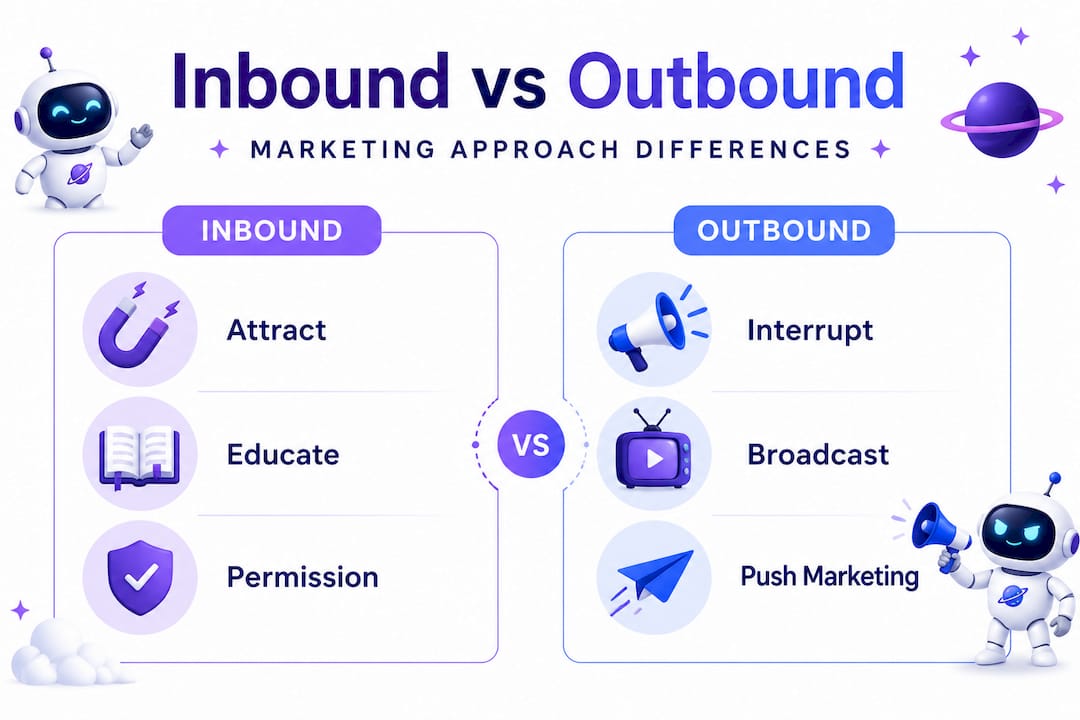
The foundation of inbound marketing rests on three core actions: attracting the right people, engaging them with relevant solutions, and delighting them so thoroughly that they become advocates for your brand. When you commit to improving your marketing strategy with an inbound mindset, you stop buying attention and start earning it.
Pro Tip: Don’t try to attract everyone. Narrow your focus to a well-defined buyer persona — a semi-fictional profile of your ideal customer based on real data — and your content will resonate far more powerfully with the people most likely to buy.
Core pillars: Attract, engage, and delight
The inbound methodology is built on three sequential phases that form a continuous growth cycle. Each phase serves a distinct purpose, but together they create a self-reinforcing engine that compounds over time. Understanding each stage clearly helps you build marketing systems that don’t just generate leads — they generate the right leads and keep them coming back.
1. Attract
The attract phase is about reaching people who are genuinely interested in what you offer, not just anyone with a pulse. You do this by creating and distributing content that directly addresses the questions, challenges, and goals of your target audience. Search engine optimization (SEO) plays a critical role here. When a CFO searches “how to reduce customer acquisition cost,” your well-optimized article on that topic becomes a magnet. Content marketing best practices show that businesses publishing consistent, valuable content attract significantly more traffic than those relying on paid channels alone.
2. Engage
Once someone discovers your brand, the engage phase begins. This is where you convert interest into action. Engagement tactics include lead capture forms, personalized email sequences, chatbots, webinars, and targeted calls to action. The goal is not to hard-sell but to nurture — to offer tools, resources, and conversations that help prospects move forward in their decision-making process. This stage is where trust deepens and leads qualify themselves. When someone downloads your industry report or attends your free workshop, they’re telling you they’re serious.

3. Delight
The delight phase is often underinvested. Most businesses pour energy into attracting and converting but neglect what happens after the sale. Delighting customers means exceeding their expectations through proactive support, personalized follow-ups, loyalty programs, and exclusive content. When you truly delight a customer, they don’t just come back — they bring others with them.
“The best marketing doesn’t feel like marketing.” — Tom Fishburne, Marketoonist. This perfectly captures the delight principle: when customers feel genuinely served, they promote your brand without being asked.
The cycle closes when delighted customers attract new prospects through referrals, reviews, and word-of-mouth, restarting the flywheel. This is the compounding advantage of inbound over outbound. Every satisfied customer becomes a marketing asset.
Essential tactics: Content, SEO, email & social media
The theory is clear. Now let’s get specific. Inbound marketing works because it relies on tactics that match how modern buyers actually behave. Buyers research independently, compare options across channels, and make decisions long before they ever speak to a sales rep. Here’s how each core tactic fits into that reality.
Content marketing
Blogs, ebooks, how-to videos, case studies, and infographics are the backbone of inbound. Each piece of content serves a purpose: building authority, answering questions, and moving buyers through your funnel. A well-written blog post on a niche topic can generate consistent organic traffic for years. A single ebook can capture hundreds of leads over months. Creative content strategies that align with your brand identity amplify recognition and trust simultaneously.
SEO
Search engine optimization ensures your content is discoverable by the right people at the right moment. This includes keyword research, on-page optimization, technical site health, and link building. When done well, SEO is one of the highest-return investments in your marketing portfolio because the traffic it generates is both targeted and largely free over time.
Email marketing
Email remains one of the most cost-effective channels in digital marketing. The key is segmentation and automation. Instead of blasting your entire list with the same message, smart email programs send the right message to the right segment based on behavior. The email marketing benefits are well-documented — personalized, automated email sequences consistently outperform generic broadcast campaigns on both open rates and conversions.
Social media
Social platforms extend your reach and create ongoing dialogue with your audience. The goal on social isn’t just posting content — it’s creating conversations. Polls, comments, live sessions, and community-building activities all fall under the inbound philosophy. These social media engagement tips show how consistent, audience-first engagement drives measurable brand loyalty.
| Tactic | Primary Goal | Inbound Stage | Performance Metric |
|---|---|---|---|
| Blog content | Drive organic traffic | Attract | Organic sessions, time on page |
| SEO | Improve discoverability | Attract | Keyword rankings, click-through rate |
| Email sequences | Nurture leads | Engage | Open rate, click rate, conversion |
| Social media | Build community | Attract & Delight | Engagement rate, shares |
| Lead magnets | Capture qualified leads | Engage | Download rate, lead volume |
Pro Tip: A content calendar tied to buyer journey stages keeps your team aligned and ensures you’re addressing the needs of prospects at every phase, not just the ones closest to buying.
Popular inbound marketing tools and automation platforms
Inbound marketing scales because of the technology behind it. Without the right tools, managing content distribution, lead nurturing, analytics, and customer communication across channels becomes unmanageable. The good news is that the software ecosystem supporting inbound has matured significantly, making powerful automation accessible even to mid-sized businesses.
Here are the core categories of tools every inbound marketing operation should consider:
- CRM platforms like HubSpot, Salesforce, or Zoho centralize your contact data, track interactions, and give your sales team full visibility into each lead’s journey.
- Email automation software like Klaviyo, Mailchimp, or ActiveCampaign enables triggered, personalized email sequences based on subscriber behavior. Leveraging email marketing automation can dramatically reduce manual workload while increasing message relevance.
- SEO and analytics tools like Semrush, Ahrefs, and Google Search Console help you track rankings, identify content gaps, and measure organic performance.
- Social media management platforms like Buffer or Sprout Social let you schedule content, monitor brand mentions, and analyze engagement across channels from a single dashboard.
- Marketing automation platforms go beyond email to manage multi-channel campaigns, lead scoring, and workflow automation. Reviewing the full range of marketing automation tools available reveals how much complexity can be systemized and simplified.
- Content management systems (CMS) like WordPress or Webflow make publishing and optimizing content straightforward, especially when integrated with SEO plugins and analytics tracking.
The right stack depends on your business size, budget, and growth stage. But the principle is consistent: the goal is less manual effort and more meaningful, personalized engagement at scale. A well-configured automation system doesn’t just save time — it ensures no lead falls through the cracks. Connecting your tools to a broader set of digital marketing solutions creates an integrated ecosystem where data flows seamlessly and decisions are grounded in evidence.
Pro Tip: Before investing in new tools, audit your current technology stack. Many businesses are paying for overlapping platforms with underused features. Simplify first, then expand.
Measuring inbound marketing ROI: Metrics that matter
Every dollar spent on marketing needs to justify itself. One of the most compelling arguments for inbound is that it’s measurable at every stage. Unlike a television spot or a print ad, inbound tactics generate trackable data that tells you exactly what’s working and what needs adjustment.
Here are the metrics that directly tie inbound activity to business outcomes:
-
Conversion rate measures the percentage of visitors who take a desired action, whether that’s filling out a form, downloading a resource, or making a purchase. This is the clearest signal of whether your content and calls to action are doing their job.
-
Cost per lead (CPL) calculates how much you’re spending to generate each new lead. As your inbound program matures and organic traffic grows, CPL typically decreases, making the channel increasingly efficient over time.
-
Customer acquisition cost (CAC) tracks the full expense of converting a prospect into a paying customer. Comparing CAC across channels reveals where inbound is outperforming paid campaigns.
-
Lead quality score isn’t just about volume — it’s about fit. Are the leads you’re generating actually converting to customers? High-quality inbound leads, because they engaged with your content voluntarily, tend to have higher close rates and shorter sales cycles.
-
Customer retention rate reflects how well your delight phase is performing. Retained customers cost significantly less to maintain than new customers cost to acquire, making retention a direct driver of profitability.
-
Net Promoter Score (NPS) measures customer loyalty and the likelihood of referrals. High NPS scores often correlate with strong inbound programs because satisfied customers become voluntary advocates.
Businesses with mature inbound marketing programs see cost-per-lead reductions of up to 62% compared to traditional outbound methods, according to industry benchmarks. That’s not a marginal difference — it’s a structural advantage that reshapes how efficiently your revenue engine operates.
Ongoing optimization is what separates average programs from exceptional ones. Monthly reviews of these metrics, combined with A/B testing of content formats and email subject lines, create a feedback loop that continuously improves performance over time.
Why inbound marketing wins in the age of customer empowerment
Here’s what most marketing articles won’t tell you: inbound marketing doesn’t fail because the tactics are wrong. It fails because organizations treat it like a campaign instead of a commitment. The companies that see the strongest long-term returns from inbound are the ones that build it into their culture, not just their marketing calendar.
Today’s buyers are more informed than at any point in history. They read reviews before clicking an ad. They consume six to ten pieces of content before talking to a sales rep. They ignore interruptions by default and gravitate toward brands that actually help them think through decisions. This is customer empowerment in action, and it fundamentally changes what effective marketing looks like.
Traditional campaigns treat customers as targets. Inbound marketing treats them as people. That shift in perspective — from persuasion to education, from selling to serving — is what drives the loyalty and advocacy that compound over years, not just quarters. Marketing transformation strategies that embrace this philosophy consistently produce stronger long-term results than those anchored in interruption-based thinking.
The uncomfortable truth is that inbound requires patience. The first three months won’t produce the same volume as a paid campaign. But by month six, the compounding effect kicks in. By year two, a well-executed inbound program often outperforms paid channels on both lead quality and cost efficiency. The businesses that commit to this approach stop renting attention and start owning it.
Take your inbound marketing further with expert solutions
Understanding inbound marketing is one thing. Building a system that consistently attracts, engages, and retains high-value customers is another. That’s where specialized expertise makes all the difference.
Monstrous Media Group helps business owners and marketing teams move from theory to execution with precision. Whether you need digital marketing expertise to architect a full inbound funnel, professional SEO services to drive qualified organic traffic, or email marketing solutions to automate and personalize your lead nurturing at scale, our team builds systems engineered for measurable outcomes. We don’t sell activities — we build growth engines. If you’re ready to stop chasing leads and start attracting them, let’s build something that works.
Frequently asked questions
How does inbound marketing differ from outbound marketing?
Inbound marketing attracts customers by providing value and building trust, while outbound marketing interrupts audiences with direct messages they didn’t ask for. The core difference is consent and timing.
What are some quick-win inbound tactics for small businesses?
Creating helpful blog content, optimizing your website for SEO, and starting an email newsletter are all effective quick-win inbound tactics that require low upfront investment and build equity over time.
Which tools help streamline inbound campaigns?
Marketing automation platforms, email marketing software, and CRM systems all help streamline and automate inbound campaigns, reducing manual effort while improving personalization and lead tracking.
How long does it take to see results from inbound marketing?
Most businesses begin seeing measurable results from inbound marketing within 3 to 6 months, though the compounding growth from content and SEO continues to accelerate well beyond that initial period.
How can I measure if my inbound marketing is successful?
Track key metrics like conversion rates, lead quality, cost per lead, and customer retention to gauge inbound marketing success and identify which channels and content types are driving real revenue impact.
Recommended
Hire the team to help you with your website, app, or other marketing needs.
We have a team of digital marketers who can help plan and bring to life all your digital marketing strategies. They can help with social media marketing, email marketing, and digital advertising!
CONTACT US
Comments