
 https://www.omahamediagroup.com/images/uploads/monster_gallery/Omaha-Media-Group-Black.jpg
admin
https://www.omahamediagroup.com/images/uploads/monster_gallery/Omaha-Media-Group-Black.jpg
admin
How to Track Marketing Outcomes for Better Results

TL;DR:
- Effective marketing measurement aligns KPIs directly with business revenue goals.
- Choosing the appropriate attribution model depends on sales cycle and data maturity.
- Regular data audits and continuous refinement improve marketing ROI and attribution accuracy.
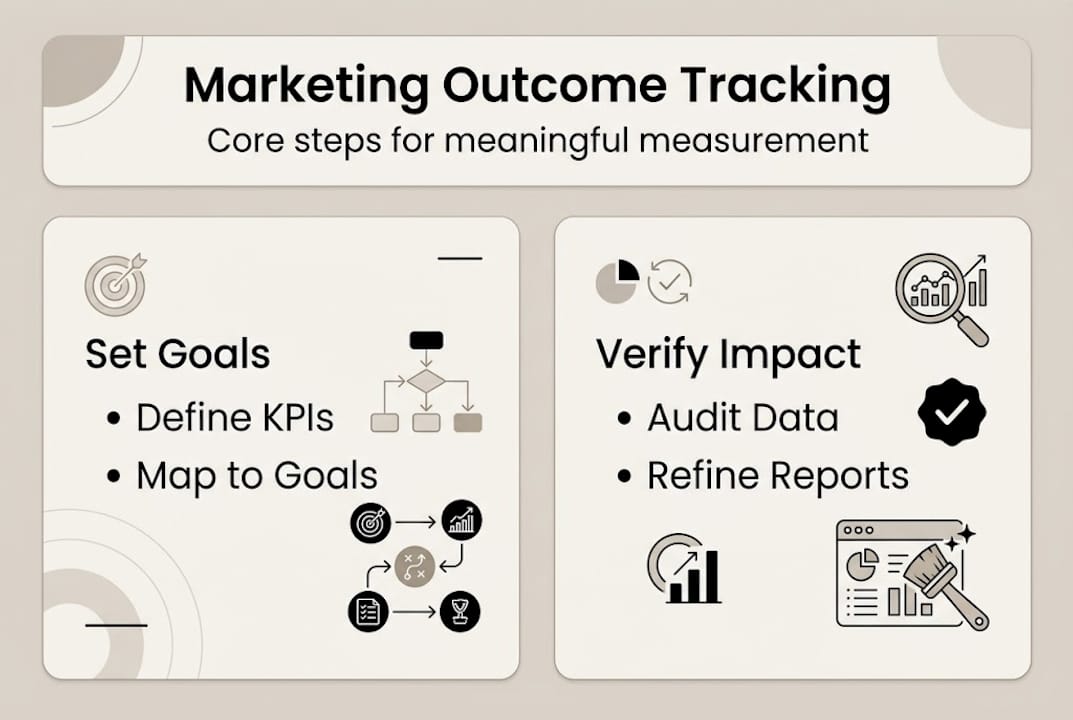
You’re spending real budget on marketing, but when leadership asks which campaigns actually drove revenue, the room goes quiet. That disconnect is more common than most executives admit. Tracking marketing effectiveness requires defining clear KPIs aligned with business goals, using attribution models to assign credit across touchpoints, and calculating ROI, ROMI, and customer acquisition cost. This guide walks you through each step: setting the right goals, selecting an attribution approach, unifying your data, and verifying that your marketing spend is generating real business outcomes.
Table of Contents
- Start with clear goals and KPIs
- Choose the right attribution model
- Unify and audit your marketing data
- Measure, refine, and verify your outcomes
- A smarter way to approach marketing measurement
- Unlock clearer marketing outcomes with expert support
- Frequently asked questions
Key Takeaways
| Point | Details |
|---|---|
| Set goals with KPIs | Clarity on KPIs aligned to business goals makes tracking meaningful and actionable. |
| Pick the right attribution model | Choose attribution that fits your business complexity to avoid misinterpreting results. |
| Unify and audit your data | Gathering all marketing data in one place ensures you get an accurate picture of outcomes. |
| Continuously refine strategy | Routine measurement and adjustments turn outcome tracking into better business results. |
Start with clear goals and KPIs
Every measurement problem in marketing starts the same way: teams track what’s easy, not what matters. Page views are easy. Revenue contribution is hard. If your KPIs don’t connect to business goals, you’re measuring motion, not progress.
The first step is aligning your marketing metrics to actual business objectives. Want to grow revenue by 20%? Then your marketing KPIs need to trace a direct line to qualified pipeline, conversion rates, and deal velocity, not just impressions or social engagement. This is the foundation that makes every other measurement effort worthwhile, and it’s how you transform your marketing strategy from a cost center into a growth engine.
The most widely used KPIs for tracking marketing outcomes include:
- Marketing Qualified Leads (MQLs): A priority for 29.6% of marketers; measures lead quality, not just volume
- Conversion rates: Tracked by 33.9% of marketers; shows how well campaigns move prospects through the funnel
- Return on Marketing Investment (ROMI): Cited by 31.1% of marketers; directly links spend to revenue
- Customer Acquisition Cost (CAC): Measures how efficiently you’re acquiring new customers relative to budget
Selecting the right KPIs means asking one question for each metric: “If this number improves, does the business make more money?” If the answer is unclear, the metric probably doesn’t belong in your core dashboard.
Benchmarks matter too. A conversion rate without context is just a number. Know your industry average, your own historical baseline, and your target. Revisit your KPIs quarterly. Markets shift, campaigns evolve, and a metric that mattered last year might mislead you today.
Statistic: Key methodologies for tracking marketing outcomes include defining clear KPIs aligned with business goals, using attribution models to assign credit across touchpoints, and calculating ROI, ROMI, and CAC.
Pro Tip: Build a single-page KPI scorecard that maps each marketing metric to a specific business goal. If a metric doesn’t appear on that scorecard, question whether it belongs in your reporting at all.
Choose the right attribution model
Once your KPIs are set, the next challenge is figuring out which marketing efforts deserve credit. A prospect might see your LinkedIn ad, read a blog post, open an email, and then convert after clicking a Google search result. Which touchpoint gets the win? That’s exactly the problem attribution models solve.
Different models distribute credit differently, and choosing the wrong one can seriously distort your picture of what’s working. Here’s a clear breakdown of the main attribution model options available:
| Model | How credit is assigned | Best for | Watch out for |
|---|---|---|---|
| First-click | 100% to first touchpoint | Brand awareness campaigns | Ignores nurture and closing touchpoints |
| Last-click | 100% to final touchpoint | Direct response; simple funnels | Undervalues top-of-funnel efforts |
| Linear | Equal credit across all touchpoints | Teams new to multi-touch | Can over-reward low-impact touches |
| Time-decay | More credit to recent touchpoints | Short sales cycles | Discounts early awareness efforts |
| Position-based (U-shaped) | 40% first, 40% last, 20% middle | Lead-gen focused businesses | Middle touchpoints get underweighted |
| W-shaped | Credit to first, lead creation, and opportunity creation | B2B with defined pipeline stages | Requires clean CRM data |
| Data-driven | ML-based; assigns credit algorithmically | High-volume, data-rich environments | Needs 300+ monthly conversions to work reliably |
For most mid-sized companies, the W-shaped model hits a practical sweet spot for B2B contexts. It recognizes the touchpoints that matter most in a complex buying cycle: initial contact, lead qualification, and opportunity creation. Pair it with PPC marketing results tracking and solid email channel tracking, and you get a much cleaner view of what’s driving pipeline.
Avoid overcomplicating attribution early. Data-driven models are powerful, but they require significant conversion volume to produce reliable outputs. Start with a model that matches your current data maturity, then upgrade as your capabilities grow.
Pro Tip: For B2B companies with sales cycles longer than 60 days, W-shaped attribution combined with CRM integration gives the most accurate picture of multi-touch influence across the full funnel.
Unify and audit your marketing data
Having chosen the right attribution model, you need a solid data foundation. Attribution is only as accurate as the data feeding it. If your channels aren’t talking to each other, your reporting is built on incomplete information.

Data silos are one of the most costly and overlooked problems in marketing measurement. When your CRM doesn’t sync with your ad platforms, and your email tool reports separately from your web analytics, you end up with duplicate lead counts, missed touchpoints, and gaps that make every report slightly wrong. As marketing attribution research confirms, cross-device tracking and privacy limitations compound these problems further, making first-party data and centralized tools essential.
Here’s how to conduct a basic audit of your marketing data stack:
- List every active marketing channel and the tool tracking it (paid search, email, social, organic, events)
- Identify where data lives for each channel and whether it feeds into a central dashboard or CRM
- Check for gaps: Are offline touchpoints captured? Is lead source data consistently tagged?
- Verify UTM parameter consistency across all campaigns so traffic is correctly categorized
- Test for duplicate records in your CRM; duplicate leads inflate conversion counts and distort CAC
- Assess privacy compliance: Confirm your tracking practices align with current data regulations
Centralized dashboards connected to your CRM are the most reliable fix. Marketing automation tools can bridge data between platforms, reducing manual reconciliation and giving your team a single source of truth.
| Common data problem | Impact on measurement | Recommended fix |
|---|---|---|
| Duplicate leads in CRM | Inflated MQL counts | Regular deduplication audits |
| Missing UTM parameters | Unattributed traffic spikes | UTM tagging standards and QA checks |
| Cross-device gaps | Broken customer journey view | First-party identity resolution |
| Offline touchpoints untracked | Incomplete attribution | Media mix modeling or CRM manual entry |
Pro Tip: Run a quarterly data audit as a standing agenda item for your marketing and ops teams. Catching errors early is far less expensive than rebuilding reports after a major campaign.
Measure, refine, and verify your outcomes
With unified and audited data, you’re ready for the final phase: actually calculating your marketing outcomes and building the discipline to improve them over time.
Start with the three core formulas every marketing leader should know:
- ROI: (Revenue from marketing minus marketing cost) divided by marketing cost, expressed as a percentage
- ROMI (Return on Marketing Investment): Similar to ROI but focused specifically on incremental revenue attributed to marketing, often excluding baseline sales
- CAC: Total marketing and sales spend divided by the number of new customers acquired in the same period
These numbers mean nothing in isolation. Compare them against prior periods, industry benchmarks, and your own targets. If CAC is rising while conversion rates hold steady, your media costs may be increasing. If ROMI drops after a campaign change, you have a direct signal to investigate.
The refinement cycle is where real performance gains happen. Top-performing marketers show that 65% meet their benchmarks through real-time refinement, with 44% reviewing campaigns weekly and 27% monthly. That cadence is not accidental. It’s the operational habit that separates teams who consistently hit targets from those who analyze results only after budgets are spent.
Here’s a practical review cycle:
- Weekly: Check conversion rates, spend pacing, and channel-level performance against targets
- Monthly: Recalculate ROMI and CAC, review attribution data, and adjust budget allocation
- Quarterly: Revisit KPIs, audit data quality, and assess whether the attribution model still fits your business context
For guidance on maximizing marketing ROI and connecting campaign performance to revenue, structured advertising outcome measurement frameworks can help you build that discipline systematically. The goal is always to tie marketing results back to revenue and justify spend with evidence, not assumptions. Measuring marketing effectiveness is an ongoing practice, not a one-time audit.
A smarter way to approach marketing measurement
Here’s something most measurement guides won’t tell you: the biggest risk isn’t choosing the wrong attribution model. It’s building false confidence from the right model applied to the wrong goals.
Many mid-sized marketing teams adopt best-practice KPIs because an article recommended them, not because those metrics reflect their specific business model. A SaaS company tracking MQLs the same way a regional services firm does will draw completely different conclusions from identical data. Context is everything.
Complex attribution also has a hidden cost. When your team spends more time debating model methodology than acting on results, the model is working against you. The marketing automation perspective holds here too: tools and frameworks should reduce decision friction, not add it.
The teams that consistently outperform don’t have the most sophisticated attribution stack. They have a culture of regular experimentation, honest outcome reviews, and the judgment to blend data with business intuition. Start with a simple model you can trust. Iterate as your data matures. And never let perfect measurement become an excuse for delayed action.
Unlock clearer marketing outcomes with expert support
Tracking marketing outcomes accurately is one of the highest-leverage things a mid-sized business can do. It focuses spend, reveals what’s actually working, and gives leadership the confidence to invest more in what drives growth.

If managing attribution models, data audits, and ROI calculations across multiple channels feels like a second full-time job, you’re not alone. Monstrous Media Group builds the measurement systems, campaign infrastructure, and reporting frameworks that eliminate guesswork. Explore our digital marketing services and SEO services to see how we help businesses like yours turn marketing spend into measurable, attributable revenue growth.
Frequently asked questions
What are the most important KPIs for tracking marketing outcomes?
The most important KPIs include lead quality (MQLs), conversion rates, marketing ROI/ROMI, and customer acquisition cost. These top marketing KPIs are prioritized by the majority of high-performing marketing teams because they connect directly to revenue.
How do I know which attribution model to use?
Choose a model based on your sales cycle length, data volume, and marketing complexity, then start simple and move to data-driven models as your capabilities grow. Data-driven attribution requires 300 or more conversions per month to produce reliable outputs, so don’t rush to complexity.
How often should marketing outcomes be reviewed?
Review marketing outcomes at least monthly, but the best-performing teams operate on a weekly cycle. 65% of marketers who consistently meet benchmarks do so through real-time or near-real-time campaign refinement.
Can offline marketing be accurately tracked?
Offline marketing results can be estimated using media mix modeling or incrementality testing, though the precision is lower than digital tracking. Offline attribution methods work best when combined with CRM data entry to capture touchpoints that don’t leave a digital footprint.
Recommended
Hire the team to help you with your website, app, or other marketing needs.
We have a team of digital marketers who can help plan and bring to life all your digital marketing strategies. They can help with social media marketing, email marketing, and digital advertising!
CONTACT US
Comments