
 https://www.omahamediagroup.com/images/uploads/monster_gallery/Omaha-Media-Group-Black.jpg
admin
https://www.omahamediagroup.com/images/uploads/monster_gallery/Omaha-Media-Group-Black.jpg
admin
How to Measure SEO Success: a 2026 Guide for Marketers

TL;DR:
- Measuring SEO success requires connecting search visibility data to revenue outcomes through a disciplined system. Traditional traffic metrics and rankings are misleading; instead, focus on conversion rates, engagement, and assisted revenue in segmented data. Building an infrastructure that links search data to business results enables more accurate, decision-driving SEO performance assessment.
Most business owners and marketing professionals know SEO matters, but when it comes time to report results, the conversation collapses into rankings and page views. That is not how to measure SEO success. The industry term for this discipline is SEO performance measurement, and it requires connecting search visibility data to revenue outcomes through a disciplined, multi-layer system. With AI-generated results and zero-click searches reshaping how users interact with search engines, traditional traffic metrics now mislead as often as they inform. This guide gives you the metrics, tools, and processes to measure what actually matters.
Table of Contents
- Key Takeaways
- How to measure SEO success: tools and setup
- Key metrics and KPIs that actually matter
- How to analyze seo results step by step
- Connecting SEO to revenue through attribution
- Common measurement mistakes that corrupt your data
- My take on where SEO measurement is heading
- Build the reporting system that drives decisions
- FAQ
Key Takeaways
| Point | Details |
|---|---|
| Tools come first | Set up Google Search Console and GA4 before analyzing any SEO performance metrics. |
| Move beyond rankings | Conversion rate, engagement, and assisted revenue are better key indicators of SEO success. |
| Segment your data | Break data by device, country, and query intent to uncover specific issues rather than misleading averages. |
| Attribution changes everything | GA4 data-driven attribution credits SEO across the full conversion path, not just the last click. |
| AI search demands new metrics | Track branded search volume and AI feature visibility to evaluate seo growth in 2026. |
How to measure SEO success: tools and setup
Before you can analyze a single metric, you need reliable data infrastructure. Two platforms are non-negotiable: Google Search Console and Google Analytics 4. Search Console covers the search visibility layer, while GA4 covers user behavior and conversions after the click. Treat them as complementary systems, not substitutes.
Here is the minimum viable setup for accurate SEO tracking:
- Google Search Console: Verify your property, connect it to GA4, and set up domain-level tracking rather than URL-prefix to capture all subdomains.
- Google Analytics 4: Configure conversion events that match your business goals, whether that is form submissions, phone call clicks, or purchases. Default “page view” tracking tells you almost nothing about business outcomes.
- Supplementary SEO platforms: Tools like Semrush, Ahrefs, or Moz provide keyword rank tracking, backlink data, and competitor benchmarks that Search Console does not offer natively.
The Search Console Performance report aggregates clicks, impressions, click-through rate (CTR), and average position, with segmentation by query, page, device, country, and search type. That segmentation is where the real diagnostic value lives.
Pro Tip: Connect Search Console to GA4 via the product linking feature inside GA4’s admin panel. This lets you analyze organic search landing pages alongside on-site behavior and conversion data inside a single interface, cutting analysis time significantly.
Understanding your data sources from the start determines whether your reporting tells a useful story or a misleading one. Search visibility and user behavior are two different things, and conflating them produces bad decisions.
Key metrics and KPIs that actually matter
The SEO industry has a long history of reporting numbers that feel significant but drive no decisions. Tracking seo effectiveness means knowing which metrics belong in your performance report and which belong in the trash.
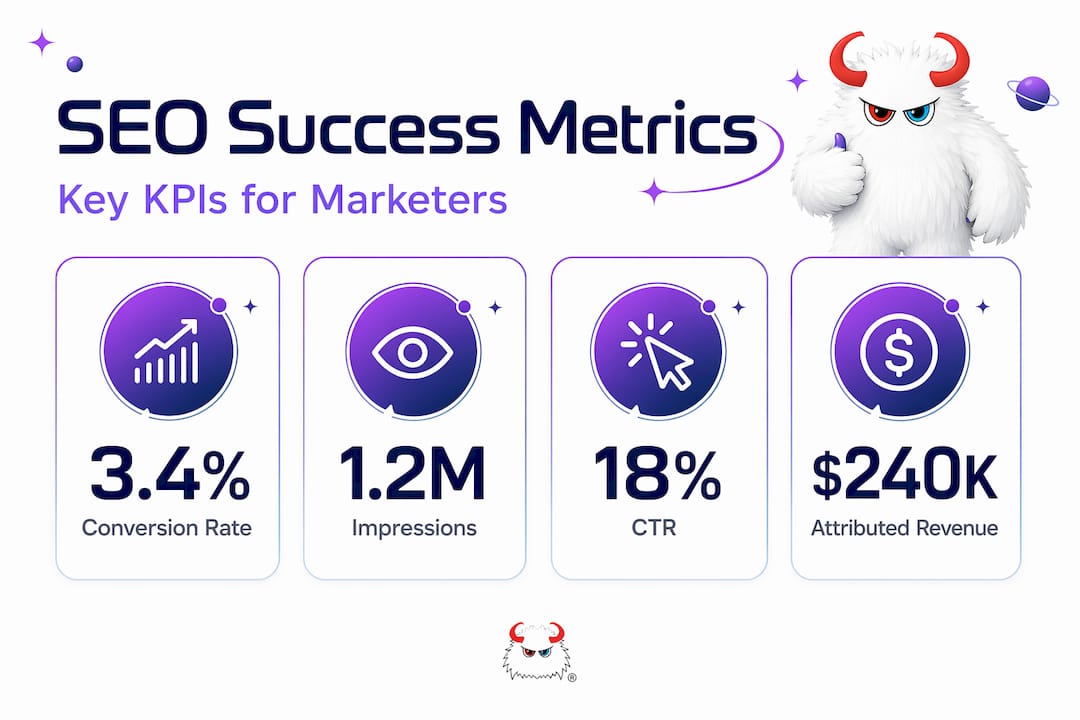
Metrics worth tracking
| Metric | What it tells you | Business relevance |
|---|---|---|
| Organic clicks | How many users visited from search | Direct traffic indicator |
| Impressions | How often your pages appeared in search | Visibility and reach |
| CTR | Ratio of clicks to impressions | Title/meta description quality |
| Average position | Ranking estimate for a query | Competitive standing |
| Conversion rate (organic) | How often organic visitors complete a goal | Revenue linkage |
| Branded search volume | How often users search your brand name | Brand authority signal |
Two metrics deserve closer attention because they are commonly misread. Clicks and impressions measure fundamentally different things: a drop in clicks with stable impressions signals a CTR problem, not a ranking problem. A drop in impressions, on the other hand, indicates a loss of visibility entirely. Treating these as interchangeable is one of the most common errors in SEO reporting.
Beyond the table above, AI-era measurement now requires tracking feature visibility, specifically whether your content appears in AI Overviews, featured snippets, or “People Also Ask” boxes. These placements drive impressions without clicks, which means traffic quality and funnel metrics now better reflect SEO value than raw traffic volume alone.
Pro Tip: Stop reporting domain authority as an SEO KPI to leadership. It is a third-party estimate, not a Google signal, and it varies across platforms. Replace it with branded search volume trend and organic conversion rate for reports that actually connect to business outcomes.
Metrics like average keyword position and domain authority often mislead decision-makers and should be supplemented with conversion-weighted visibility scores and topical authority measures.
How to analyze seo results step by step
Raw data does not diagnose problems. Analysis does. Here is a repeatable workflow for interpreting your SEO performance data each month.
- Start with impressions trends. Open Search Console and compare the last 28 days to the prior period. If impressions fell, you lost visibility before users ever had a chance to click.
- Check CTR by page and query. Sort your top pages by impressions, then identify those with CTR below the expected range for their average position. Pages ranking in positions 1 through 3 should typically see CTR above 10%. Below that, your title tag or meta description needs work.
- Segment by device and geography. A page losing ground on mobile in a single country is a very different problem from a page losing rank globally. Segmentation by query intent, device, and country transforms broad averages into targeted diagnostics.
- Cross-reference with GA4. Pull organic landing page performance inside GA4. Look at engagement rate, average session duration, and goal completions. A page with strong impressions and high CTR that shows poor engagement points to a content and user experience problem, not an SEO problem.
- Prioritize fixes by impact and effort. Not every SEO issue deserves immediate attention. Pages with high impressions, acceptable rank, and low CTR are quick wins. Pages with low impressions require content or authority-building work, which takes longer.
Pro Tip: Use Search Console’s Search Type filter to separate web, image, and video performance. Many sites bleed organic traffic from image search without realizing it, and the fix (proper alt text, image sitemaps) takes less than a day.
When diagnosing traffic drops, always check impressions, CTR, and average position segmented by device and geography before drawing conclusions. Averages across all queries will hide the specific issue every time.

Connecting SEO to revenue through attribution
This is where most SEO programs fail. They report traffic. They stop there. The teams that actually protect and grow revenue integrate SEO data with business outcome data by tracking the full conversion journey.
GA4’s data-driven attribution model uses machine learning to assign conversion credit across all touchpoints, not just the final click before conversion. For SEO specifically, this matters because organic search often initiates a buying journey that converts later via email or direct traffic.
Here is what advanced attribution measurement looks like in practice:
- Assisted conversion reports: Pull these from GA4’s Advertising section. They show how often organic search appeared in a conversion path without getting last-click credit.
- Custom channel dashboards: Build a GA4 exploration combining organic traffic, engagement metrics, and conversion events. Add revenue or lead value fields if your CRM exports to GA4.
- CRM integration: If you use a CRM like HubSpot or Salesforce, match closed deals back to their original acquisition source. Organic search credit at the deal level is the most persuasive data you can show leadership.
Data-driven attribution in GA4 allocates conversion credit based on machine learning, requiring sufficient conversion volume to run accurately. For lower-volume sites, the linear or time-decay models are more reliable than last-click, which systematically undercredits SEO.
| Attribution model | How it credits SEO | Best for |
|---|---|---|
| Last click | Credits final touchpoint only | Short, single-session sales |
| Linear | Equal credit across all touches | Multi-session B2B funnels |
| Data-driven | ML-based weighted allocation | High-conversion-volume sites |
| Time decay | More credit to recent touches | Short evaluation cycles |
Pro Tip: Track return visit rate and pages per session segmented by awareness vs. conversion-stage landing pages. A user who found you through a blog post and returned three times before converting is an SEO win that last-click attribution will credit to direct traffic.
Common measurement mistakes that corrupt your data
Even experienced marketers make measurement errors that produce false confidence or false alarms. Here are the most damaging ones and how to avoid them.
- Reporting aggregate averages: An average position of 14.2 across 3,000 queries is statistically meaningless. Always filter by your most commercially valuable queries.
- Ignoring zero-click behavior: AI Overviews and featured snippets answer queries without generating clicks. Impressions may rise while clicks fall. This is not an SEO failure. It is a change in search behavior that requires adjusting what you measure.
- Single-channel attribution: If your report credits or blames SEO based on last-click data alone, your budget decisions will be wrong. Attribution model misunderstandings are among the most costly errors in digital marketing.
- No baseline or comparison period: Reporting 4,200 organic sessions means nothing without context. Always compare to a prior period and to the same period last year to account for seasonality.
Relying on rankings or traffic volume alone risks strategic misdirection. Business outcomes and conversion metrics should guide all SEO measurement and reporting decisions.
My take on where SEO measurement is heading
I’ve watched SEO reporting evolve from spreadsheets of keyword rankings to multi-system attribution models, and the gap between teams doing this well and teams doing it poorly has never been wider. What I’ve learned is that the measurement problem is usually a systems problem, not a data problem. Most businesses have access to Search Console and GA4. Very few have built the workflow to connect those systems to actual revenue reporting.
The teams making smart decisions right now are not obsessing over position tracking. They are building SEO visibility systems that connect search data to pipeline data. They are tracking branded search growth as a proxy for brand authority. They are watching AI feature visibility because they understand that getting cited in an AI Overview is the new position one.
My honest advice: if your SEO report does not include a conversion metric and an assisted-revenue number, it is not an SEO performance report. It is a visibility report. Both have value, but only one justifies budget.
Build the reporting system that drives decisions

Most businesses do not have an SEO data problem. They have a system problem. The metrics exist. The platforms exist. What is missing is the infrastructure to connect search visibility data to revenue outcomes in a way that drives actual decisions.
Monstrous Media Group builds exactly that. From professional SEO services with integrated performance tracking to AI-powered marketing systems that tie search visibility to pipeline, MMG builds measurement infrastructure, not vanity dashboards. If your current SEO reporting is not producing budget-level decisions, the system needs rebuilding. Monstrous Media Group can do that for you. Visit monstrousmediagroup.com/services/digital-marketing to see how the system works.
FAQ
What are the most important SEO metrics to track?
The most impactful SEO performance metrics are organic conversion rate, click-through rate, impressions by query, and assisted conversions in GA4. Rankings alone do not reflect business outcomes.
How do I know if my SEO is actually working?
Track organic conversions and revenue attribution alongside traffic. If organic visitors are completing goals and appearing in your conversion paths, your SEO program is generating measurable value.
Why did my organic traffic drop even though my rankings held?
A drop in clicks with stable impressions and rankings typically indicates a CTR problem with your title tag or meta description, or a shift in search behavior such as AI Overviews answering queries directly without generating clicks.
How does GA4 attribution affect SEO reporting?
GA4’s data-driven attribution model allocates conversion credit across all touchpoints, which typically increases SEO’s measured contribution compared to last-click models that credit only the final session before conversion.
How often should I review SEO performance data?
Review Search Console data weekly for anomalies and run full attribution and conversion analysis monthly. Comparing 28-day periods and year-over-year data together gives the most accurate read on SEO growth trends.
Recommended
Hire the team to help you with your website, app, or other marketing needs.
We have a team of digital marketers who can help plan and bring to life all your digital marketing strategies. They can help with social media marketing, email marketing, and digital advertising!
CONTACT US
Comments