
 https://www.omahamediagroup.com/images/uploads/monster_gallery/Omaha-Media-Group-Black.jpg
admin
https://www.omahamediagroup.com/images/uploads/monster_gallery/Omaha-Media-Group-Black.jpg
admin
How to Align Sales and Marketing for Revenue Growth

TL;DR:
- Sales and marketing alignment involves integrating both teams around shared goals, definitions, and accountability systems, leading to a 208% increase in marketing revenue contribution.
- Building a foundation with consistent lead definitions, shared customer profiles, integrated technology, and executive sponsorship is essential for sustained alignment.
- Regular operational reviews, microteams, and revenue-focused metrics ensure ongoing collaboration and prevent regression of alignment efforts over time.
Sales and marketing alignment is defined as the formal integration of both teams around shared goals, lead definitions, pipeline metrics, and mutual accountability systems. Companies that achieve this integration see 208% higher marketing revenue contribution compared to misaligned organizations. That number is not a rounding error. It reflects what happens when two revenue-generating functions stop operating as separate departments and start functioning as one system. This article covers how to align sales and marketing using SLAs, shared KPIs, joint pipeline reviews, and microteam frameworks that produce measurable outcomes in 2026.
How to align sales and marketing: foundational elements first
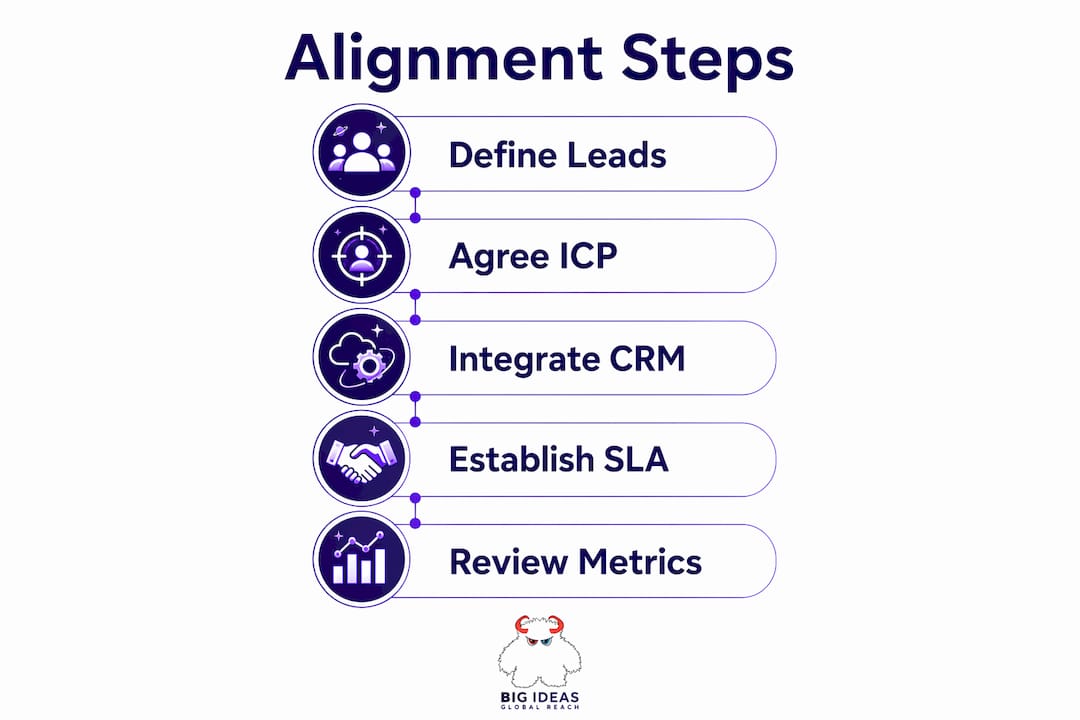
Alignment begins before any meeting cadence or technology platform enters the picture. The foundation is a shared vocabulary. If marketing defines a Marketing Qualified Lead (MQL) as anyone who downloads a whitepaper, and sales defines a Sales Qualified Lead (SQL) as someone with budget authority and a 90-day timeline, the two teams are working from incompatible maps. Every lead handed off under those conditions creates friction, distrust, and wasted effort.

The first step is to document agreed definitions for MQL, Sales Accepted Lead (SAL), and SQL across both teams. These definitions must include firmographic criteria, behavioral signals, and disqualifying factors. A B2B SaaS company, for example, might define an MQL as a contact from a company with 50 or more employees who has visited the pricing page twice within 14 days. That specificity eliminates ambiguity at the handoff point.
Beyond lead definitions, both teams need alignment on the Ideal Customer Profile (ICP) and buyer journey stages. Marketing must understand which objections sales encounters most often at each stage, and sales must understand which content assets marketing has built to address those objections. This is where content adoption becomes a measurable metric rather than an afterthought.
Technology integration is the third foundational requirement. A CRM platform like Salesforce or HubSpot must serve as the single source of truth for both teams. When marketing runs campaigns in an isolated automation platform and sales works exclusively in a disconnected CRM, the data gap produces blind spots that no meeting can fix. Executive sponsorship is the final prerequisite. Without a VP or C-suite owner who enforces shared accountability, alignment efforts collapse into voluntary participation.
Pro Tip: Build a shared glossary document in Notion or Confluence that defines every lead stage, disposition code, and pipeline term. Require both sales and marketing leadership to sign off on it quarterly. This single artifact eliminates more misalignment than most technology investments.
| Element | What it requires |
|---|---|
| Shared lead definitions | Documented MQL, SAL, and SQL criteria agreed upon by both teams |
| Unified ICP | One customer profile used for targeting, content, and qualification |
| Integrated technology | CRM and marketing automation connected with real-time data sync |
| Executive sponsorship | A named owner with authority to enforce cross-team accountability |
How to establish and enforce sales-marketing SLAs
A Service Level Agreement (SLA) between sales and marketing is the operational contract that converts alignment intentions into measurable commitments. Formal documented SLAs replace vague expectations with specific delivery standards tracked on a shared dashboard. Without this contract, alignment is aspirational. With it, alignment is auditable.
Marketing SLA commitments typically include monthly MQL volume targets by channel, minimum lead data completeness standards (such as company size, industry, and phone number), and content delivery timelines tied to campaign calendars. Sales SLA commitments cover lead response time, required follow-up touches before disposition, and the obligation to update lead status within 24 hours of contact.
Lead response time is where most SLAs fail in practice. Responding within 5 minutes increases conversion likelihood by 9 times compared to a 30-minute delay. That gap represents real revenue lost to slow process, not bad leads. When sales teams understand that their response speed directly affects the conversion rate on leads marketing spent budget to generate, the SLA becomes a shared interest rather than a compliance requirement.
Enforcement mechanisms matter as much as the SLA itself. A weekly lead disposition report shared with both teams creates visibility into where leads are stalling. When marketing sees that 40% of MQLs are being marked “not qualified” without follow-up notes, that data triggers a conversation about lead quality or sales process, not a blame session. The feedback loop is the mechanism. The SLA is the standard.
Pro Tip: Post your SLA commitments on a shared dashboard visible to both teams in real time. Visibility alone changes behavior. When sales reps see their average response time displayed next to the 5-minute benchmark, performance improves without a single additional meeting.
What operational practices sustain ongoing collaboration
Process alignment without operational cadence degrades within weeks. Alignment regresses within a quarter unless supported by cultural practices and recurring review structures. The fix is embedding alignment into the weekly operating rhythm of both teams, not treating it as a quarterly initiative.
The most effective operational structure follows this sequence:
- Weekly pipeline review (30 minutes). Both sales and marketing review the top of funnel together. Marketing reports on MQL volume and channel performance. Sales reports on lead disposition rates and pipeline velocity. The agenda is fixed and the meeting is short.
- Biweekly stakeholder sync. Biweekly 30-minute reviews among cross-functional stakeholders prevent roadmap drift and surface integration issues before they become revenue problems. Include IT and operations representatives when technology or data infrastructure is on the agenda.
- Monthly win/loss review. Both teams examine closed-won and closed-lost deals together. Marketing learns which content influenced pipeline. Sales learns which campaigns generated the highest-quality leads. This is where strategic goal alignment translates into adjusted tactics.
- Quarterly SLA audit. Review and revise SLA commitments based on actual performance data. Metrics that no longer reflect business priorities get replaced. Targets that were consistently missed get root-cause analysis, not just adjustment.
Microteams with scoped authority and 90-day experiment windows accelerate pipeline problem solving without the delays inherent in large committee structures. A microteam of three to four people, one from sales, one from marketing, and one from operations, can test a new lead nurture sequence or qualification framework in a single quarter and report results back to the broader team. This model keeps decision velocity high while maintaining accountability.
RACI matrices must be publicly visible and accessible to all stakeholder departments to avoid accountability confusion. When everyone knows who is Responsible, Accountable, Consulted, and Informed for each pipeline function, escalation paths are clear and ownership gaps close faster.
How to measure and optimize alignment success
Measurement is where most alignment programs break down. Teams default to tracking metrics that are easy to report rather than metrics that reflect revenue impact. Vanity metrics like total MQLs generated or email open rates tell you about activity, not outcomes. Shared revenue-based KPIs and AI tools improve feedback quality and force both teams to own the same number.
The metrics that actually measure alignment health include:
- MQL acceptance rate. The percentage of marketing-generated leads that sales accepts as SALs. A rate below 70% signals a lead quality or definition problem.
- Lead velocity rate. The month-over-month growth in qualified leads entering the pipeline. This metric predicts future revenue before it closes.
- Marketing-influenced revenue. The total closed revenue where marketing touched the account at any stage. This connects marketing spend directly to closed deals.
- Lead response time. Tracked by rep and by channel. Deviations from the SLA standard are visible and addressable in real time.
- Content adoption rate. The percentage of sales-stage content assets that reps actually use in active deals. Low adoption signals a content-relevance problem, not a volume problem.
AI-powered conversation intelligence platforms analyze sales call recordings and surface patterns in objections, competitor mentions, and buying signals. This data feeds directly back to marketing for content and messaging adjustments. Leveraging AI-driven tools for feedback loops between marketing and sales closes the gap between what marketing assumes buyers care about and what sales actually hears in conversations.
Organizations with aligned teams are nearly 3 times more likely to exceed new customer acquisition targets. That advantage compounds when measurement systems are in place to identify what is working and replicate it at scale.
Key takeaways
Sales and marketing alignment produces measurable revenue outcomes only when shared definitions, formal SLAs, recurring operational cadences, and revenue-based metrics replace siloed processes and vanity reporting.
| Point | Details |
|---|---|
| Shared lead definitions | Document MQL, SAL, and SQL criteria with both teams before any process or tool is implemented. |
| Formal SLAs | Commit marketing and sales to specific, trackable obligations including lead volume, data quality, and response time. |
| Operational cadence | Weekly pipeline reviews and biweekly stakeholder syncs prevent alignment from degrading between quarters. |
| Revenue-based KPIs | Track MQL acceptance rate, lead velocity, and marketing-influenced revenue instead of activity metrics. |
| Microteam experimentation | Use small cross-functional teams with 90-day windows to test and scale pipeline improvements quickly. |
Why alignment fails without a system behind it
Most alignment efforts I have seen fail at the same point. The teams agree on definitions, build a shared dashboard, and run two or three productive joint meetings. Then a quarter passes, a leadership change happens, or a campaign misses its number, and both teams retreat to their separate reporting structures and separate priorities. The alignment was real. The system behind it was not.
The uncomfortable truth about aligning sales and marketing is that the process work is the easy part. Documenting an MQL definition takes an afternoon. Building a RACI matrix takes a day. The hard part is enforcing accountability when the numbers are bad and the instinct is to protect your team’s metrics. That is where executive sponsorship stops being a nice-to-have and becomes the only thing that keeps the system running.
Microteams work precisely because they bypass the political dynamics of large cross-functional committees. A three-person team with a 90-day mandate and a clear success metric does not have time for territorial behavior. They either solve the pipeline problem or they do not. That clarity is what most alignment programs are missing.
The other pattern I see consistently is over-investment in technology and under-investment in culture. A marketing automation platform does not align teams. It surfaces data that aligned teams can act on. The sequence matters. Fix the process and the accountability structure first. Then add the technology to scale what is already working.
— Vector
Build alignment infrastructure with Monstrous Media Group

Monstrous Media Group builds the systems that make sales and marketing alignment operational, not theoretical. From integrated digital marketing infrastructure to AI-enabled lead management and marketing automation, MMG connects your pipeline data, campaign performance, and sales activity into one revenue system. If your teams are running on separate dashboards and quarterly blame sessions, that is a systems problem. MMG solves it by building the infrastructure that keeps both teams accountable to the same number. Contact Monstrous Media Group to map your current alignment gaps and build a system that closes them.
FAQ
What does sales and marketing alignment mean?
Sales and marketing alignment is the formal integration of both teams around shared lead definitions, pipeline metrics, and mutual accountability systems. It replaces siloed reporting with a unified revenue process.
How do SLAs improve sales and marketing collaboration?
SLAs convert vague expectations into specific, trackable commitments for both teams, covering lead volume, data quality, and response time. Formal SLAs are the single most effective tool for sustaining alignment beyond the initial planning phase.
What metrics should aligned teams track together?
Aligned teams track MQL acceptance rate, lead velocity rate, marketing-influenced revenue, lead response time, and content adoption rate. These metrics connect both teams to revenue outcomes rather than activity volume.
How often should sales and marketing meet to stay aligned?
Weekly 30-minute pipeline reviews and biweekly cross-functional stakeholder syncs are the recommended cadence. Quarterly-only reviews allow too much drift and typically produce blame sessions rather than problem solving.
Why do most sales and marketing alignment efforts fail?
Alignment efforts fail when they rely on process documentation without enforcement mechanisms or executive sponsorship. Without a named owner and visible accountability systems, alignment regresses within a single quarter.
Recommended
Hire the team to help you with your website, app, or other marketing needs.
We have a team of digital marketers who can help plan and bring to life all your digital marketing strategies. They can help with social media marketing, email marketing, and digital advertising!
CONTACT US
Comments