The 5 Revenue Leaks Quietly Killing Growth in Most Businesseshttps://pub-c065268fe1194494af1625a8b7104611.r2.dev/blog/The_5_Revenue_Leaks_Quietly_Killing_Growth_in_Most_Businesses.pngOmaha Media Grouphttps://www.omahamediagroup.com/images/uploads/monster_gallery/Omaha-Media-Group-Black.jpgadmin
The 5 Revenue Leaks Quietly Killing Growth in Most Businesses
March 04, 2026
in one minute
Most growth problems are misdiagnosed.
When revenue feels inconsistent, leadership assumes there is a marketing issue. More traffic. More ads. More campaigns.
But in many organizations, demand is not the problem.
Leakage is.
Revenue rarely collapses overnight. It erodes slowly through missed follow ups, unclear ownership, slow response times, and unstable infrastructure. The cost compounds quietly until scaling becomes expensive and unpredictable.
Here are the five most common revenue leaks we see inside growing businesses.
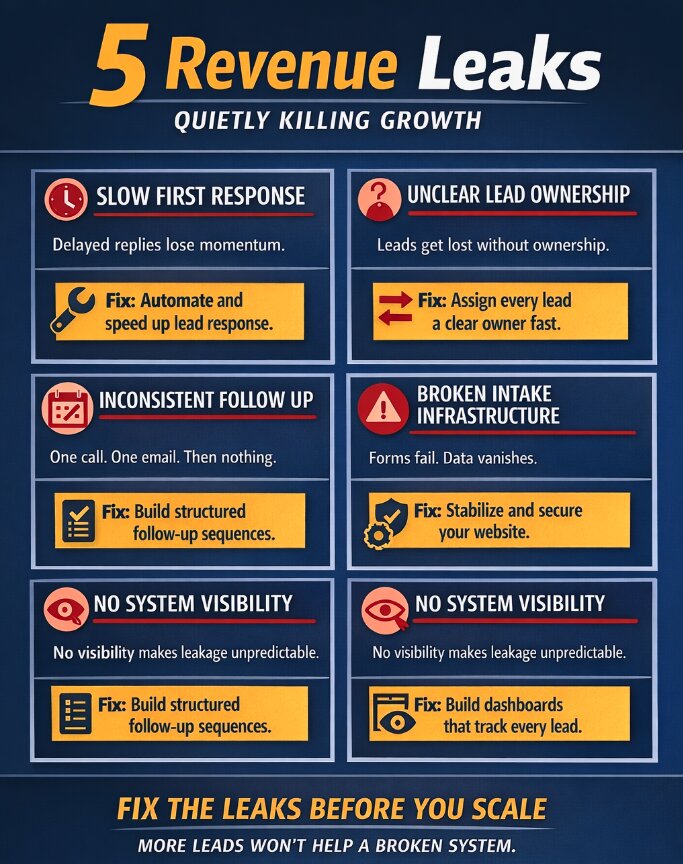
Revenue Leak #1: Slow First Response
Speed is leverage.
When someone fills out a form, requests a quote, or submits an inquiry, their intent is highest in that moment. Delays reduce momentum.
If response time varies by rep, by day, or by workload, revenue becomes inconsistent.
Most teams believe they respond quickly. Few measure it accurately.
Fix: Define response time expectations and automate routing so every new inquiry has immediate ownership. Speed should be system driven, not personality driven.
Revenue Leak #2: Unclear Lead Ownership
When a lead enters the system and no one clearly owns it, it becomes invisible.
Ownership must be automatic and trackable. Every inquiry should have a defined owner within minutes, not hours.
Fix: Build a lead routing system that assigns ownership based on rules, geography, service line, or availability. Eliminate ambiguity.
Revenue Leak #3: Inconsistent Follow Up
Most deals are not lost to competitors.
They are lost to silence.
One call and done. One email and forgotten. Follow up that depends on memory instead of structure.
Momentum fades when follow up lacks discipline.
Fix: Implement structured follow up sequences with defined touchpoints and visibility. Lead recovery systems ensure opportunities are not abandoned simply because teams get busy.
Revenue Leak #4: Broken Intake Infrastructure
Your website is the intake layer of your revenue engine.
If forms break, integrations fail, pages load slowly, or data does not pass cleanly into your CRM, opportunities vanish without warning.
Technical instability is revenue risk.
Fix: Stabilize infrastructure. Monitor uptime. Test forms. Maintain integrations. Managed website infrastructure protects the foundation so marketing performance does not collapse under technical stress.
Revenue Leak #5: No System Visibility
Executives often ask, “How are we doing?”
The answer is usually activity metrics, traffic, impressions, leads.
Rarely is the answer: “Here is what happened to every lead.”
Without system visibility, leadership cannot identify where leakage occurs. Revenue appears unpredictable when it is simply untracked.
Fix: Build dashboards that track lead movement from click to close. Measure ownership, response time, follow up cadence, and close rate by source. Visibility removes guesswork.
Why Adding More Leads Makes It Worse
If these five leaks exist, adding more traffic does not solve the problem.
It magnifies it.
More leads flow into a weak system. Response slows. Ownership blurs. Follow-up declines. Leadership questions marketing performance.
Scaling without rixing leakage increases cost and stress.
Revenue protection must precede expansion.
The Revenue Protection Loop
Strong businesses operate a loop:
Visibility generates demand.
Infrastructure captures intent.
Lead recovery systems protect opportunity.
Sales converts consistently.
Each layer reinforces the next.
When this loop is aligned, growth feels calm and predictable. When it is misaligned, marketing feels chaotic and expensive.
Fix the Leaks Before You Scale
Before increasing ad spend or hiring additional sales staff, answer these questions:
What is our true first response time?
Who owns each new lead immediately?
How is follow up structured and tracked?
Are all intake systems tested regularly?
Can we trace every lead from click to close?
If the answers are unclear, the opportunity is internal.
Revenue does not need to be chased. It needs to be protected.
STOP REVENUE LEAKS!
If revenue feels inconsistent despite steady marketing effort, there is likely leakage inside the system.
We build revenue protection and lead recovery systems that eliminate those blind spots and stabilize growth.
An integrated visibility engine is a system that makes your business discoverable across traditional search, local search, and AI answers. It combines technical SEO structure, AEO content clarity, and GEO authority signals so your site can be found, understood, and referenced consistently, not only ranked.
Does SEO still matter with AI Overviews and ChatGPT?
Yes. SEO is the foundation. AI systems still depend on crawlable websites, clear architecture, strong internal linking, and reliable technical performance. Without that foundation, your content is harder to index, harder to interpret, and less likely to be included in AI summaries or recommendations.
AEO is the practice of structuring content so it can be extracted as direct answers by search features and AI tools. AEO typically uses clear question-based headings, concise definitions, short paragraphs, and logical formatting so machines can confidently summarize the page.
GEO is the practice of building domain-level authority so generative AI systems are more likely to mention, reference, or cite your brand. GEO relies on topic depth, consistency across related pages, internal linking, trust signals, and technical stability, not single-page keyword targeting.
SEO improves discoverability in traditional search through technical health, structure, and authority. AEO improves answer visibility by making content easy for systems to extract and present as direct responses. GEO improves generative visibility by strengthening domain authority so AI tools recognize your site as a trustworthy source across a topic.
How do AI systems choose which sources to cite or reference?
AI systems tend to favor sources that are clear, structured, and consistent. Common signals include clean headings and hierarchy, direct answers, topical depth across multiple pages, credible trust signals, strong internal linking, and reliable technical performance that supports crawling and interpretation.
How do I optimize for Google AI Overviews and AI-driven search?
Start with technical SEO and site speed, then structure content to answer real questions directly. Build topic clusters, reinforce internal linking, use clear definitions, and publish consistent supporting content that demonstrates authority. AI visibility improves when your site is easy to interpret and hard to misunderstand.
Schema is not the only factor, but it helps reduce ambiguity. Structured data can clarify entities, services, locations, and page intent. FAQPage and Organization schema can support extractable answers and improve machine understanding, especially when paired with clean on-page structure.
Measure SEO with indexed coverage, rankings where relevant, organic conversions, and technical health. Measure AEO with visibility in featured snippets, AI Overviews, and question-based queries, plus assisted conversions. Measure GEO with increases in branded search, referral patterns from AI tools where trackable, and lift in high-intent inbound leads and close rate quality.
How do SEO, AEO, and GEO affect local search and Google Maps?
Local visibility depends on accurate business data, strong location signals, relevant service pages, reviews, and consistent citations. SEO supports technical structure and local pages, AEO improves clarity for local intent questions, and GEO strengthens overall authority so AI tools and search systems treat your business as a reliable local option.
Hire the team to help you with your website, app, or other marketing needs.
We have a team of digital marketers who can help plan and bring to life all your digital marketing strategies. They can help with social media marketing, email marketing, and digital advertising!




Comments