
 https://www.omahamediagroup.com/images/uploads/monster_gallery/Omaha-Media-Group-Black.jpg
admin
https://www.omahamediagroup.com/images/uploads/monster_gallery/Omaha-Media-Group-Black.jpg
admin
Digital transformation for business growth: 82% prioritize it

TL;DR:
- Digital transformation requires a fundamental operational change, not just software upgrades.
- High-performing companies invest more deeply and redesign workflows end-to-end for real results.
- Success depends on active leadership, clear metrics, and cultural shifts beyond technology adoption.
82% of C-suite executives now rank digital transformation as a top priority for efficiency and growth. Yet despite record investment and near-universal agreement on its importance, most organizations walk away with little more than upgraded software and a fresh layer of complexity on top of old problems. The gap between intention and result is stunning. This guide cuts through the noise to define what digital transformation actually means, why so many initiatives stall before they deliver real value, and what separates the small group of high-performing companies that genuinely move the needle from everyone else.
Table of Contents
- What is digital transformation and why does it matter?
- The business impact: Efficiency, revenue, and missed expectations
- Key drivers and critical success factors for transformation
- Best practices for implementing a successful digital transformation strategy
- Real-world examples: High-impact digital transformation in action
- A candid take: What most digital transformation advice misses
- Unlock your organization’s digital potential with expert support
- Frequently asked questions
Key Takeaways
| Point | Details |
|---|---|
| Strategic approach essential | Success requires more than technology—leadership, investment, and workflow redesign are must-haves. |
| Measure results, not output | Track clear business metrics instead of just deploying digital tools for their own sake. |
| Culture and buy-in matter | Active executive support and engaging your staff are critical to driving actual transformation. |
| Invest for real impact | Top performers dedicate significant budgets and rethink processes, not just tech upgrades. |
What is digital transformation and why does it matter?
Digital transformation is one of those terms that gets used so often it starts to lose meaning. At its core, it is not about buying new software or migrating data to the cloud. It is a fundamental shift in how a business operates, competes, and delivers value, touching strategy, processes, culture, and technology simultaneously.
Think of it this way: a company that automates a broken process is not transforming. It is just breaking down faster with better equipment. Real transformation means questioning why a process exists before deciding how to improve it.
Key components of genuine digital transformation include:
- Workflow automation that eliminates manual bottlenecks and reduces human error
- Data-driven decision making that replaces gut instinct with measurable insight
- Digital-first culture where teams actively seek technology-enabled improvements
- Customer experience redesign that meets buyers where they are, not where you wish they were
- Scalable infrastructure that grows without requiring proportional headcount increases
“Digital transformation is less about the technology itself and more about what the technology enables you to do differently.”
82% of C-suite leaders list digital transformation as a strategic priority, with 64% focusing on efficiency gains and the remainder targeting revenue growth. Understanding the latest digital marketing trends can help contextualize where technology investment delivers the fastest return. Context matters here. A mid-size manufacturer’s transformation looks completely different from a professional services firm’s. The destination is unique, but the discipline required to get there is not.
The business impact: Efficiency, revenue, and missed expectations
Here is where the picture gets uncomfortable. Organizations pour billions into digital transformation each year, expecting operational efficiency, new revenue, and competitive advantage. What most get is incremental improvement at best.
Research tells a sobering story. Only 6% of companies attribute more than 5% EBIT (earnings before interest and taxes) improvement to digital or AI initiatives, even though 88% report using AI in some capacity. The technology is present. The results are not.
The difference between typical and high-performing organizations is stark:
| Factor | Typical companies | High-performing companies |
|---|---|---|
| Technology budget allocation | Under 10% | Over 20% |
| Workflow redesign | Partial updates | End-to-end redesign |
| EBIT improvement from digital | Under 2% | Over 5% |
| Leadership involvement | Delegated to IT | Active C-suite ownership |
| Measurement discipline | Occasional reviews | Continuous tracking |
High performers do not just invest more money. They invest differently, committing to deeper process change and treating leadership involvement as non-negotiable. Exploring AI for business shows how these organizations extract genuine value from technology rather than simply deploying it.
Beyond efficiency, digital transformation opens new revenue channels. Improved customer engagement methods powered by better data translate directly into higher retention and larger deal sizes.

Pro Tip: Measuring the right metrics matters more than measuring everything. Identify three to five KPIs tied directly to business outcomes and review them monthly. Vanity metrics like pageviews and app downloads will not tell you if transformation is actually working.
Key drivers and critical success factors for transformation
Knowing the results gap exists is useful. Understanding what drives high performers across that gap is what matters for your organization.
Leadership is the single biggest variable. When C-suite executives treat digital transformation as an IT project rather than a business strategy, it fails. Full stop. Active executive sponsorship, clear accountability, and visible commitment from the top signal to the entire organization that this initiative is real, funded, and expected to produce results.
The other critical factors include:
- Investment depth: High performers invest deeply and allocate over 20% of their technology budget to transformation, compared to the average company’s single-digit allocation
- End-to-end workflow redesign: Patching individual steps in a broken process produces limited gains; redesigning the entire workflow from input to output produces transformational ones
- Talent and culture alignment: Technology alone cannot change how people think or work; both must evolve together
- Clear success metrics: High performers define what success looks like before the project begins, not after the budget is spent
| Characteristic | Low-performing organizations | High-performing organizations |
|---|---|---|
| Leadership role | Passive oversight | Active ownership |
| Process approach | Automate existing steps | Redesign from scratch |
| Budget commitment | Under 10% of IT spend | Over 20% of IT spend |
| Culture change effort | Minimal | Intentional and ongoing |
| Results attribution | Unclear | Clearly measured |
Strong transforming marketing strategies follow the same logic: redesign before you automate, lead before you delegate, and measure before you celebrate.
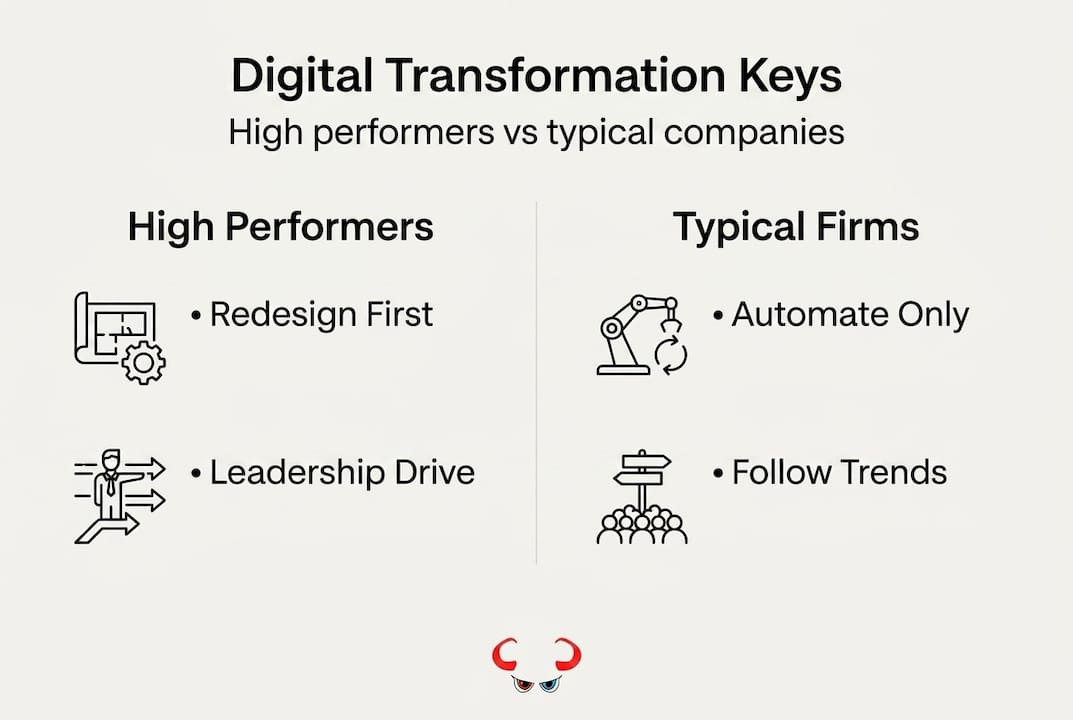
Pro Tip: Before automating any process, map it out completely. Ask whether it should exist in its current form at all. Automating an outdated workflow just locks in the inefficiency at a faster speed.
Best practices for implementing a successful digital transformation strategy
Strategy without execution is just a slide deck. Here is a practical framework for turning digital transformation ambition into measurable results.
- Assess your current state honestly. Audit existing workflows, technology, and team capabilities. Know exactly where inefficiencies live before committing resources to fix them.
- Set specific, measurable goals. Avoid broad goals like “become more digital.” Define targets such as reducing order processing time by 40% or increasing digital revenue by 20% within 12 months.
- Secure visible leadership buy-in. Executive sponsorship is not a formality. It is a prerequisite. Without it, teams deprioritize transformation work the moment competing demands appear.
- Invest at the level required. Underfunding transformation and expecting breakthrough results is a contradiction. Budget appropriately and protect that investment from being redirected mid-initiative.
- Measure, adjust, and repeat. Only 6% properly attribute digital and AI gains to real bottom-line improvements, largely because they do not build measurement systems before they begin.
Common pitfalls to avoid include launching without clear process maps, treating culture change as an afterthought, and selecting technology before defining the problem it needs to solve. A digital transformation success case worth studying shows exactly how strategic clarity accelerates results. Applying AI in digital marketing is one area where targeted investment consistently produces measurable returns when paired with strong process design.
Pro Tip: Start with one pilot program in a high-visibility area. Early wins build internal confidence, generate proof of concept, and create momentum that makes the next initiative easier to fund and execute.
Real-world examples: High-impact digital transformation in action
Theory is useful. Proof is better. Here is how leading organizations have translated transformation strategy into real business outcomes.
Retail sector workflow redesign: A major retailer redesigned its entire inventory management process from manual tracking to AI-driven forecasting. The result was a 30% reduction in overstock costs and a 20% improvement in product availability. They did not simply automate what existed. They rebuilt the process from the ground up, using data to drive every decision.
Financial services automation: One global bank integrated AI-powered document processing across its loan origination workflow. Processing time dropped from days to hours, error rates fell by over 60%, and customer satisfaction scores climbed. The key insight from their approach mirrors what Chase digital success demonstrates: technology investment delivers when it is tied to a clearly defined customer outcome.
Professional services data strategy: A consulting firm deployed a centralized data platform to replace disconnected reporting tools. Partners now access real-time project profitability data, enabling faster staffing decisions and reducing write-offs by 15% annually.
Key actions that drove these outcomes:
- Mapped existing workflows before selecting technology
- Trained teams specifically for new processes, not just new tools
- Established clear baselines and tracked improvement weekly
- Had executive sponsors who participated in progress reviews
High performers redesign workflows for maximum value, treating every process as an opportunity rather than a constraint.
The pattern is consistent. The organizations that achieve real results do not adopt technology and wait. They redesign, measure, and adapt continuously.
A candid take: What most digital transformation advice misses
Most transformation guides focus heavily on frameworks, tools, and investment levels. What they consistently underestimate is the people problem.
Technology is the easy part. You can buy software, hire consultants, and redesign workflows on a whiteboard in a week. What takes much longer is changing how people think about their work, how teams communicate across silos, and how leaders model the behaviors they expect from everyone else. Resistance to change is not a minor obstacle to manage. It is often the primary reason transformation stalls.
Here is the uncomfortable truth: many organizations pursue digital transformation while protecting the assumptions that made them successful in the past. They layer new tools on top of old mindsets and call it progress. The companies that win are the ones that challenge those foundational assumptions first.
Reviewing real marketing transformation lessons reveals a consistent theme: lasting change starts with leaders who are willing to be wrong about how things have always worked. Challenge your team. Challenge yourself. That is where real transformation begins.
Unlock your organization’s digital potential with expert support
Understanding digital transformation is one thing. Building a system that actually generates better outcomes for your business is another challenge entirely.
Monstrous Media Group designs and executes digital marketing services built around measurable business results, not activity reports. From strategy and workflow design to full-scale implementation, our team builds systems that stop revenue leaks and accelerate growth. If you are ready to explore how AI-driven solutions can be applied specifically to your organization’s goals, we are ready to have that conversation. Real outcomes start with the right partner.
Frequently asked questions
What are the main benefits of digital transformation?
Digital transformation streamlines workflows, reduces operational costs, and creates new revenue opportunities. 82% of C-suite leaders prioritize it specifically for efficiency gains and sustainable growth.
Why do most digital transformation efforts fail?
Most fail because leadership delegates the initiative rather than owning it, and organizations automate existing processes instead of redesigning them. Only 6% attribute meaningful gains to digital or AI investments, which reflects a systemic problem with execution depth.
How much should companies invest in digital transformation?
High-performing organizations commit over 20% of their technology budget to transformation initiatives and pair that investment with complete workflow redesign rather than incremental changes.
What are the first steps for starting digital transformation?
Begin by mapping your current workflows honestly, identifying where inefficiencies generate the most cost or friction, then secure C-suite commitment before selecting any technology. Strategy first, tools second.
Recommended
- Updated: Four digital marketing trends ruling the web
- Digital Marketing Company in Omaha | Monstrous Media Group
- Harnessing Social Media to Maximize Customer Engagement in 2024
- How AI can boost your email open rates and conversions
- Ρόλος Digital Transformation στη Λογιστική: Πλήρης Οδηγός - Χρήστος Καβαλλάρης - Λογιστής
Hire the team to help you with your website, app, or other marketing needs.
We have a team of digital marketers who can help plan and bring to life all your digital marketing strategies. They can help with social media marketing, email marketing, and digital advertising!
CONTACT US
Comments