
 https://www.omahamediagroup.com/images/uploads/monster_gallery/Omaha-Media-Group-Black.jpg
admin
https://www.omahamediagroup.com/images/uploads/monster_gallery/Omaha-Media-Group-Black.jpg
admin
Digital growth strategies for business expansion in 2026

TL;DR:
- Digital growth is a systematic, integrated expansion of business revenue through cohesive digital channels.
- Successful models rely on frameworks like the AARRR funnel and the 5-Pillar approach, emphasizing data and AI.
- Ongoing measurement and full system integration are critical to sustainable digital growth and avoiding pitfalls.
Most business leaders assume digital growth means more website traffic, more social media followers, or a bigger ad budget. That assumption is costing companies real revenue. Digital growth is the systematic expansion of business reach, revenue, and engagement through integrated digital channels, strategies, and technologies. It is not a campaign. It is not a channel. It is a business operating system built for compounding returns. This guide breaks down the core definitions, frameworks, AI-driven mechanics, and measurement practices that separate businesses scaling sustainably from those spinning their wheels on activity without outcomes.
Table of Contents
- What is digital growth? Definitions and fundamentals
- Core digital growth frameworks and methodologies
- AI, personalization, and the new mechanics of digital growth
- Benchmarks, measurement, and avoiding common digital growth pitfalls
- Why most approaches to digital growth miss the mark
- Accelerate your digital growth with expert support
- Frequently asked questions
Key Takeaways
| Point | Details |
|---|---|
| Holistic approach wins | True digital growth comes from integrated strategies, not isolated campaigns. |
| Leverage smart frameworks | Applying frameworks like AARRR and the 5-Pillars helps you scale effectively and measure real progress. |
| Invest in the right tech | Using AI, martech, and unified data systems gives your business a measurable growth edge. |
| Measure what matters | Track lifetime value, acquisition costs, and ongoing ROI rather than just website traffic or followers. |
What is digital growth? Definitions and fundamentals
With that misconception cleared, let’s define what digital growth actually means and why it’s distinct from typical marketing jargon.
Digital growth is the systematic, sustainable expansion of a business through integrated digital channels working in concert. It is not the same as running a Google Ads campaign or posting consistently on LinkedIn. Those are tactics. Digital growth is the architecture that connects those tactics into a revenue-generating system. Scalable, data-driven systems drive digital growth, not isolated tactics executed in silos.
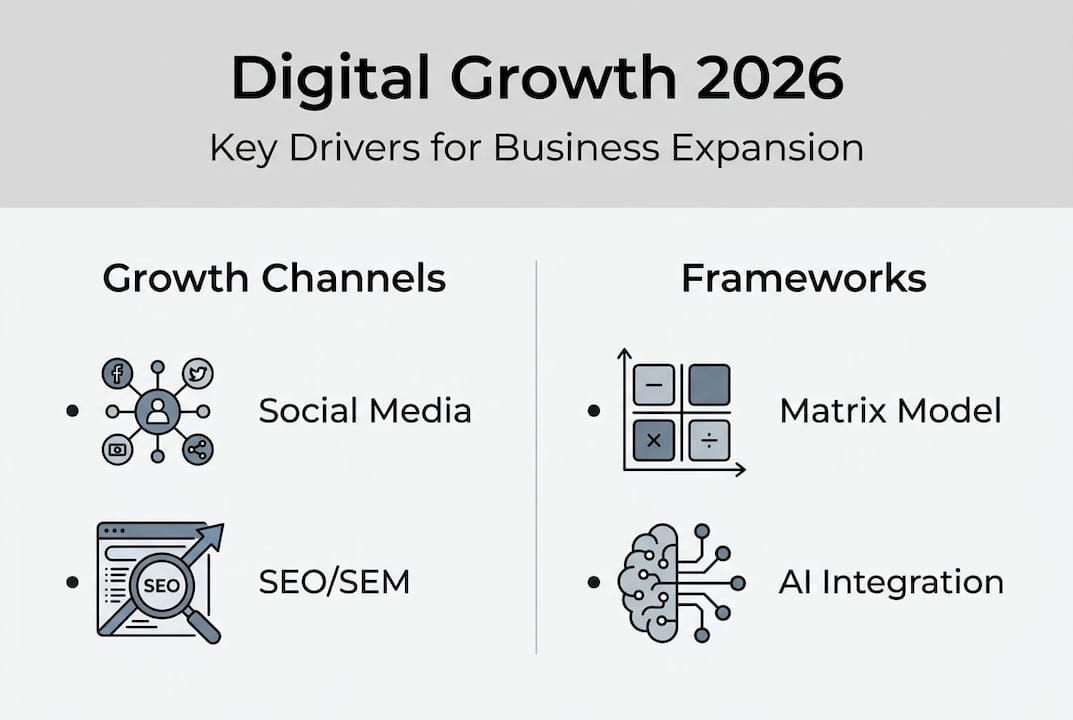
The distinction matters enormously for business leaders. Ad-hoc marketing produces spikes. Digital growth produces compounding momentum. When your SEO, paid media, email automation, CRM, and content strategy are aligned under a unified growth model, each channel amplifies the others. When they operate independently, you pay full price for each channel and capture only a fraction of the potential value.
Foundational elements of a true digital growth model include:
- Integrated strategy: Every channel, from organic search to paid social, feeds a shared funnel and data model.
- AI and automation: Machine learning powers targeting, personalization, and optimization at scale.
- Omnichannel focus: Customers move across devices and platforms. Your growth system must follow them seamlessly.
- Value metrics: Success is measured by lifetime value (LTV), customer acquisition cost (CAC), and return on investment (ROI), not vanity metrics like impressions.
Here is a quick comparison to illustrate the difference between a holistic digital growth approach and a tactical marketing approach:
| Dimension | Tactical marketing | Digital growth model |
|---|---|---|
| Focus | Campaign performance | Business revenue expansion |
| Time horizon | Short-term | Long-term, compounding |
| Key metrics | Traffic, clicks, impressions | LTV, CAC, ROI, conversion rate |
| Channel strategy | Channel-by-channel | Integrated, omnichannel |
| Technology use | Ad platforms, basic analytics | AI, CRM, automation, martech stack |
| Adaptability | Reactive | Predictive and proactive |
“Digital growth is not a marketing function. It is a business strategy that uses digital channels as its primary engine for sustainable revenue expansion.”
Businesses that explore digital marketing services built around this integrated model consistently outperform those chasing individual channel wins. You can also see this principle in action by reviewing digital success stories from companies that made the shift from tactical to systemic.
Core digital growth frameworks and methodologies
Now that you’ve got the overall definition, it’s time to see what actionable frameworks top performers use for scalable digital growth.
Frameworks give structure to strategy. Without them, even well-funded teams waste resources chasing the wrong signals. Core methodologies include frameworks like the AARRR funnel and 5-Pillar models that guide how organizations plan, execute, and measure growth.
The AARRR funnel (Acquisition, Activation, Retention, Referral, Revenue) maps the full customer journey from first touch to long-term loyalty. It forces teams to measure every stage, not just the top of the funnel where most marketing budgets are concentrated.
The 5-Pillar model organizes digital growth around five interconnected capabilities:
- AI and predictive analytics for smarter targeting and forecasting
- Personalization to deliver relevant experiences at every touchpoint
- Automation to scale execution without scaling headcount
- Privacy-first data collection to build trust and comply with evolving regulations
- Omnichannel integration to unify the customer experience across platforms
The growth matrix adds another layer, mapping your strategies across market penetration, market development, product development, and diversification axes. This helps leaders allocate resources based on where the highest-leverage opportunities exist right now.
Here is how these frameworks compare in terms of where they deliver the most value:
| Framework | Primary value | Best applied when |
|---|---|---|
| AARRR funnel | Full-funnel visibility | Building or auditing a growth funnel |
| 5-Pillar model | Strategic capability building | Planning annual growth investments |
| Growth matrix | Resource allocation | Evaluating new markets or products |
A real-world digital growth implementation roadmap typically follows this sequence:
- Align leadership on growth goals and revenue targets.
- Define your ideal customer profile (ICP) with behavioral and demographic precision.
- Build content and SEO infrastructure to capture demand organically.
- Establish your channel mix based on where your ICP actually spends time.
- Implement measurement systems before scaling spend.
Investing in AI-powered marketing and marketing automation at steps three and four dramatically accelerates the compounding effect. Gartner digital strategy insights reinforce that organizations integrating these capabilities early see faster time-to-value.

Pro Tip: Avoid the temptation to adopt standalone tools for each function. A disconnected martech stack creates data gaps that undermine every framework you apply. Integration is where the compounding effect lives.
AI, personalization, and the new mechanics of digital growth
With frameworks in mind, let’s dig into how technology is powering and requiring new growth mechanics.
AI is no longer a competitive advantage reserved for enterprise brands. It is rapidly becoming the baseline for any business serious about digital growth. The mechanics have shifted. Where growth once meant reaching more people, it now means reaching the right people with the right message at the right moment, at scale.
Predictive analytics and personalization are now central to digital growth strategy, with the focus shifting from traffic volume to LTV and CAC optimization. This is a fundamental change in how growth is measured and pursued.
The essential components of a modern digital growth stack include:
- CRM platform: The central nervous system for customer data and relationship management.
- Marketing automation: Triggers personalized communications based on behavior, not just schedules.
- AI analytics engine: Identifies patterns, predicts churn, and surfaces optimization opportunities.
- Content personalization layer: Adapts website and email content dynamically to individual users.
- Unified data infrastructure: Connects all tools so every team works from the same customer truth.
- Privacy-compliant data collection: First-party data strategies that build trust while maintaining targeting precision.
Companies that reach maturity in AI adoption can see a 2x growth advantage over competitors still relying on manual processes and intuition-based decisions. That gap widens every year AI capabilities advance.
The metric shift is equally important. Businesses still optimizing for clicks and impressions are measuring the wrong things. AI-driven email personalization alone demonstrates how moving from volume metrics to engagement and conversion metrics produces measurably better revenue outcomes.
Pro Tip: Invest in martech systems that unify your customer data before you invest in AI features. AI is only as smart as the data it runs on. Fragmented data produces fragmented insights, regardless of how sophisticated the tool is.
Benchmarks, measurement, and avoiding common digital growth pitfalls
Technologies and frameworks are powerful, but without clear measurement, growth stalls.
Measurement is where most digital growth strategies break down. Leaders invest in the right tools and frameworks, then measure the wrong outcomes. Rigorous ROI measurement and adaptation to industry benchmarks are what separate genuine growth from the appearance of growth.
The most important digital growth KPIs for business leaders include:
- Customer lifetime value (LTV): The total revenue a customer generates over their relationship with your business.
- Customer acquisition cost (CAC): What you spend to acquire each new customer across all channels.
- LTV to CAC ratio: A ratio above 3:1 is generally considered healthy for sustainable growth.
- Full-funnel conversion rate: Measures how efficiently your funnel moves prospects to paying customers.
- Engagement rate by channel: Indicates content relevance and audience alignment.
- Revenue attribution: Connects specific campaigns and channels to closed revenue, not just leads.
For context on realistic targets, digital success benchmarks from Forrester show that retail digital sales now represent approximately 35% of total sector revenue, a figure that continues to climb across most verticals.
Measurement must be ongoing, not quarterly. Growth compounds when optimization is continuous. A single annual audit misses dozens of inflection points where small adjustments produce outsized returns.
Common pitfalls that stall or fake digital growth:
- Vanity metric obsession: Optimizing for followers, page views, or impressions instead of revenue-connected outcomes.
- Siloed teams and tools: When marketing, sales, and product operate from different data sets, no one has an accurate picture.
- Ignoring the long tail: Early wins in high-volume keywords or channels distract from the compounding value of mid and long-tail optimization.
- One-time project thinking: Treating a website redesign or SEO audit as a finish line rather than a starting point.
Reviewing how transforming your marketing strategy works in practice, alongside staying current on latest digital trends, helps leaders avoid these traps before they become expensive.
“Digital growth is an ongoing optimization, not a one-time project.”
Why most approaches to digital growth miss the mark
Having seen the mechanics, it’s worth asking why so many organizations still struggle with digital growth despite having access to the same frameworks and tools.
The honest answer is that most leaders still treat digital growth as a marketing problem rather than a business model challenge. They hand it to a marketing team, set a traffic goal, and measure success by channel performance. That approach produces diminishing returns because it optimizes parts of the system while leaving the whole system broken.
The organizations that win are not doing more. They are doing less, but integrating deeply and measuring rigorously. They resist the pressure to chase every new channel or platform and instead build compounding infrastructure that gets smarter over time.
The biggest under-investment we consistently observe is in data integration and martech maturity. Teams buy sophisticated tools and then run them in isolation. The result is expensive noise. The lesson from companies like ThredUp is that integrated, data-unified systems outperform fragmented, high-spend approaches every time. Doing less, but doing it with precision and integration, is the contrarian move that actually works.
Accelerate your digital growth with expert support
If you’re ready to make the shift from digital dabbling to systematic, high-impact growth, here’s how to start.
Most businesses have the ambition for digital growth but lack the integrated systems to execute it without wasted spend. Monstrous Media Group builds the infrastructure that connects your strategy, technology, and data into one revenue-generating system.

From digital marketing solutions that align your channels under a unified growth model, to SEO services that build compounding organic reach, to marketing automation that scales your outreach without scaling your headcount, every service is designed to produce outcomes. Not activity reports. Not vanity dashboards. Revenue. If your current approach is producing busywork instead of growth, it’s time to build something better.
Frequently asked questions
How is digital growth different from traditional digital marketing?
Digital growth prioritizes systematic and scalable strategies to expand business value, not just increasing website visits or ad campaigns. It treats the entire revenue engine as the product, not individual campaigns.
What are the most important metrics for measuring digital growth?
Key metrics include customer lifetime value (LTV), customer acquisition cost (CAC), ROI, and full-funnel conversion rates. Rigorous ROI measurement tied to industry benchmarks separates real growth from inflated activity numbers.
How does AI enhance digital growth efforts today?
AI personalizes customer journeys, predicts behaviors, and improves marketing efficiency for faster, smarter growth. Predictive analytics integration shifts the focus from traffic volume to the value metrics that actually drive revenue.
What’s a common pitfall when pursuing digital growth?
Focusing on short-term results, isolated marketing tactics, or vanity metrics leads to diminishing returns. Treating growth as ongoing optimization rather than a one-time project is what separates sustainable scalers from stalled organizations.
Recommended
Hire the team to help you with your website, app, or other marketing needs.
We have a team of digital marketers who can help plan and bring to life all your digital marketing strategies. They can help with social media marketing, email marketing, and digital advertising!
CONTACT US
Comments