
 https://www.omahamediagroup.com/images/uploads/monster_gallery/Omaha-Media-Group-Black.jpg
admin
https://www.omahamediagroup.com/images/uploads/monster_gallery/Omaha-Media-Group-Black.jpg
admin
Cloud marketing: Strategies, tools, and real-world value

TL;DR:
- Cloud marketing transforms operations with automation, personalization, and real-time analytics.
- Choosing the right platform depends on business size, complexity, and compliance needs.
- Successful implementation requires strategic alignment, data quality, and ongoing team training.
Most business owners believe they’re already doing modern marketing because they run Google Ads or send email blasts. That assumption is costing them revenue. Cloud marketing refers to the use of cloud-based platforms and technologies to manage, automate, personalize, and analyze marketing campaigns across digital channels, eliminating the need for on-premises infrastructure. It’s not just a newer version of digital marketing. It’s a fundamentally different operating model, one that changes how campaigns are built, who can run them, how fast they launch, and how precisely they reach the right audience. This guide breaks down exactly what cloud marketing is, which platforms lead the market, and how your business can capture real value from it.
Table of Contents
- Understanding cloud marketing: Definition and core principles
- The impact of cloud marketing platforms: Features and benefits
- Comparing leading cloud marketing platforms
- Critical considerations: Security, compliance, and choosing the right approach
- From understanding to action: How to implement cloud marketing in your business
- What most companies get wrong about cloud marketing
- Accelerate your marketing transformation with expert help
- Frequently asked questions
Key Takeaways
| Point | Details |
|---|---|
| Cloud marketing defined | It uses cloud-based tech to automate, personalize, and analyze marketing at scale. |
| Major business benefits | Cloud solutions improve ROI, streamline campaigns, and enable rapid market adaptation. |
| Choose platforms wisely | Evaluate compliance, integration, and growth needs to find your best fit. |
| Implementation matters | Success requires aligning cloud technology choices with business strategy and goals. |
| Expert guidance helps | Partnering with specialists accelerates transformation and maximizes value. |
Understanding cloud marketing: Definition and core principles
With the basics outlined, let’s drill into what sets cloud marketing apart from both traditional and standard digital approaches.
Traditional marketing relied on print, broadcast, and direct mail, all of which required long lead times and offered almost no targeting precision. First-generation digital marketing improved targeting but still depended heavily on on-premises tools, siloed data, and manual processes. Cloud marketing eliminates those constraints entirely.
At its core, cloud marketing refers to the use of cloud-based platforms and technologies to manage, automate, personalize, and analyze marketing campaigns across digital channels. The infrastructure lives off-site, managed by platform providers, which means your marketing team can access powerful tools without waiting on IT to provision servers or install software.
The five core principles that define cloud marketing are:
- Automation: Campaign triggers, audience segmentation, and content delivery happen automatically based on rules and real-time data, not manual execution.
- Personalization at scale: Every customer can receive a different message, offer, or experience based on their behavior, location, purchase history, or stage in the buying journey.
- Rapid deployment: New campaigns can go live in hours, not weeks, because there’s no hardware to configure or software to install.
- Unified analytics: Data from every channel, email, social, paid search, website, and CRM flows into a single reporting environment, giving you a complete picture of performance.
- Cost flexibility: You pay for what you use. Scaling up for a product launch or seasonal campaign doesn’t require capital investment in new infrastructure.
Cloud marketing isn’t just about moving tools to the internet. It’s about rebuilding your marketing operation around data, speed, and personalization as foundational capabilities rather than aspirational goals.
For business leaders who rely on digital marketing services to drive pipeline and revenue, understanding this distinction is the first step toward making smarter technology investments.
The impact of cloud marketing platforms: Features and benefits
Now that we’ve covered what cloud marketing is, let’s see what practical features and benefits these platforms bring to the table.
Cloud marketing platforms are built around a set of core features that directly translate into business outcomes. The most impactful include real-time analytics dashboards, multi-channel campaign management, marketing automation engines, dynamic content delivery, and customer data platforms (CDPs) that unify behavioral and transactional data.

Here’s how those features map to measurable business benefits:
| Feature | Business benefit | Practical result |
|---|---|---|
| Real-time analytics | Faster, smarter decisions | Shift budget mid-campaign based on live data |
| Automation engine | Reduced manual workload | Nurture 10,000 leads with one workflow |
| Multi-channel management | Consistent brand experience | Same message across email, social, and paid ads |
| Dynamic content delivery | Higher engagement rates | Personalized landing pages per audience segment |
| Customer data platform | Precise targeting | Retarget only high-intent visitors |
The personalization capability alone is a significant competitive advantage. Platforms can serve tailor-made adverts based on browsing history via social media and online portals, meaning a prospect who visited your pricing page sees a different ad than someone who only read a blog post. That level of precision was previously available only to enterprise brands with massive data science teams.
The top five business benefits of cloud marketing platforms are:
- Lower total cost of ownership: No servers to buy, no software licenses to renew, and no IT staff dedicated to maintaining marketing infrastructure.
- Faster time to market: Campaigns that once took four to six weeks to build and launch can now go live in days.
- Higher ROI from data-driven targeting: Spending is concentrated on audiences most likely to convert, reducing wasted impressions and clicks.
- Improved customer personalization: Every touchpoint can be customized, which increases conversion rates and customer lifetime value.
- Scalability without friction: Whether you’re running a campaign for 500 people or 5 million, the platform scales without any operational changes on your end.
The email marketing benefits alone from cloud-based platforms are substantial, with automated sequences, behavioral triggers, and A/B testing built directly into the workflow. Pair that with robust marketing automation solutions and you have a system that works around the clock without adding headcount.
Pro Tip: Before selecting a platform, map out your current marketing workflow and identify the three biggest time drains. The right cloud platform should eliminate at least two of them through automation within the first 90 days.
Comparing leading cloud marketing platforms
Knowing the benefits, the next step is choosing the right platform. Here’s how popular solutions compare.
Not all cloud marketing platforms are built the same, and choosing the wrong one is an expensive mistake. The four major platforms in the market are Salesforce Marketing Cloud, Adobe Experience Cloud, Oracle CX, and HubSpot, each with distinct strengths and ideal use cases.
| Platform | Best for | Core strength | Complexity level |
|---|---|---|---|
| Salesforce Marketing Cloud | Large enterprises with CRM needs | CRM integration, journey automation | High |
| Adobe Experience Cloud | Content-heavy, experience-driven brands | Personalization, content management | High |
| Oracle CX | Enterprise data unification | ERP/data integration, B2B scale | Very high |
| HubSpot | SMBs and fast-scaling teams | Ease of use, fast implementation | Low to medium |
Salesforce Marketing Cloud is the dominant choice for businesses that already run Salesforce CRM. Its Journey Builder tool lets marketers map complex, multi-step customer journeys triggered by CRM data, making it exceptionally powerful for sales-driven organizations. The tradeoff is implementation complexity and cost.
Adobe Experience Cloud is the platform of choice when content and creative experience are central to the brand strategy. It excels at delivering personalized web experiences, managing digital assets, and integrating content management with campaign analytics. It’s particularly strong for B2C brands in retail, media, and financial services.
Oracle CX is built for enterprises that need to unify marketing data with ERP systems, supply chain data, and complex B2B account structures. It’s the most powerful option for large organizations with sophisticated data needs, but it requires significant technical resources to implement and maintain.
HubSpot stands apart for its accessibility. It offers a full marketing, sales, and service suite that most teams can be up and running on within weeks. For SMBs and mid-market companies, it delivers strong marketing automation benefits without the enterprise price tag or implementation timeline.
Key considerations when comparing platforms:
- Integration depth: Does it connect natively with your CRM, ecommerce platform, and analytics tools?
- Total cost of ownership: Include implementation, training, and ongoing licensing, not just the monthly fee.
- Vendor support quality: Enterprise platforms often require certified partners for implementation.
- Scalability ceiling: Will this platform still fit your needs at three times your current size?
- User adoption curve: A powerful platform nobody uses is a liability, not an asset.
Critical considerations: Security, compliance, and choosing the right approach
Before implementation, it’s essential to address compliance and strategic fit.
Security and compliance are not optional considerations. They are foundational requirements, especially for businesses operating in regulated sectors like healthcare, finance, insurance, or legal services. Cloud marketing platforms handle enormous volumes of customer data, including behavioral data, purchase history, and personally identifiable information (PII). A breach or compliance failure in any of these areas carries serious legal and reputational consequences.
The right platform architecture depends heavily on your industry and data governance requirements. Modular best-of-breed platforms like Adobe and Oracle are better suited for complex or regulated businesses, while unified platforms like Salesforce and HubSpot favor speed and simplicity. Regulated sectors often need hybrid cloud setups that keep sensitive data on-premises while using cloud tools for campaign execution.
Use this checklist to assess your organization’s readiness and requirements:
- Sector and regulatory environment: Are you subject to HIPAA, GDPR, CCPA, or other data privacy regulations? Your platform must support compliant data handling.
- Data residency requirements: Some industries require that customer data remain within specific geographic boundaries. Verify your platform’s data center locations.
- Access controls and audit trails: Enterprise platforms should offer role-based access, multi-factor authentication, and detailed audit logs.
- Vendor security certifications: Look for SOC 2 Type II, ISO 27001, and relevant industry certifications.
- Integration security: Every integration point is a potential vulnerability. Evaluate how the platform handles API security and third-party data sharing.
- Incident response protocols: Understand the vendor’s breach notification timelines and your contractual rights.
For most businesses outside heavily regulated sectors, the decision framework is simpler. Prioritize speed of implementation, ease of integration with existing tools, and the platform’s ability to scale with your growth trajectory.
Pro Tip: Before signing any cloud marketing contract, request a security and compliance documentation package from the vendor. If they can’t produce it quickly, that tells you everything you need to know about their operational maturity.
Effective email campaign management within a cloud environment also requires clear data governance policies, particularly around list hygiene, consent management, and unsubscribe processing.
From understanding to action: How to implement cloud marketing in your business
With risks considered, here’s how to turn cloud marketing concepts into real business results.
Implementation is where most businesses either capture value or waste their investment. The difference between the two usually comes down to whether the organization treats cloud marketing as a technology project or a business transformation initiative. It’s the latter. The personalization and automation capabilities of cloud marketing platforms only deliver results when they’re aligned with clear marketing goals and supported by clean, well-organized data.
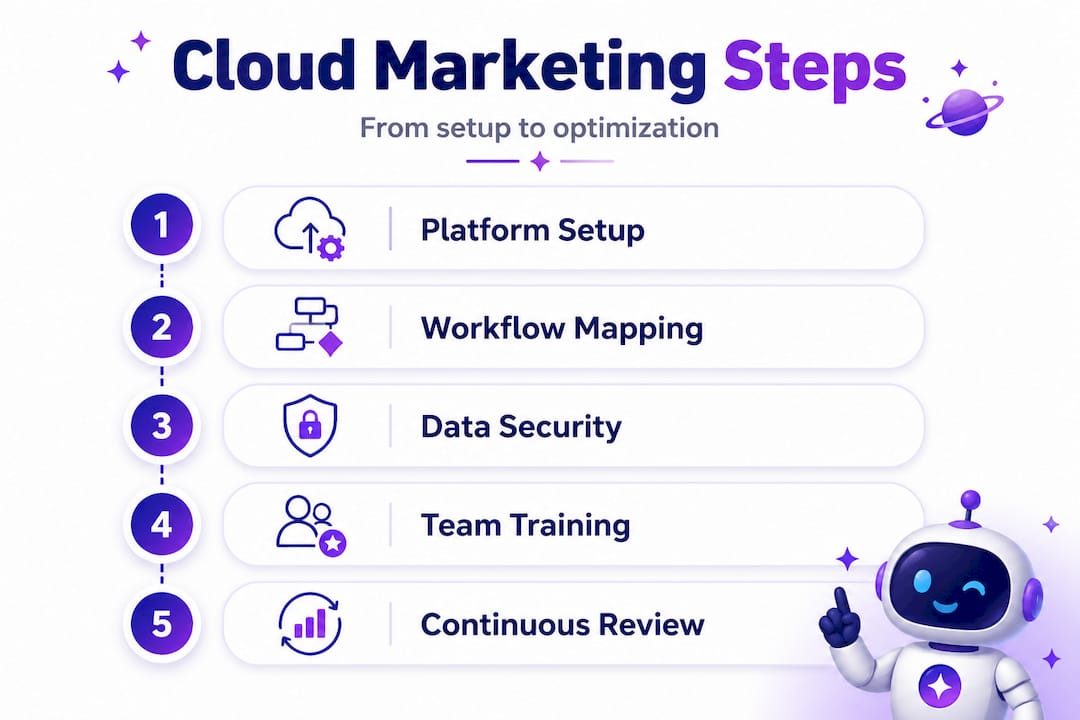
Follow this five-step roadmap to implement cloud marketing effectively:
-
Audit your current marketing stack and data assets. Before evaluating platforms, document every tool you currently use, where your customer data lives, and what integrations already exist. Identify gaps, redundancies, and data quality issues. A platform built on dirty data will produce inaccurate targeting and misleading analytics.
-
Define your core use cases and success metrics. Don’t buy a platform and then figure out what to do with it. Start with two or three specific outcomes you want to achieve, such as reducing lead response time, increasing email conversion rates, or improving attribution accuracy. These use cases will guide your platform selection and implementation priorities.
-
Run a structured pilot campaign. Before full deployment, test the platform with a controlled campaign. This reveals integration issues, training gaps, and workflow problems before they affect your entire marketing operation. A 60-day pilot with a single audience segment is usually sufficient to validate the platform’s fit.
-
Integrate your data sources systematically. Connect your CRM, website analytics, ecommerce platform, and advertising accounts in a deliberate sequence. Rushing integrations creates data inconsistencies that undermine the personalization and analytics capabilities you’re paying for.
-
Optimize based on analytics, not assumptions. Once the platform is live, establish a regular cadence of performance reviews. Use the platform’s analytics to identify what’s working and reallocate budget and effort accordingly. Businesses that use cloud tools for social media and other channels effectively treat optimization as an ongoing process, not a one-time setup task.
Common pitfalls to avoid include underestimating the complexity of data migration, skipping change management training for your marketing team, and treating compliance as an afterthought. Each of these mistakes can delay your time to value by months and significantly increase your total implementation cost.
What most companies get wrong about cloud marketing
Here’s the uncomfortable truth most vendors won’t tell you: buying a cloud marketing platform doesn’t transform your marketing. It gives you the infrastructure to transform your marketing. That distinction matters enormously.
The majority of companies that struggle with cloud marketing adoption made the same mistake. They treated it as a software upgrade rather than an operational shift. They bought Salesforce or HubSpot, imported their contact lists, and expected results to follow. When the results didn’t materialize, they blamed the platform. The real problem was that nobody changed how the marketing team worked, how it collaborated with sales, or how it used data to make decisions.
The biggest ROI from cloud marketing comes from alignment, not automation. When marketing and IT share a common data model from day one, when sales and marketing agree on what a qualified lead looks like, and when leadership commits to acting on analytics rather than instinct, cloud platforms deliver extraordinary returns. Without that alignment, you’re paying enterprise software prices for a fancier email tool.
There’s also a people dimension that gets consistently underestimated. Cloud marketing doesn’t replace marketers. It amplifies what skilled marketers can do. A team that understands customer psychology, knows how to write compelling copy, and can interpret behavioral data will get dramatically more value from these platforms than a team that simply knows how to click through the interface. Investing in email marketing automation insights and building genuine platform expertise within your team is as important as the platform selection itself.
The companies winning with cloud marketing in 2026 aren’t necessarily the ones with the biggest budgets or the most sophisticated platforms. They’re the ones that built a culture of data-driven decision-making and gave their marketing teams the tools and authority to act on what the data shows.
Accelerate your marketing transformation with expert help
Implementing cloud marketing effectively requires more than a platform subscription. It requires a strategy that connects your technology stack to your revenue goals, and the expertise to build it correctly from the start.
At Monstrous Media Group, we build marketing systems that produce outcomes, not just activity reports. Our marketing automation experts help you select, implement, and optimize the right cloud marketing infrastructure for your specific business model, growth stage, and competitive environment. We integrate cloud marketing with SEO, content, and paid media strategies so every channel works together to generate and capture revenue. If you’re ready to stop guessing and start building a system that actually grows your business, our digital marketing consulting team is the right starting point.
Frequently asked questions
What are the main benefits of switching to cloud marketing?
Cloud marketing gives you flexibility, scalability, and better personalization while cutting IT costs and speeding up campaign rollouts, because cloud-based platforms eliminate the need for on-premises infrastructure entirely.
Which industries or businesses benefit most from cloud marketing?
Most businesses can benefit, but fast-scaling, multi-channel brands and companies needing rapid personalization and analytics see the biggest gains from cloud-based campaign management.
Is cloud marketing secure enough for regulated industries?
Yes, but regulated sectors often require hybrid or modular platforms with enhanced compliance features, since modular platforms like Adobe and Oracle are specifically designed to handle complex data governance requirements.
How is cloud marketing different from just digital marketing?
Cloud marketing uses advanced cloud technology for automation, personalization, and unified analytics, while traditional digital marketing may still rely on older or on-premises tools that limit campaign personalization and analysis capabilities.
Can small businesses afford cloud marketing solutions?
Yes, with options like HubSpot and modular platforms, SMBs can select only the features they need and scale up over time, since HubSpot is specifically designed to be agile and accessible for smaller organizations.
Recommended
- Social Media: Maximize Customer Engagement
- Harnessing Social Media to Maximize Customer Engagement in 2024
- Digital Marketing Company in Omaha | Monstrous Media Group
- From stale to stellar: Transforming your marketing strategy for success
- Proven Marketing Strategies for Enterprises to Drive ROI
- Top market intelligence examples to drive growth
Hire the team to help you with your website, app, or other marketing needs.
We have a team of digital marketers who can help plan and bring to life all your digital marketing strategies. They can help with social media marketing, email marketing, and digital advertising!
CONTACT US
Comments