
 https://www.omahamediagroup.com/images/uploads/monster_gallery/Omaha-Media-Group-Black.jpg
admin
https://www.omahamediagroup.com/images/uploads/monster_gallery/Omaha-Media-Group-Black.jpg
admin
B2B marketing: core strategies, frameworks, and best practices

TL;DR:
- B2B marketing targets buying committees with longer, rational decision cycles, unlike B2C’s quick, emotional buying.
- Successful B2B strategies include defining ICP, aligning sales and marketing, and using account-based marketing.
- Combining data-driven tactics with human creativity and brand building is essential for long-term B2B growth.
B2B marketing: core strategies, frameworks, and best practices
Most people assume B2B marketing is just B2C marketing with a longer sales cycle and a higher price tag. That assumption costs companies real pipeline. B2B marketing is the practice of promoting products or services from one business to another, targeting buying committees rather than individual consumers. The mechanics, motivations, and measurement frameworks are fundamentally different. Today’s B2B buyer is digitally savvy, skeptical, and rarely acts alone. Understanding those differences is not optional. It’s the foundation every effective B2B growth strategy must be built on.
Table of Contents
- Defining B2B marketing: core concepts and decision dynamics
- The modern B2B buyer’s journey: stages and challenges
- Key B2B marketing strategies and tactics for growth
- Beyond basics: trends, edge cases, and measurement in B2B marketing
- The hidden truth: why B2B marketing is both science and art
- Supercharge your B2B marketing with expert solutions
- Frequently asked questions
Key Takeaways
| Point | Details |
|---|---|
| B2B is not B2C | B2B marketing centers on committee-driven, complex buying processes that are fundamentally different from consumer marketing. |
| Strategies drive pipeline | Focusing on ideal customers, content, and sales alignment yields greater business impact than simple lead volume. |
| Measure and adapt | Top marketers blend data, trends, and adaptability to maximize ROI and outperform competitors over time. |
| Brand is vital long-term | Building brand trust and credibility is essential for reaching the 95% of buyers not ready to purchase immediately. |
Defining B2B marketing: core concepts and decision dynamics
With the confusion addressed, let’s clearly define what B2B marketing actually means in practice. At its core, B2B marketing focuses on generating demand, building trust, and enabling purchasing decisions among business buyers, not individual shoppers. The audience is not a single person scrolling a social feed. It’s a buying committee made up of finance leads, end users, technical evaluators, and executive sponsors, each with their own priorities, objections, and timelines.
This structural difference changes everything. B2B marketing involves longer sales cycles, higher deal values, and rational decision-making focused on ROI, efficiency, and risk reduction. A B2C shopper might decide in minutes. A B2B committee might deliberate for 9 to 18 months before signing a contract. Every tactic, piece of content, and outreach strategy has to account for that reality.
To make the contrast concrete, here’s how B2B and B2C marketing differ across key dimensions:
| Dimension | B2B Marketing | B2C Marketing |
|---|---|---|
| Primary audience | Buying committees | Individual consumers |
| Decision driver | ROI, efficiency, risk | Emotion, price, convenience |
| Sales cycle length | Months to years | Hours to days |
| Content type | Whitepapers, case studies, webinars | Ads, reviews, social posts |
| Relationship type | Long-term, account-based | Transactional |
| Deal value | High | Low to moderate |
As B2B vs B2C research confirms, B2B features multi-stakeholder committees, nonlinear cycles, and rational and risk-averse decisions, while B2C is faster and more emotionally driven. These are not just academic distinctions. They dictate channel selection, message framing, and how you measure success.
Industries where B2B marketing is most active include:
- Enterprise software and SaaS platforms
- Professional services (legal, accounting, consulting)
- Industrial manufacturing and supply chain
- Healthcare technology and medical devices
- Financial services and fintech infrastructure
- Advertising, marketing and media services
- Logistics and commercial real estate
One critical data point: the average B2B purchase involves 6 to 10 stakeholders. That means your message needs to resonate with multiple roles simultaneously. A CFO cares about cost containment. An IT lead cares about integration risk. A department head cares about adoption and workflow. Effective B2B marketing speaks to all of them, at the right time, through the right channels.
The modern B2B buyer’s journey: stages and challenges
Understanding the basics sets the stage for a deeper look at how B2B decision-making really works. The buyer’s journey in B2B is not a straight line. It loops, stalls, restarts, and often involves buyers going dark for weeks before re-engaging. The B2B buyer’s journey consists of awareness, consideration, decision, and retention stages, with longer funnels due to multiple decision-makers, typically 6 to 10 stakeholders per deal.
The four core stages look like this:
- Awareness: The buyer recognizes a business problem or growth opportunity. They begin researching broadly, usually through search, industry publications, peer recommendations, and social platforms like LinkedIn. At this stage, educational content builds credibility.
- Consideration: The buyer actively evaluates solutions. They compare vendors, read case studies, attend webinars, and loop in additional stakeholders. Content needs to differentiate your offer and address specific objections.
- Decision: The committee narrows to 2 or 3 vendors. Demos, pricing discussions, legal review, and security assessments happen here. Sales and marketing must be tightly aligned to handle this stage efficiently.
- Retention: Post-sale, the focus shifts to adoption, renewal, and expansion. In B2B, retention is a marketing function too. Customer success content, usage guides, and executive business reviews all extend the relationship.
Here’s how the numbers look across typical B2B deal sizes:
| Deal Size | Avg. Sales Cycle | Avg. Stakeholders Involved |
|---|---|---|
| Under $25K | 1 to 3 months | 3 to 5 |
| $25K to $100K | 3 to 6 months | 5 to 7 |
| $100K to $500K | 6 to 12 months | 7 to 10 |
| Over $500K | 12 to 24 months | 10+ |
“The buying committee is not a single voice. It’s a chorus of competing priorities that only move forward when alignment is reached. Marketers who treat B2B as a one-to-one conversation are leaving revenue on the table.”
Common bottlenecks in B2B funnels include misalignment between sales and marketing on lead quality standards, content gaps during the consideration stage, delayed follow-up after initial inquiries, and failure to engage all committee members rather than just the primary contact. Addressing these friction points directly reduces cycle length and improves close rates. The organizations that map content and outreach to each stakeholder role, not just the “champion,” consistently outperform those that don’t.

Key B2B marketing strategies and tactics for growth
Now, let’s move from the buyer’s perspective to the marketing actions that actually drive growth. Strategy without structure is just activity. Effective B2B marketing starts with a clear foundation and builds systematically toward pipeline contribution.
Core B2B marketing strategies that drive measurable results:
- Ideal Customer Profile (ICP) and Total Addressable Market (TAM): Defining precisely who you serve and how large the opportunity is prevents wasted spend on the wrong audiences. Your ICP should include firmographics, technographics, behavioral signals, and pain profiles.
- Value proposition clarity: Your market position must answer one question clearly: why should a skeptical committee choose you over every other option? Vague claims about being “innovative” or “best-in-class” do not work.
- Account-based marketing (ABM): Rather than casting a wide net, ABM focuses resources on a defined list of high-value accounts. It aligns sales and marketing around the same targets and personalizes outreach at the account level.
- Educational content marketing: B2B marketing strategies include creating whitepapers, webinars, and ROI calculators that build buyer confidence and reduce perceived risk. Content is not filler. It’s a pipeline asset.
- Sales and marketing alignment: Pipeline contribution, not lead volume, is the right success metric. When sales and marketing share a revenue target, the entire funnel performs better.
- Data-driven experimentation: A/B testing messaging, offer types, and channels should be ongoing. Markets shift, buyer behavior evolves, and what worked last quarter may underperform today.
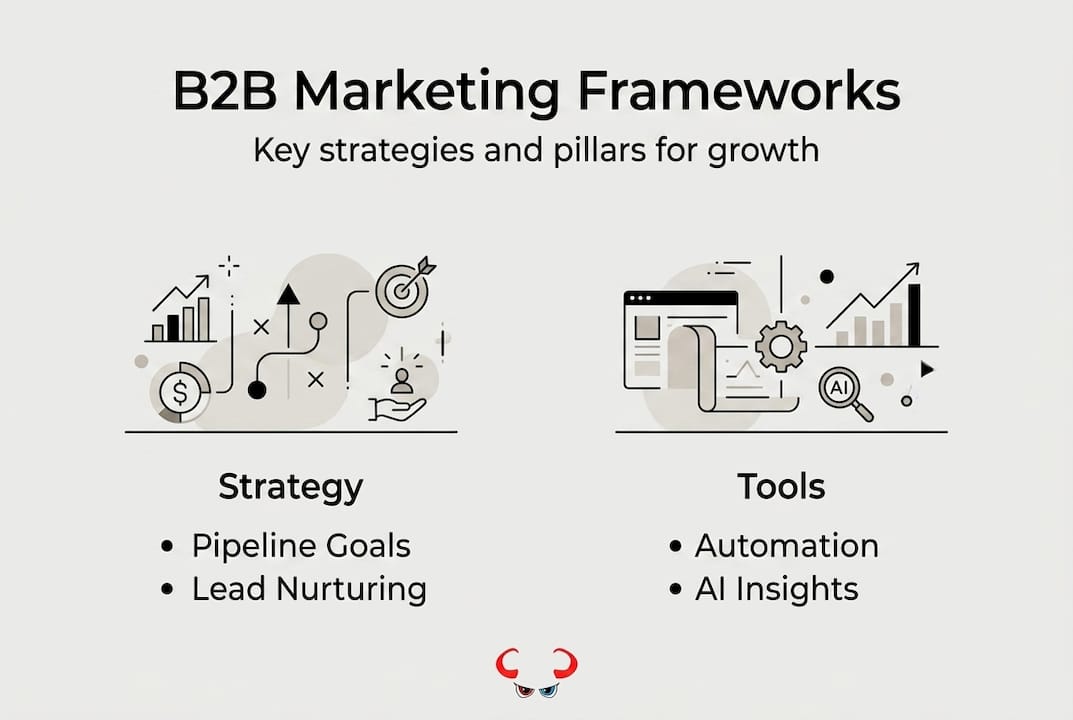
Effective B2B strategies prioritize pipeline contribution over lead volume, sales and marketing alignment, buyer enablement for committees, and balancing performance with brand building amid AI commoditization.
The role of AI-powered marketing tools in B2B is growing fast. AI can segment audiences more precisely, personalize content at scale, score leads based on behavioral signals, and surface insights from large data sets that human analysts would miss. When deployed correctly, AI compresses timelines and improves conversion rates. However, AI is an accelerant, not a replacement for strategy. Teams that deploy AI without a clear ICP or defined pipeline goals will simply generate noise faster.
Pro Tip: Don’t sacrifice brand building for short-term demand generation. The 95-5 rule reminds us that at any given moment, 95% of your target market is not ready to buy. Brand visibility today creates familiarity that converts months from now. Performance marketing captures existing demand. Brand marketing creates future demand. You need both.
Marketing automation solutions also play a critical role in B2B efficiency. Automated lead nurturing sequences, CRM integrations, and triggered content delivery keep prospects engaged between sales touchpoints without adding headcount. The goal is to stay top-of-mind across a long cycle without overwhelming your team or the buyer.
Beyond basics: trends, edge cases, and measurement in B2B marketing
Armed with proven strategies, it’s crucial to address evolving trends and measurement hurdles in today’s market. B2B marketing is not static. The channels, tools, and buyer expectations that shaped strategy two years ago are already shifting.
Top trends redefining B2B marketing in 2026:
- AI-driven personalization at scale: Generative AI is being used to create personalized email sequences, dynamic landing pages, and tailored ad creative based on account-level data. The top marketing trends show AI moving from experimental to operational across B2B teams.
- Intent data and predictive analytics: Tools that track which accounts are actively researching your category allow marketers to time outreach to match buyer readiness, dramatically improving conversion rates.
- Channel-agnostic buyer behavior: Modern B2B buyers move fluidly across LinkedIn, email, industry events, podcasts, and search. Campaigns must be coordinated across all channels without depending on any single one.
- The 95-5 rule in practice: The majority of your target market is out-of-market at any given time. Brand campaigns that build recognition and trust today will prime those buyers when they enter an active cycle.
- Experimentation culture: Teams that treat campaigns as learning opportunities and iterate quickly based on data outperform those locked into annual plans.
Edge cases and nuances around AI are especially important to understand. AI investment is high across B2B marketing teams, but ROI measurement remains a challenge, with approximately 40% of B2B marketers lacking confidence in measuring AI-driven results.
This measurement gap is one of the most significant challenges in modern B2B marketing. Attribution in B2B is inherently difficult. A prospect might read a blog post, attend a webinar, get a cold email, see a LinkedIn ad, and then respond to a sales call, all before converting. Single-touch attribution models fail to capture that complexity. Multi-touch attribution, revenue attribution platforms, and influenced pipeline metrics give a more complete picture.
Pro Tip: Build your measurement framework before you launch campaigns. Define what pipeline contribution means, assign UTM parameters consistently, connect your CRM to your marketing platform, and review attribution data monthly. If you can’t measure it, you can’t improve it.
AI-powered strategies are only as effective as the data they’re trained on. In B2B, data quality is often the limiting factor. Dirty CRM data, incomplete contact records, and inconsistent lead scoring criteria undermine AI outputs before they reach a sales rep. Investing in data hygiene is not glamorous, but it’s foundational.
Another evolving area is buying network strategy. Traditional B2B marketing focused on a single decision-maker. Today, AI-boosted email and content campaigns need to reach every member of the buying committee. Sequencing content for multiple personas, coordinating account-level ad retargeting, and using intent signals to prioritize which accounts receive human outreach are now standard practice for high-performing teams.
The hidden truth: why B2B marketing is both science and art
Most B2B marketing guides stop at frameworks. They hand you a flowchart for the buyer’s journey and a checklist of tactics. That’s useful, but it’s incomplete. What those guides consistently understate is the role of creativity, emotional resonance, and human judgment in long-cycle B2B deals.
Here’s an uncomfortable truth: the committee members evaluating your solution are still human beings. They have career risk on the line. They worry about making the wrong call in front of their peers. Fear of failure shapes B2B decisions just as much as ROI spreadsheets do. Marketers who understand this build campaigns that address both the logical and emotional dimensions of the purchase.
Building brand loyalty in B2B is not a soft metric. It’s a revenue driver. Companies with strong brand recognition consistently command higher prices, close deals faster, and retain customers longer. Brand isn’t just for consumer companies. In B2B, where trust is everything and cycles are long, brand building is one of the highest-ROI investments a marketing team can make.
The organizations that win over time are the ones that experiment, listen to their buyers, adapt their messaging based on real feedback, and resist the temptation to copy what competitors are doing. Distinctive, honest, and buyer-centric marketing will always outperform formulaic execution.
Supercharge your B2B marketing with expert solutions
Putting these strategies into action requires more than a to-do list. It requires the right systems, the right data, and the right expertise to execute without wasting budget or time.
Monstrous Media Group builds B2B marketing systems that generate, capture, and close more revenue without adding operational chaos. From B2B digital marketing services that align your funnel from awareness to close, to AI-powered marketing solutions that give your team a measurable performance edge, we design programs built for real pipeline outcomes. Not vanity metrics. Not activity reports. If you’re ready to move from disconnected tactics to an integrated system that produces results, this is where that conversation starts.
Frequently asked questions
How is B2B marketing different from B2C marketing?
B2B marketing targets business decision-makers and committees with longer, more rational buying cycles, while B2C focuses on individual consumers making faster, emotion-driven decisions. The channel mix, content strategy, and success metrics are fundamentally different in each context.
What are the main stages of the B2B buyer’s journey?
The main stages are awareness, consideration, decision, and retention, with multiple stakeholders involved at each step and a typically extended timeline ranging from months to over a year for enterprise deals.
Which strategies drive the best results in B2B marketing?
Defining your ideal customer profile, aligning sales and marketing around shared pipeline goals, deploying account-based marketing, and balancing brand investment with demand generation consistently deliver the strongest B2B results.
Is AI essential for modern B2B marketing?
AI can sharpen targeting, personalize content, and surface better insights, but only 40% of B2B marketers feel confident measuring AI-driven ROI, which means success depends on having clear measurement systems before deploying AI tools.
Recommended
Hire the team to help you with your website, app, or other marketing needs.
We have a team of digital marketers who can help plan and bring to life all your digital marketing strategies. They can help with social media marketing, email marketing, and digital advertising!
CONTACT US
Comments