
 https://www.omahamediagroup.com/images/uploads/monster_gallery/Omaha-Media-Group-Black.jpg
admin
https://www.omahamediagroup.com/images/uploads/monster_gallery/Omaha-Media-Group-Black.jpg
admin
AI in marketing guide: boost efficiency and results

Many marketers launch AI initiatives with high hopes, only to watch them fail or deliver underwhelming results. Integration challenges, poor data quality, and lack of clear strategy cause over 60% of AI marketing projects to stall or underperform. Yet companies that implement AI thoughtfully achieve productivity gains of up to 50% and reduce customer acquisition costs by 30%. This guide walks you through a proven, phased approach to integrate AI into your marketing strategy effectively. You’ll learn how to prepare your team and data, execute with human-AI collaboration, and verify results to drive continuous growth while avoiding the common pitfalls that derail AI adoption.
Table of Contents
- Key takeaways
- Understanding the AI marketing challenge: barriers and opportunities
- Preparing for AI in marketing: foundations and phased approaches
- Executing AI marketing integration: collaboration and insight-driven scaling
- Verifying results and optimizing AI marketing for continued growth
- Explore AI-powered marketing solutions with Monstrous Media Group
- Frequently asked questions
Key Takeaways
| Point | Details |
|---|---|
| Phased AI rollout | A proven phased approach to integrating AI reduces risk and speeds ROI. |
| Human AI collaboration | Humans provide creativity and strategy that improve outcomes beyond AI alone. |
| Integration challenges | Complex integration, data fragmentation, and governance gaps are the primary reasons AI marketing efforts stall. |
| Productivity and CAC gains | Successful AI marketing can increase productivity by up to 50 percent and reduce customer acquisition costs by about 30 percent. |
Understanding the AI marketing challenge: barriers and opportunities
AI marketing promises transformative results, but reality often falls short of the hype. Integration complexity causes 60% of AI marketing implementation failures, leaving marketing teams frustrated and skeptical. The technical challenges of connecting AI tools to existing martech stacks, combined with fragmented data and weak governance, create barriers that many organizations struggle to overcome.
Consumer backlash adds another layer of risk. 52% of consumers reduce engagement due to generic AI-generated content that feels impersonal or creepy. When brands automate too aggressively without human oversight, they sacrifice the authenticity and personalization that build trust. This tension between efficiency and engagement creates a dilemma for marketers trying to balance automation with genuine connection.
The marketing community remains split between optimists who see AI as revolutionary and skeptics who view it as overhyped. Both perspectives hold truth. AI can dramatically improve targeting, personalization, and campaign optimization when implemented strategically. However, treating AI as a magic solution without addressing foundational issues like data quality, team readiness, and governance leads to disappointing outcomes.
Key barriers marketers face when adopting AI include:
- Disconnected data sources that prevent AI from generating accurate insights
- Lack of clear use cases and success metrics before implementation
- Insufficient team training on AI tools and best practices
- Over-reliance on automation without human creative input
- Poor change management that leaves teams resistant to new workflows
Understanding these challenges helps you plan more carefully and avoid the mistakes that doom most AI initiatives. The top advertising trends of 2024 show that successful marketers combine AI capabilities with strong human judgment to maintain brand voice and customer trust.
“The biggest mistake companies make is implementing AI tools before establishing data foundations and clear governance. Without these basics, even the most sophisticated AI delivers mediocre results.”
Human oversight remains essential throughout the AI marketing journey. While AI excels at processing data and identifying patterns, humans provide the creativity, empathy, and strategic thinking that turn insights into compelling campaigns. This partnership approach positions you to capture AI’s benefits while maintaining the authentic connections that drive customer loyalty.
Preparing for AI in marketing: foundations and phased approaches
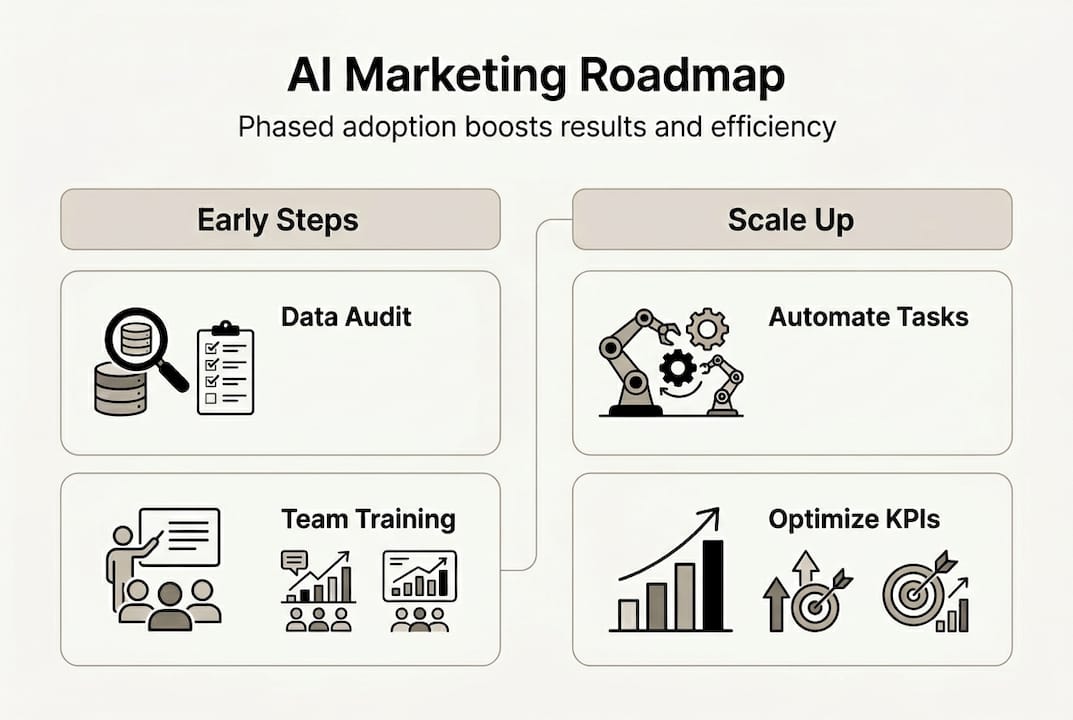
Successful AI integration starts long before you deploy any tools. Begin with a comprehensive audit of your current marketing capabilities, data infrastructure, and team readiness. Assess where your data lives, how clean and accessible it is, and whether your team has the skills to work effectively with AI tools. This foundation determines whether your AI initiatives will thrive or struggle.
Data quality stands as the most critical preparation factor. AI systems learn from your data, so incomplete, inconsistent, or siloed information produces unreliable results. Establish data governance policies that define ownership, quality standards, and access protocols. Create unified customer profiles by connecting data from your CRM, email platform, website analytics, and other touchpoints. Foundations including data quality and governance drive 2.3x higher ROI compared to organizations that skip this groundwork.

Tool selection requires matching AI capabilities to specific marketing goals rather than chasing trendy features. Identify your highest-priority challenges, whether that’s improving email personalization, optimizing ad spend, or generating content more efficiently. Research tools designed for those use cases and evaluate them based on integration ease, learning curve, and proven results in your industry. Avoid the temptation to implement multiple AI tools simultaneously, which fragments attention and complicates measurement.
Phased rollout methodologies reduce risk and accelerate learning. The Crawl-Walk-Run framework provides a proven structure:
- Crawl phase: Pilot AI with a single low-risk use case like email subject line optimization or basic chatbot responses. Focus on learning how the tool works and establishing baseline metrics.
- Walk phase: Expand to additional use cases once the pilot shows positive results. Integrate AI more deeply into workflows and train team members on best practices.
- Run phase: Scale successful AI applications across marketing channels and optimize based on accumulated data and insights.
Phased implementation methodologies like Crawl-Walk-Run enable tangible ROI within 60-90 days, making it easier to secure ongoing investment and team buy-in. This gradual approach also helps you identify and fix integration issues before they impact major campaigns.
| Phase | Timeline | Focus Areas | Success Metrics |
|---|---|---|---|
| Crawl | Weeks 1-4 | Single pilot use case, baseline measurement | Tool functionality, initial engagement lift |
| Walk | Weeks 5-8 | Multiple use cases, workflow integration | Efficiency gains, cost per result improvement |
| Run | Weeks 9-12+ | Cross-channel scaling, optimization | Revenue impact, CAC reduction, productivity gains |
Monitor metrics and governance from the start. Define KPIs aligned to business goals before launching any AI initiative. Track both efficiency metrics like time saved and outcome metrics like conversion rate or customer lifetime value. Regular measurement lets you course-correct quickly and demonstrate value to stakeholders.
Pro Tip: Involve cross-functional teams including IT, data analytics, and customer service early in AI planning. Their input on integration requirements, data access, and customer pain points accelerates adoption and prevents costly rework. Marketing can’t succeed with AI in isolation.
Explore marketing automation solutions that integrate AI capabilities with your existing martech stack. Understanding the benefits of marketing automation helps you identify where AI can deliver the most immediate value while building toward more sophisticated applications over time.
Executing AI marketing integration: collaboration and insight-driven scaling
Execution separates successful AI adopters from those who struggle. Start with human-assisted AI tasks that balance automation benefits with creative control. Use AI to generate initial drafts, analyze data patterns, or suggest audience segments, then have marketers refine and personalize the output. This collaboration approach captures efficiency gains while maintaining brand voice and strategic judgment.
Avoid the trap of over-automation that produces generic, impersonal campaigns. AI excels at processing data and identifying patterns, but it lacks the empathy and cultural awareness that create emotional connections with audiences. Keep humans in the loop for final content approval, campaign strategy decisions, and customer interaction quality checks. Human-AI collaboration yields 2.4x better outcomes than AI alone, proving that partnership beats pure automation.
Use data continuously to optimize campaigns and guide scaling decisions. Monitor performance metrics daily during initial rollouts to catch issues quickly. Look for patterns in what AI-enhanced campaigns perform best and why. Test variations systematically to understand which AI applications deliver the strongest results for your audience and business model. AI integration focus delivers 2.3x ROI compared to feature focus, emphasizing the importance of strategic implementation over tool accumulation.
Common AI marketing approaches differ significantly in effectiveness:
| Approach | Pros | Cons | Best For |
|---|---|---|---|
| AI-only automation | Maximum efficiency, 24/7 operation | Generic output, brand voice drift | High-volume routine tasks |
| Human-AI collaboration | Quality + efficiency, brand consistency | Requires training, slower initially | Strategic campaigns, content creation |
| AI-assisted analysis | Better insights, faster decisions | Still needs human interpretation | Data analysis, audience segmentation |
| Hybrid workflows | Balanced benefits, scalable | Complex to set up | Mature marketing operations |
Scale gradually based on proven results rather than rushing to automate everything. Once a use case shows consistent positive impact, expand it to additional channels or audience segments. Document what works so you can replicate success and train team members effectively. Build AI capabilities in layers, with each phase strengthening the foundation for more sophisticated applications.
Key execution principles include:
- Start small with focused pilots before enterprise-wide rollouts
- Maintain human oversight for customer-facing content and interactions
- Test AI recommendations before fully automating decisions
- Gather team feedback regularly to improve workflows and training
- Celebrate wins to build momentum and organizational support
Pro Tip: Create AI content guidelines that specify when human review is required, what brand voice elements AI must preserve, and how to personalize AI-generated output. These guardrails help teams work confidently with AI while protecting brand integrity and customer relationships.
Learn from the power of AI blueprint to understand strategic frameworks for AI adoption. Discover how AI boosting email open rates demonstrates practical applications that deliver measurable improvements in campaign performance.
The execution phase requires patience and discipline. Resist pressure to show immediate massive results by automating prematurely. Instead, build capabilities methodically, learn from each implementation, and scale based on data-driven insights. This approach creates sustainable AI marketing operations that deliver compounding returns over time.
Verifying results and optimizing AI marketing for continued growth
Measurement separates AI marketing success from expensive experiments. Identify clear KPIs aligned to business goals before launching any AI initiative. Revenue impact, customer acquisition cost, conversion rate, and customer lifetime value matter more than vanity metrics like impressions or clicks. Define what success looks like numerically so you can objectively assess whether AI delivers value.
41% of marketers struggle measuring AI impact due to fragmented data and weak governance, highlighting the importance of measurement infrastructure. Create dashboards that track AI-specific metrics alongside traditional marketing KPIs. Compare AI-enhanced campaigns directly against control groups or historical benchmarks to isolate AI’s contribution. Establish regular review cadences to analyze results and identify optimization opportunities.
Common pitfalls undermine AI marketing effectiveness:
- Neglecting measurement and treating AI as a black box
- Ignoring customer feedback about AI-generated content quality
- Over-automating without testing impact on engagement and conversion
- Failing to update AI models as market conditions change
- Skipping governance policies that ensure data quality and ethical use
Iterate campaigns based on data to increase conversion and lower customer acquisition costs. When AI-generated subject lines underperform, analyze which elements failed and adjust your prompts or training data. If personalization algorithms recommend irrelevant products, investigate data quality issues or segmentation logic. Treat AI as a system requiring ongoing optimization rather than a set-it-and-forget-it solution.
Successful teams achieve 20-50% gains in productivity and conversions through optimized AI, proving that continuous improvement multiplies initial results. Small refinements compound over time as you learn what works for your specific audience and business model.
Practical steps to troubleshoot integration problems and improve results:
- Audit data quality and completeness across all sources feeding AI systems
- Review AI-generated content samples to identify brand voice inconsistencies
- Survey customers about their experience with AI-powered interactions
- Compare AI-enhanced campaign performance against non-AI benchmarks
- Test different AI model configurations or prompt variations systematically
- Train team members on interpreting AI insights and recommendations
- Update governance policies based on lessons learned during implementation
- Scale successful use cases while sunsetting underperforming applications
Establish feedback loops that connect customer behavior data back to AI optimization. When customers abandon carts after receiving AI-generated product recommendations, investigate whether the suggestions matched their actual interests. Use A/B testing to validate AI improvements before rolling them out broadly. This disciplined approach prevents optimization theater where you make changes without verifying impact.
Governance policies maintain AI marketing quality over time. Define who can modify AI configurations, how often models get retrained, and what approval processes apply to AI-generated content. Document decision criteria for when to use AI versus human-created content. These policies prevent quality drift and ensure AI continues serving business goals as your marketing operation scales.
Explore the email marketing automation power to see how systematic optimization of AI-enhanced email campaigns drives sustained performance improvements. The verification phase never truly ends because markets evolve, customer preferences shift, and new AI capabilities emerge. Build a culture of continuous learning and optimization to maintain competitive advantage.
Explore AI-powered marketing solutions with Monstrous Media Group
Implementing AI marketing successfully requires expertise, proven frameworks, and integrated technology solutions. Monstrous Media Group specializes in AI-powered digital marketing services that help businesses navigate phased AI adoption while maximizing ROI. Our team combines deep marketing knowledge with technical AI capabilities to build systems that drive measurable revenue growth.
We understand that AI works best when it enhances human creativity rather than replacing it. Our approach keeps your brand voice and strategic judgment central while leveraging AI to improve efficiency, personalization, and campaign performance. Whether you’re starting your first AI pilot or scaling existing initiatives, our digital marketing services provide the expertise and support you need to succeed.
Partner with us to implement marketing automation solutions that integrate seamlessly with your existing technology stack and workflows. We build systems that stop revenue leaks and drive growth, not busywork. Contact Monstrous Media Group to explore how AI-enhanced marketing can transform your results while maintaining the authentic customer connections that build lasting business value.
Frequently asked questions
What is AI marketing and why is it important?
AI marketing uses artificial intelligence technologies like machine learning, natural language processing, and predictive analytics to improve marketing processes and outcomes. It helps businesses increase efficiency by automating routine tasks, personalize customer interactions at scale, and deliver measurable ROI through better targeting and optimization. Companies that implement AI thoughtfully gain competitive advantages through faster decision-making and more effective campaigns.
How do I start implementing AI in my marketing strategy?
Begin with comprehensive audits of your current marketing capabilities, data quality, and team readiness to identify gaps and opportunities. Choose specific low-risk AI use cases like email subject line optimization or basic chatbot responses to pilot before broader deployment. Establish clear success metrics and governance policies from the start. Use phased rollout methodologies that let you learn and adjust before scaling to more complex applications.
What are the most common challenges in AI marketing adoption?
Integration complexity and poor data governance lead to most failures, causing 60% of AI marketing projects to underperform or stall. Over-automation without human oversight risks producing generic content that reduces customer engagement by over 50%. Fragmented data sources prevent AI from generating accurate insights. Lack of clear use cases and measurement frameworks makes it difficult to prove ROI and secure ongoing investment.
How can human teams best collaborate with AI tools?
Humans provide judgment, creativity, and personalization that AI alone cannot replicate, making collaboration essential for quality results. Use AI to generate initial drafts, analyze data patterns, or suggest optimizations, then have marketers refine and personalize the output. Maintain human oversight for customer-facing content and strategic decisions. This partnership approach multiplies marketing effectiveness and delivers over 2.4 times better outcomes than AI-only automation.
Recommended
Hire the team to help you with your website, app, or other marketing needs.
We have a team of digital marketers who can help plan and bring to life all your digital marketing strategies. They can help with social media marketing, email marketing, and digital advertising!
CONTACT US
Comments