
 https://www.omahamediagroup.com/images/uploads/monster_gallery/Omaha-Media-Group-Black.jpg
admin
https://www.omahamediagroup.com/images/uploads/monster_gallery/Omaha-Media-Group-Black.jpg
admin
Actionable strategies to maximize ROI online for businesses

TL;DR:
- Establish clear ROI benchmarks and track essential metrics like CAC and CLTV for accurate measurement.
- Upgrade tracking methods to server-side and first-party data to recover 15-30% more conversions.
- Use a hybrid marketing approach combining SEO and paid ads for optimal short- and long-term ROI.
Every dollar you put into digital marketing either works or it doesn’t. Yet most business owners and marketing executives spend months running campaigns, watching dashboards, and still can’t answer one simple question: is this actually profitable? Wasted ad spend, misread metrics, and attribution gaps quietly drain revenue while teams celebrate clicks and impressions. This guide cuts through that noise. You’ll learn how to establish a real ROI baseline, fix the tracking gaps that hide your true results, choose the right channel mix for your goals, and adapt to AI-driven search before your competitors do. Each step is practical, sequenced, and built for businesses that want outcomes, not activity reports.
Table of Contents
- Assess your current ROI: Benchmarks, tools, and metrics
- Upgrade your tracking: From guesswork to accurate attribution
- Deploy high-ROI campaigns: SEO, paid, and hybrid strategies
- Optimize for the new landscape: AI search and commercial intent
- Our take: Why most ROI “wins” fail the verification test
- Unlock greater ROI with expert guidance
- Frequently asked questions
Key Takeaways
| Point | Details |
|---|---|
| Track ROI with precision | Upgrading to server-side tracking and first-party data ensures you capture all real conversions. |
| Choose the right channel mix | Combining paid ads for quick wins with long-term SEO yields the best ROI in most cases. |
| Adapt for AI search | Shifting content strategy to target AI Overviews and commercial intent keeps your ROI growing. |
| Benchmark for success | A ROI between 500-1000% is considered strong for online marketing. |
Assess your current ROI: Benchmarks, tools, and metrics
Once you know why ROI matters, your next step is to establish where you are now and what “good” looks like. Return on investment (ROI) measures how much profit you generate relative to what you spend. Return on Ad Spend (ROAS) is a narrower version that tracks revenue per advertising dollar. Both matter, but ROI tells the fuller story because it accounts for overhead, not just revenue.
According to marketing ROI benchmarks, a strong ROI benchmark falls between 500% and 1000%, while anything under 200% is typically unprofitable once you factor in overhead costs. SEO consistently outperforms outbound tactics, closing leads at a 14.6% vs 1.7% rate for outbound. Those numbers aren’t marginal. They’re the difference between a scalable growth engine and a budget sinkhole.
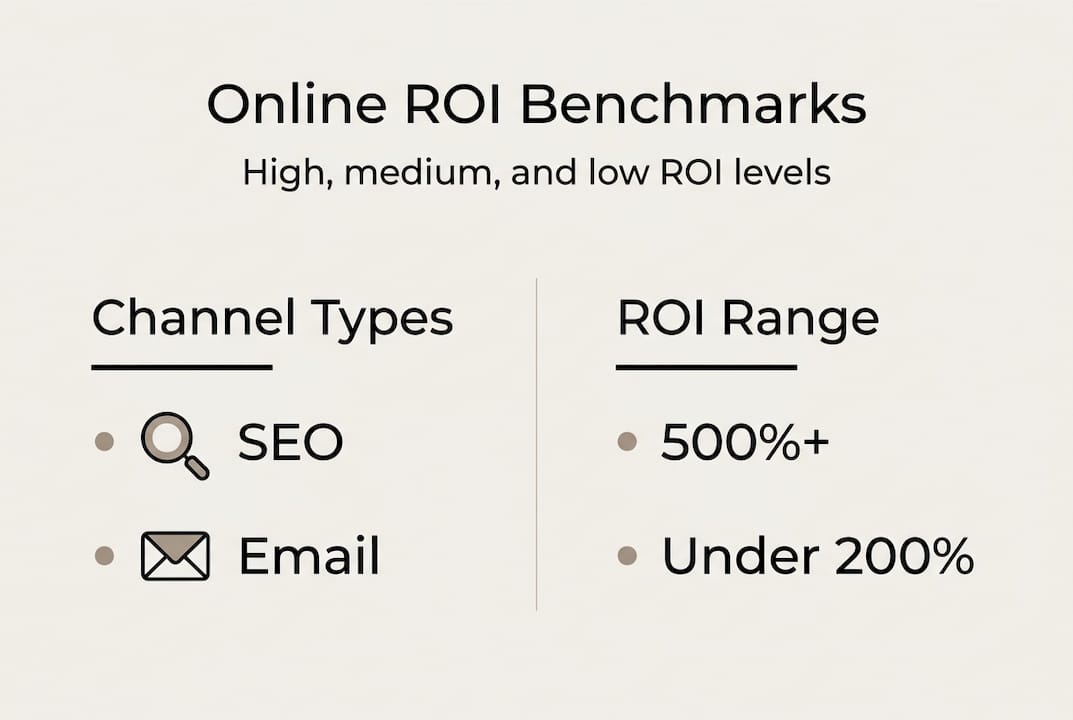
Here’s a snapshot of typical ROI ranges by channel:
| Channel | Typical ROI Range | Ramp Time | Sustainability |
|---|---|---|---|
| SEO | 500%–700%+ | 3–6 months | High |
| PPC / Paid Ads | 200%–800% | Immediate | Medium |
| Email Marketing | 3600%–4200% | 1–4 weeks | High |
Email marketing ROI is worth a closer look. Explore email marketing ROI benchmarks to see how properly structured campaigns consistently outperform most paid channels at a fraction of the cost.
To measure any of these accurately, you need the right tools and metrics in place. Essential tools include Google Analytics 4, server-side tag management, and CRM-integrated first-party data pipelines.
Key metrics to track:
- Customer Acquisition Cost (CAC): Total spend divided by new customers acquired
- Customer Lifetime Value (CLTV): Average revenue a customer generates over their relationship with you
- Conversion rate: The percentage of visitors who complete a desired action
- Attribution model: The logic that assigns credit to each touchpoint in the buyer journey
Without these four metrics working together, ROI reporting is just a guess. You need to understand which SEO service metrics tie directly to revenue, not just traffic volume.
Upgrade your tracking: From guesswork to accurate attribution
Once your benchmarks are clear, the next foundation is making sure your tracking is precise so ROI isn’t hidden by missing data. Most businesses still rely on client-side tracking, where a pixel fires in the user’s browser to record conversions. The problem is that browser privacy tools, ad blockers, and iOS restrictions now suppress a significant portion of those signals. You’re likely undercounting conversions and making budget decisions on incomplete data.
Server-side tracking solves this by moving data collection to your server rather than the user’s browser. Combined with first-party data, this approach can recover 15–30% more conversions that would otherwise go unrecorded due to privacy restrictions. That’s not a minor adjustment. Recovering 15 to 30 percent of your conversion data fundamentally changes which campaigns look profitable and which don’t.
Statistic: Businesses using server-side tracking effectiveness with first-party data attribution recover 15–30% more conversions lost to privacy tools and browser restrictions.
Steps to implement advanced tracking:
- Audit your current tag setup to identify data gaps and browser-blocked events
- Migrate key conversion events to a server-side tag management system
- Connect your CRM to your analytics platform for closed-loop attribution
- Test conversion paths across devices and browsers monthly
- Document your attribution model and apply it consistently across all reporting
Proper improving marketing attribution also means aligning your attribution model with how customers actually buy. Last-click attribution, still the default in many platforms, overstates the role of the final touchpoint and ignores the earlier content and campaigns that built intent.
Pro Tip: Run a quarterly tag audit and cross-check your analytics conversions against CRM-recorded customers. Gaps between those two numbers signal tracking failures worth fixing immediately.
Deploy high-ROI campaigns: SEO, paid, and hybrid strategies
With reliable attribution, you can make informed decisions about which marketing channels will yield the highest ROI for your business. The real question isn’t “should I do SEO or paid ads?” It’s “which mix gives me the best results at this stage of growth?”

Paid advertising produces fast results. Paid ads quick wins can deliver ROAS between 2x and 8x in the short term, making paid channels ideal for product launches, seasonal promotions, and rapid market testing. The downside is cost: stop spending, and results stop too.
SEO operates differently. It takes longer to build, but the 700%+ long-term ROI potential and lower customer acquisition costs make it the smarter long-game investment. Organic traffic compounds over time, meaning the content and authority you build today keeps generating leads years from now.
| Strategy | ROI Potential | Ramp Time | Cost Structure | Sustainability |
|---|---|---|---|---|
| Paid Ads | 200%–800% | Immediate | Pay-per-click | Medium |
| SEO | 500%–700%+ | 3–6 months | Fixed/retainer | High |
| Hybrid | 600%–1000%+ | 1–3 months | Blended | Highest |
A hybrid approach uses paid ads to generate immediate revenue while SEO builds sustainable long-term traffic. This is the strategy that tends to outperform single-channel approaches for most businesses. Learn more about building high-performing PPC campaigns alongside organic growth.
How to launch a hybrid campaign:
- Define your primary conversion goal before selecting channels
- Allocate 60–70% of budget to paid for immediate traction
- Simultaneously build SEO-optimized content targeting buyer-intent keywords
- Track CAC and CLTV separately by channel each month
- Shift budget from paid to SEO as organic rankings mature and CAC decreases
- Review channel performance quarterly and rebalance based on data
Pro Tip: Set a calendar reminder every 90 days to review channel-level ROI. Markets shift, bids change, and a channel that outperformed last quarter may need rebalancing. Investing in SEO pays dividends specifically when paired with paid campaign data that reveals which keywords convert best.
Optimize for the new landscape: AI search and commercial intent
To keep ROI maximized as digital landscapes shift, forward-thinking businesses must prepare for new search behaviors and AI-driven platforms. Search is no longer just a list of blue links. AI Overviews now appear at the top of results for a growing share of queries, and they pull from a narrow set of trusted, authoritative sources.
“In 2026, 55% of searches surface AI Overviews rather than classic links, reshaping how businesses earn visibility and traffic.”
This shift has a direct impact on ROI. If your content isn’t being cited in AI-generated responses, you’re losing visibility even when you rank on page one. Optimizing for AI-driven search strategies means structuring content so AI systems recognize it as authoritative and relevant.
Action steps for AI search adaptation:
- Target commercial-intent keywords over high-volume informational terms that don’t convert
- Structure content with clear questions and direct answers to earn featured snippet placement
- Build topic authority across clusters of related content rather than isolated pages
- Earn citations from credible industry sources to increase likelihood of AI Overview inclusion
- Monitor AI Overview appearances for your target keywords weekly and adjust content accordingly
The businesses that adapt to new SEO trends early will capture disproportionate ROI from organic channels. Think of ignoring this shift like refusing to build a mobile-friendly website in 2012. The window to get ahead of it is narrowing. Understanding the AI impact on marketing extends beyond search, touching email personalization, conversion optimization, and audience targeting across every channel.
Adapting content strategy now ensures your ROI doesn’t erode as search behavior evolves. Visibility in AI-driven results is the new first-page ranking, and it rewards authority, clarity, and commercial relevance above all else.
Our take: Why most ROI “wins” fail the verification test
Here’s something most marketing reports won’t tell you: a large portion of claimed ROI successes are built on shaky data. The attribution model was set to last-click. Leads were counted as customers before they actually closed. Or the reporting period conveniently ended before churn showed up. These aren’t isolated mistakes. They’re systematic blind spots that inflate results on paper while actual revenue stays flat.
What we’ve seen consistently across clients is that the teams who audit and adjust outperform those who adopt a set-it-and-forget-it approach every single time. Not because they spend more, but because they verify. They ask the uncomfortable question: did this spend actually produce sustained profit, or just a spike in a vanity metric?
The real test is simple. Look at your quarterly revenue change against your quarterly spend change. If spend went up 30% and revenue went up 8%, something is broken regardless of what the dashboard says. Review email ROI case studies for examples of what genuine, verified ROI improvement actually looks like in practice.
Pro Tip: Build a “ROI fail list” each quarter. Document every campaign or channel that underperformed, what the hypothesis was, and what actually happened. This becomes your single most valuable planning input for the next quarter.
Misattribution doesn’t just waste money. It actively misleads future decisions. Treat every ROI claim as a hypothesis until your CRM, revenue data, and spend data all tell the same story.
Unlock greater ROI with expert guidance
Translating these strategies into consistent results requires more than knowledge. It requires systems, tools, and the experience to know when to course-correct before a quarter goes sideways. In-house teams are often stretched thin, and digital best practices shift faster than most internal schedules allow.

Working with digital marketing experts who specialize in ROI-driven systems means you’re not starting from scratch each time the algorithm shifts or a new platform emerges. Monstrous Media Group builds measurement frameworks, attribution pipelines, and campaign architectures designed to generate, capture, and close revenue without adding chaos or wasted spend. If you’re ready to stop guessing and start compounding, explore professional SEO strategies built for sustainable, measurable growth.
Frequently asked questions
What is a good ROI for online marketing?
A strong ROI sits between 500% and 1000%; anything below 200% is usually unprofitable once overhead costs are factored in. Use this range as your performance baseline before evaluating individual channels.
How can I track ROI more accurately with new privacy rules?
Shift to server-side tracking and first-party data collection to recover 15–30% more conversions lost to ad blockers and browser privacy tools. Pair this with a CRM-integrated attribution model for closed-loop reporting.
Is SEO or paid advertising better for ROI?
SEO delivers stronger long-term ROI and lower customer acquisition costs, while paid ads generate immediate results. A hybrid strategy combining both typically outperforms either channel used alone.
How has AI changed maximizing online ROI?
AI-powered search now surfaces overviews in 55% of searches, making citation-worthy, commercially focused content essential for maintaining organic visibility and sustained ROI growth.
Recommended
Hire the team to help you with your website, app, or other marketing needs.
We have a team of digital marketers who can help plan and bring to life all your digital marketing strategies. They can help with social media marketing, email marketing, and digital advertising!
CONTACT US
Comments